When data upkeep fails in municipal surveillance platforms
An analysis of the Smart Sampa facial recognition platform reveals thousands of police detentions accompanied by hundreds of erroneous approaches. The findings show that human and administrative data upkeep failures surpass algorithmic identification mistakes.
Reviewed by Matheus Grangeiro
- Sample size
- 3400
Key numbers
2018ano
Ano de publicação do livro Future Politics
2024ano
Início do período de monitoramento de detenções do Smart Sampa
2026ano
Fim do período de monitoramento de detenções do Smart Sampa
3400pessoas
Total de pessoas detidas e conduzidas a delegacias pelo reconhecimento facial
268casos
Total de erros cometidos pelo sistema de monitoramento
72%
Percentual de erros decorrentes de dados cadastrais desatualizados
75casos
Quantidade de erros atribuídos exclusivamente ao algoritmo de reconhecimento
11meses
Tempo em que dados sigilosos permaneceram expostos em repositório público
Evidence level: Opinion and analysis based on reported operational monitoring; not a peer-reviewed evaluation
Why it matters: Facial-recognition systems used in public security can affect liberty, privacy and due process. When their underlying police and court registries are outdated, even an accurate image-matching algorithm can contribute to wrongful detentions. The Smart Sampa case illustrates why governance of data, vendor access and independent oversight matters as much as model accuracy.
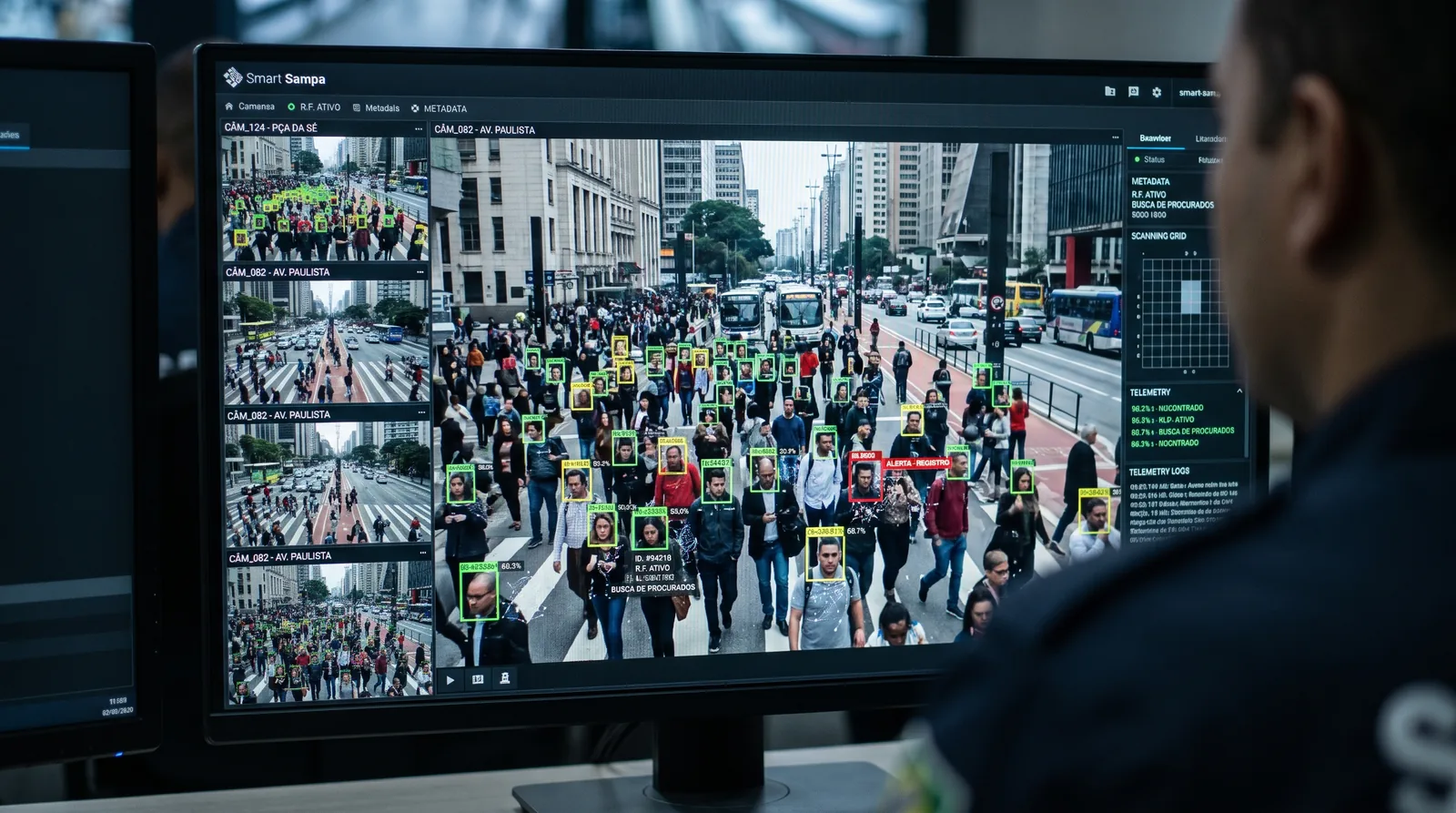
Urban monitoring and facial recognition deployment Between November 2024 and May 2026, 3,400 people were detained and taken to police stations following facial-recognition matches by São Paulo’s Smart Sampa system. During the same monitoring period, the system made errors in 268 cases.
These figures describe operational use of a municipal surveillance platform, not a controlled evaluation of its accuracy. They also do not mean that all 3,400 detentions were wrongful; the reported error count is 268.
The article’s author, Leandro Piquet Carneiro, argues that algorithms are increasingly used to allocate public goods and classify people, and that surveillance and AI tools are spreading across Western democracies. These are analytical claims and projections, not findings demonstrated by a study of Smart Sampa.
Operational failures and database discrepancies The reported errors were predominantly administrative rather than failures of the image-recognition model. 72% of the 268 errors resulted from outdated arrest-warrant databases or other registry errors; the facial-recognition algorithm itself erred in 75 cases.
In other words, the system could correctly match a face to a record while still producing an erroneous detention if that record was outdated, incomplete or incorrectly maintained. The article concludes that outdated databases caused hundreds of potentially wrongful detentions.
This distinction matters: software accuracy and data quality are separate failure modes. A facial-recognition system cannot be assessed solely by its image-matching performance if the warrant and identity records feeding it are unreliable.
Data exposure and institutional opacity Confidential data from the Smart Sampa programme remained publicly accessible in an online repository for approximately 11 months. The exposure reportedly allowed the platform to be reproduced on computers and mobile phones outside the official system.
The leaked material included users’ names and CPFs, vehicle licence plates and police reports. The article presents this as a serious data-governance failure, not merely a technical vulnerability.
According to the article, the municipal administration acknowledged that it does not have access to the system’s source code, AI models or facial-recognition training data, all of which are controlled by the concessionaire. It also stated that no independent audits of the algorithms are reported.
Digital justice and public-security promises The article invokes Jamie Susskind’s Future Politics (2018), arguing that justice in a digital society depends substantially on the algorithms used and how they are applied. It frames algorithmic systems as part of a broader socio-technical environment in which law, data and infrastructure interact.
The author also argues that autonomous AI agents could change policing and criminal-justice workflows, including emergency response and financial-crime monitoring. These claims are speculative and forward-looking; the article does not provide evidence that such agents have replaced existing police practices or reduced crime.
Similarly, the author’s statement that a world with very low crime may become visible by 2030 is an opinion, not a forecast supported by a model or empirical result in the article.
What the reported errors do not show It may seem that software misidentification is the primary cause of erroneous police stops in Smart Sampa. In fact: outdated warrant records and other registry failures accounted for 72% of the 268 reported errors, while the facial-recognition algorithm accounted for 75.
The 3,400 facial-recognition-related detentions do not establish that 3,400 detentions were wrongful; the article reports 268 system errors during the period.
The reported figures do not measure false-positive rate, false-negative rate, demographic disparities, racial bias, recidivism, crime reduction or the system’s effect on public safety.
The data exposure does not establish that the leaked information was misused, only that it was publicly accessible for approximately 11 months and could be used to replicate the platform outside the official system.
The absence of independent audits, as reported in the article, does not by itself prove that the algorithms are inaccurate; it means that independent verification of their performance and governance is not available.
Verdict: Reported monitoring of Smart Sampa found 3,400 facial-recognition-related detentions and 268 system errors between November 2024 and May 2026. Administrative failures—outdated warrant records and other registry problems—accounted for 72% of errors, while the facial-recognition algorithm accounted for 75; however, the source is an opinion article, and it does not provide an independent audit, error-rate denominator, demographic analysis or evidence of crime reduction.
Based on reporting from Jornal da USP. This is an independent explainer, written in our own words with AI assistance; Jornal da USP has not reviewed or endorsed it. Read the original for the full details.