Chronological Age Shifts the Impact of Melanoma Mutations
A new observational study from Yale University reveals that the prevalence and growth impact of key melanoma mutations, such as BRAF and NRAS, shift dramatically depending on a patient's chronological age. Incorporating these age-dependent probabilities could reshape how targeted cancer therapies and clinical trials are designed for different age groups.
Reviewed by Matheus Grangeiro
- Peer reviewed
- Yes
Key numbers
6day of month
publication date in November
Press versus study
Equivalent
What the press says
One melanoma mutation in a gene called BRAF showed greater growth and persistence in tumors from younger patients but declined at older ages.
What the study shows
The advantage of BRAF V600E declined precipitously with age.
Evidence level: Observational genomic and evolutionary-modeling study
Why it matters: Precision oncology generally matches therapies to genetic alterations detected in a patient’s tumour. This study suggests that, in melanoma, the biological importance of a mutation may depend not only on which alteration is present, but also on the patient’s age when the cancer develops.
How chronological age reshapes melanoma drivers Yihan Liu, Jeffrey D. Mandell, Moein Rajaei, Douglas Brash, Jorge Alfaro-Murillo and Jeffrey P. Townsend analysed approximately 5,500 melanoma samples—5,472 melanomas—from patients across age groups, using data from The Cancer Genome Atlas and the American Association for Cancer Research Project GENIE. The study was published in Science Advances on 6 November 2026.
Rather than relying only on how often a mutation appears, the researchers modelled its selective advantage: the degree to which a mutation promotes tumour-cell growth and persistence relative to other genetic changes. They analysed age-dependent patterns across three groups: patients younger than 40, patients aged 40–59, and patients aged 60 or older.
The study found that neutral mutation rates increased only modestly with age and that ultraviolet-radiation damage remained the predominant mutational process. In contrast, selection on major melanoma driver mutations changed substantially with age.
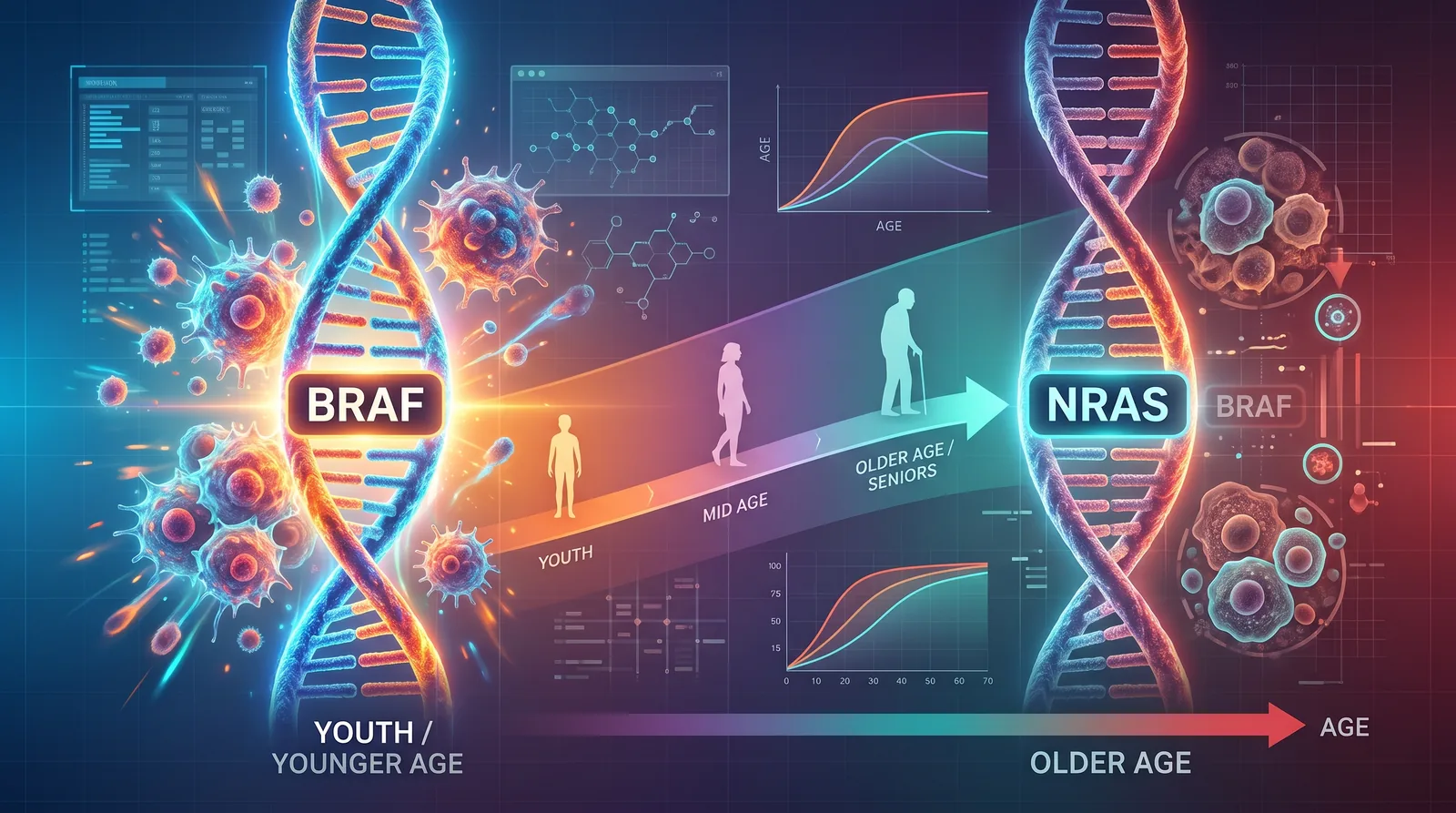
Age-dependent decline of the BRAF V600E advantage The selective advantage of BRAF V600E declined sharply with age. This mutation showed greater growth and persistence in tumours from younger patients, while its advantage decreased in older patients.
Prevalence followed a similar direction: approximately 59% of melanomas in patients younger than 40 carried BRAF mutations, compared with 38% in patients older than 60. However, prevalence and selective advantage are distinct measures; a mutation can remain common while becoming less strongly selected as a cancer driver.
NRAS Q61 gains advantage with age The pattern was reversed for activating NRAS Q61 mutations, including Q61L, Q61H and Q61K. These alterations gained selective advantage with increasing age, indicating that NRAS-driven melanomas may be more strongly selected in older patients.
The study also found that TERT promoter mutations became more frequent with age but conferred less selective advantage. This distinction reinforces the paper’s central point: mutation frequency alone does not establish how important a mutation is to tumour evolution.
What the study implies for precision oncology The findings suggest that age should be considered when interpreting tumour genomics, developing targeted therapies and designing clinical trials. Jeffrey Townsend, the study’s senior author, stated that a BRAF mutation is extremely likely to lead to melanoma in a young person, but less likely—though still possible—in an older person.
Because therapies targeting BRAF exist, the authors suggest that their effectiveness could be lower in older patients than in younger ones. This is a hypothesis for future clinical research, not a demonstrated difference in treatment response: the study did not compare outcomes of BRAF/MEK inhibitors by patient age.
The results also support enrolling patients across a broader range of ages in trials of mutation-targeted drugs. Townsend noted that many trial protocols exclude people with comorbidities, which can bias study populations toward younger participants.
What the study does not show It may seem that detecting a BRAF mutation in an older patient carries exactly the same therapeutic implications as detecting it in a younger person. In fact: the study found a lower selective advantage for BRAF V600E with age, but it did not demonstrate that BRAF-targeted treatment is less effective in older patients.
The study is observational and evolutionary in design; it does not establish that age causes the observed differences in mutation selection.
The findings concern population-level patterns across age groups. They do not provide an individual patient with a new rule for choosing or withholding BRAF-targeted therapy.
The study analysed melanoma samples from TCGA and AACR Project GENIE; its results may not generalize equally to all melanoma subtypes, ancestries, geographic populations or treatment settings.
The biological reasons why selection on BRAF and NRAS changes with age remain unresolved. The authors propose that age-related changes in the tumour microenvironment and surrounding non-cancerous tissue may contribute.
Verdict: In an analysis of 5,472 melanomas, the selective advantage of BRAF V600E declined sharply with patient age, while NRAS Q61 mutations gained advantage. The findings support considering age in tumour-genomic interpretation and trial design, but they do not demonstrate that BRAF-targeted therapies are less effective in older patients.
Based on reporting from Yale News. This is an independent explainer, written in our own words with AI assistance; Yale News has not reviewed or endorsed it. Read the original for the full details.