Mapping the hidden hubs of biology and nutrition
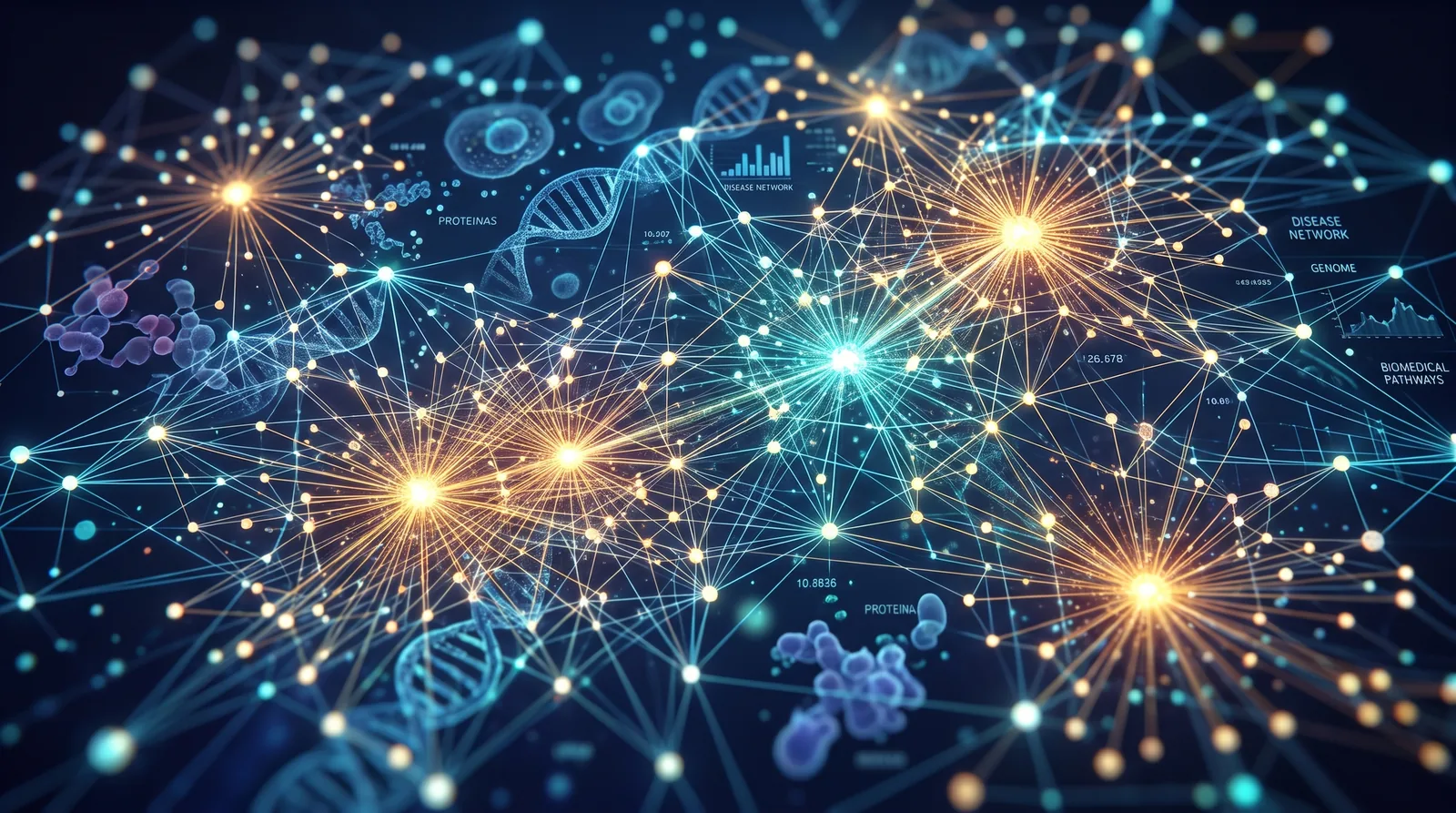
Researchers have mapped how complex systems across biology, society, and technology share underlying network principles driven by organizing hubs. This shift explains why most pharmaceutical drugs act downstream rather than binding directly to primary disease-causing proteins.
Reviewed by Matheus Grangeiro
Key numbers
135000compounds
compounds residing outside conventional nutrition categories
30years
approximate duration of acquaintance and collaboration between Barabási and Strogatz
1990sdecade
period when researchers began mapping real-world networks
1995year
year of Barabási's unpublished first network paper
1998year
year when postdoc How Hong Jon helped map the World Wide Web
10speakers
number of speakers at the Internet Archives event in San Francisco
98percent
percentage of web pages possessing between one and five links
1950decade
starting decade for previous network modeling paradigms
Evidence level: Expert interview and science communication; historical and conceptual claims, not a primary research study
Why it matters: Traditional biomedical research often focuses on individual genes, proteins or nutrients, but biological function emerges from interactions among many components. Network approaches may help identify disease modules, drug targets and food-derived molecules whose effects remain poorly understood. These ideas are promising, but they are not equivalent to demonstrated clinical benefits.
How network architecture reframes biology and nutrition Albert-László Barabási, a network scientist at Northeastern University with appointments at Harvard Medical School and Central European University, argues that many complex systems share organizational principles despite differing in scale and purpose. In a Quanta Magazine conversation with Steven Strogatz and Janna Levin, he describes network science as a relational approach: genes, neurons and people gain meaning through their connections, not in isolation.
Barabási does not reject reductionism. He describes it as an essential scientific tool, while arguing that science has often focused so heavily on individual components that it has neglected how those components interact.
Genomics provides an inventory of cellular components—genes, RNAs and proteins—but does not by itself reveal how they interact. Network medicine seeks to map those interactions and use that map to understand how a disrupted component propagates effects through a cellular system.
How preferential attachment builds scale-free networks In the 1990s, researchers found that many real networks did not follow the degree distribution predicted by random-graph models. Instead of a bell curve, they observed power-law distributions: many nodes had few connections, while a small number of highly connected hubs had disproportionately many.
Barabási and colleagues proposed that this pattern can emerge from two processes: growth, in which new nodes join over time, and preferential attachment, in which new nodes are more likely to connect to already well-connected nodes. Together, these processes can generate hubs.
This does not mean that every network is scale-free. Barabási explicitly notes that material networks, for example, are not, because atoms have fixed valence; friendship networks defined by intimate ties also differ from acquaintance networks.
The size and number of hubs can increase with network size. Barabási gives the World Wide Web as an example: most pages had few links, while major sites had orders of magnitude more.
Historical origins of network science Paul Erdős and Alfréd Rényi developed random-graph theory, which helped mathematicians study phenomena such as phase transitions. Steven Strogatz explains their model using an analogy of buttons connected randomly by threads; the analogy is his, not a description of how Erdős and Rényi conducted their research.
Barabási wrote an unpublished network paper in 1995. In 1998, he and his postdoc Hawoong Jeong—rendered as “How Hong Jon” in the published transcript—began mapping the World Wide Web; their paper appeared in 1999.
Shortly afterward, Barabási spoke at the Internet Archive in San Francisco, where Larry Page, then a graduate student, distributed early Google T-shirts to roughly 10 speakers. The anecdote illustrates the period when web-scale data made large network mapping feasible.
Barabási also notes that some growth processes unfold over very long timescales, sometimes as long as four billion years. This is an illustrative claim about the antiquity of network-forming processes, not a claim that every network has existed for billions of years.
How network medicine maps disease modules Barabási describes network medicine as building on genomics by adding interaction maps. His lab focuses primarily on physical interactions, including protein–protein binding and protein–DNA regulatory interactions, rather than solely on co-expression patterns.
Around 2015, he and colleagues described disease modules: groups of genes associated with a disease that tend to cluster in particular neighbourhoods of a molecular interaction network. This clustering may help identify intervention points and predict which patients respond to particular drugs.
As an example, Barabási cites work on rheumatoid arthritis and the drug Humira. He says a network-based tool developed by Cypher, a company he founded, uses a blood sample to predict whether a patient will respond to Humira. This is a commercial application described by its founder; it is not presented in the interview as independent clinical-trial evidence.
How the Foodome maps nutritional “dark matter” Barabási’s Foodome project catalogues molecules found in food and investigates what they do inside cells. He estimates that approximately 135,000 food-borne molecules are not conventional nutritional components—molecules beyond the usual focus on energy, building blocks and vitamins.
He calls these compounds the “dark matter of nutrition.” The description emphasizes how little is known about their biological effects; it does not establish that all 135,000 molecules have been measured, characterized or shown to affect health.
This framing challenges the idea that conventional nutrition already accounts for the chemical complexity of food. It does not, however, show that these molecules cause or prevent disease, nor does it identify safe or effective interventions based on them.
What the 135,000 compounds do not show It may seem that conventional nutritional science accounts for all chemicals in food. In fact: Barabási estimates that about 135,000 food-borne molecules lie outside conventional nutritional categories; this is an estimate and a research agenda, not a complete catalogue of validated health effects.
It may seem that most drugs directly neutralize the primary protein or gene causing a disease. In fact: Barabási states that 85% of drugs do not bind to disease-related proteins or genes and instead act downstream.
It may seem that network science has already transformed clinical practice. In fact: Barabási presents promising examples, including a rheumatoid-arthritis response test, but the interview does not provide a systematic evaluation of clinical impact across diseases.
It may seem that all real networks are scale-free. In fact: Barabási explicitly identifies important exceptions, including material networks and intimate friendship networks.
It may seem that the buttons-and-threads experiment was how Erdős and Rényi developed random-graph theory. In fact: it is Strogatz’s explanatory analogy for their mathematical model.
Verdict: The interview presents a network-based view of biology, medicine and nutrition: hubs and preferential attachment can shape real networks; disease genes may cluster in network modules; and many food-borne molecules remain outside conventional nutrition. These are influential hypotheses and research programmes, not proof that network science can yet fix disease causes, predict all treatment responses or fully characterize the health effects of 135,000 food-borne molecules.
Based on reporting from Quanta Magazine. This is an independent explainer, written in our own words with AI assistance; Quanta Magazine has not reviewed or endorsed it. Read the original for the full details.