Turning Wastewater Nitrate into Valuables with a Phosphorus Catalyst
Researchers demonstrated an electrochemical system that transforms nitrate-contaminated wastewater into ammonium derivatives while cutting energy use and emissions. This approach matters because it tackles water pollution while generating useful industrial chemicals under continuous operation.
Reviewed by Matheus Grangeiro
- Peer reviewed
- Yes
Key numbers
8.94 × 10⁻7mol cm⁻2 s⁻1
nitrate reduction rate
92%
ammonia Faradaic efficiency
220mA cm⁻2
sustained operation current density
1.6mmol h⁻1 cm⁻2
ammonium persulfate production rate
55%
lower energy consumption
99.6%
lower CO2 emissions
4.0
Creative Commons license version
Evidence level: Prototype or demonstration
Why it matters: Nitrate-contaminated wastewater is an environmental problem, while conventional production of ammonium persulfate is energy-intensive and carbon-emitting. An electrochemical system that treats nitrate- and sulfate-containing wastewater while producing a valuable industrial oxidant could turn a disposal burden into a source of value.
How the phosphorus-mediated reverse hydrogen spillover synchronizes reactions Yaobin Wang, Hanbo Cui, Changhui Zhou, Chaoyue Xie, Ruiqing Zhao, Wanru Liao, Hongmei Li, Yan Zhang, Lei Li, Zhiyuan Su, Yongyang Chen, Jinhua Li, Abdolreza Simchi, Jing Bai, Baoxue Zhou and Min Liu reported a phosphorus-mediated reverse hydrogen spillover mechanism that synchronizes nitrate reduction and sulfate oxidation. The study was published in Nature Communications on 15 November 2026.
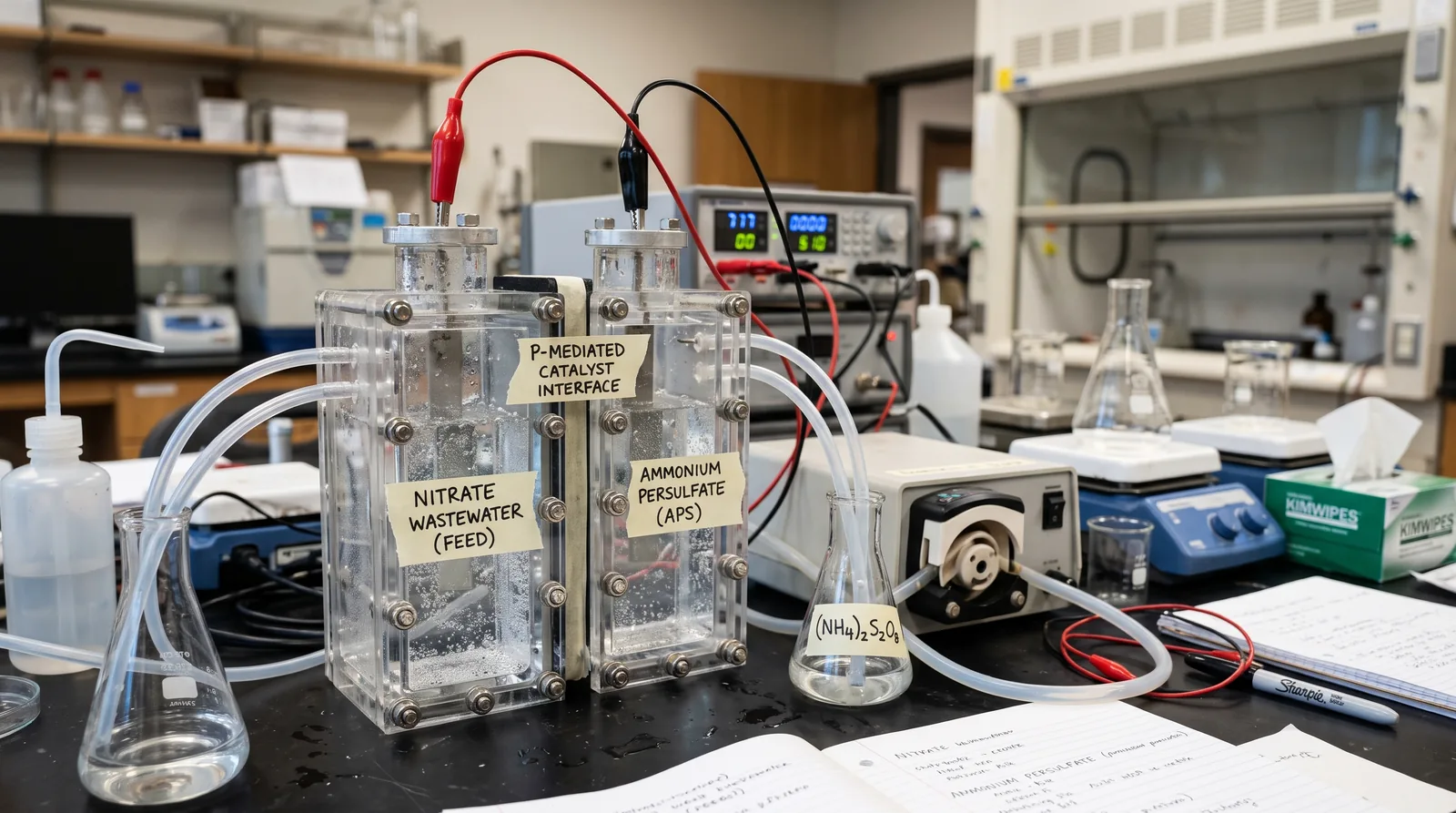
The system converts nitrate-contaminated wastewater into value-added ammonium products and directly electrosynthesizes ammonium persulfate, (NH₄)₂S₂O₈. The paired electrolyzer uses a membrane-electrode assembly to couple the two reactions.
In situ spectroscopy and ab initio molecular-dynamics simulations showed that the PdP₂@Cu₃P heterointerface catalyst dynamically shuttles active hydrogen from hydrogen-generation sites to nitrate-activation sites. This rapid, phosphorus-mediated hydrogenation at the interface decouples hydrogen production from consumption.
By bypassing the multistep proton-coupled electron-transfer pathway, the mechanism enables kinetically synchronized nitrate reduction and sulfate oxidation. This rate matching is what allows the paired electrolyzer to produce ammonium persulfate efficiently.
How this paired electrolyzer compares to standard methods Traditional paired electrolysis systems are hindered by sluggish nitrate-reduction kinetics and poor matching between reduction and oxidation rates. These mismatches have limited practical implementation.
The reported membrane-electrode paired electrolyzer produces ammonium persulfate at a rate of 1.6 mmol h⁻¹ cm⁻². It uses 55% less energy and emits approximately 99.6% less CO₂ than conventional routes.
These comparisons are reported by the authors relative to conventional production routes. The abstract does not specify the conventional route, operating conditions, system boundaries or uncertainty ranges used for the energy and emissions comparison.
What this laboratory prototype does not demonstrate The abstract does not report the absolute economic cost per tonne of ammonium persulfate, capital expenditure, maintenance requirements or the timeline needed to scale the electrolyzer to an industrial municipal wastewater plant.
It also does not report performance in real municipal wastewater, long-term durability, fouling resistance, tolerance to variable wastewater composition or full-scale mass and energy balances. These factors will determine whether the laboratory result can translate into an industrial process.
The study establishes a general strategy for nitrate–sulfate wastewater valorization and high-value oxidant production. It does not claim that the system is already a net producer of value or that it is ready for commercial deployment.
Analysis of performance metrics and engineering hurdles The catalyst achieves a nitrate-reduction rate of 8.94 × 10⁻⁷ mol cm⁻² s⁻¹, an ammonia Faradaic efficiency exceeding 92%, and sustained operation at 220 mA cm⁻².
By addressing the historical bottleneck of mismatched redox rates, the system pairs nitrate-wastewater treatment with direct electrosynthesis of ammonium persulfate.
Bridging the gap to real municipal use requires demonstrating economic viability, industrial capital expenditure, long-term stability and performance on real wastewater streams. The abstract does not report these engineering or economic results.
What the prototype does not show It may seem that the system produces more value than it consumes. In fact: the study reports a production rate and reduced energy use and emissions relative to conventional routes, but it does not establish net value creation.
It may seem that the system is ready for municipal deployment. In fact: it is a laboratory paired electrolyzer demonstrated under controlled conditions; real wastewater, scale-up and durability are not reported in the abstract.
It may seem that the catalyst eliminates all electron-transfer steps. In fact: it bypasses the multistep proton-coupled electron-transfer pathway for nitrate reduction; electron transfer remains part of the electrochemical process.
It may seem that the 99.6% CO₂ reduction applies to every conventional process. In fact: the abstract does not specify the conventional route, operating conditions or system boundaries used for the comparison.
It may seem that the system treats only nitrate. In fact: it is a nitrate–sulfate paired electrolysis system that valorizes both wastewater components.
Verdict: The study demonstrates a prototype electrochemical system that synchronizes nitrate reduction and sulfate oxidation to convert nitrate- and sulfate-containing wastewater into ammonium persulfate. It achieves a nitrate-reduction rate of 8.94 × 10⁻⁷ mol cm⁻² s⁻¹, ammonia Faradaic efficiency exceeding 92%, sustained operation at 220 mA cm⁻² and ammonium-persulfate production of 1.6 mmol h⁻¹ cm⁻²; however, economic viability, capital cost, real-wastewater performance and industrial scale-up remain unreported in the abstract.
Based on reporting from Nature Communications. This is an independent explainer, written in our own words with AI assistance; Nature Communications has not reviewed or endorsed it. Read the original for the full details.