Direct detection reveals atmospheric organic nitrogen as a major nutrient source for global oceans
Researchers calculated that 12.8 million tonnes of atmospheric organic nitrogen fall into the global oceans annually, supplying over a quarter of total marine nitrogen deposition. This finding alters our understanding of how terrestrial activity feeds open-sea biological growth.
Reviewed by Matheus Grangeiro
- Peer reviewed
- Yes
- Sample size
- 418
Key numbers
12.8 milliontonnes
annual organic nitrogen deposition into global oceans
27%
proportion of total nitrogen deposition comprised by organic nitrogen
418samples
marine aerosol samples analyzed
21research cruises
expeditions from which aerosol samples were gathered
0.01μg N m⁻³
minimum aerosol ON concentration over the remote Southern Ocean
10μg N m⁻³
maximum aerosol ON concentration over the Yellow Sea
30%
average share of aerosol nitrogen made up by organic nitrogen
4.8 milliontonnes
annual organic nitrogen from biomass burning emissions
Press versus study
Equivalent
What the press says
The study reveals that 12.8 million tonnes of organic nitrogen (ON) are deposited from the atmosphere into the global oceans annually, constituting approximately 27% of total nitrogen deposition.
What the study shows
The model estimated annual ON deposition to oceans at 12.8 (4.0 to 22.7) teragrams of nitrogen per year (Tg N year −1 ), contributing 27% (11 to 40%) of total N deposition.
Evidence level: Observation or measurement
Why it matters: Atmospheric nitrogen is a major nutrient input to the oceans, supporting marine productivity and shaping global biogeochemical cycles. For decades, the contribution of organic nitrogen has been difficult to quantify because researchers often estimated it by subtracting inorganic nitrogen from total nitrogen—an approach vulnerable to measurement error. By directly measuring organic nitrogen in marine aerosols and combining those observations with a global atmospheric model, this study provides a much stronger baseline for understanding how wildfires, human emissions, and marine processes influence ocean nutrient supply.
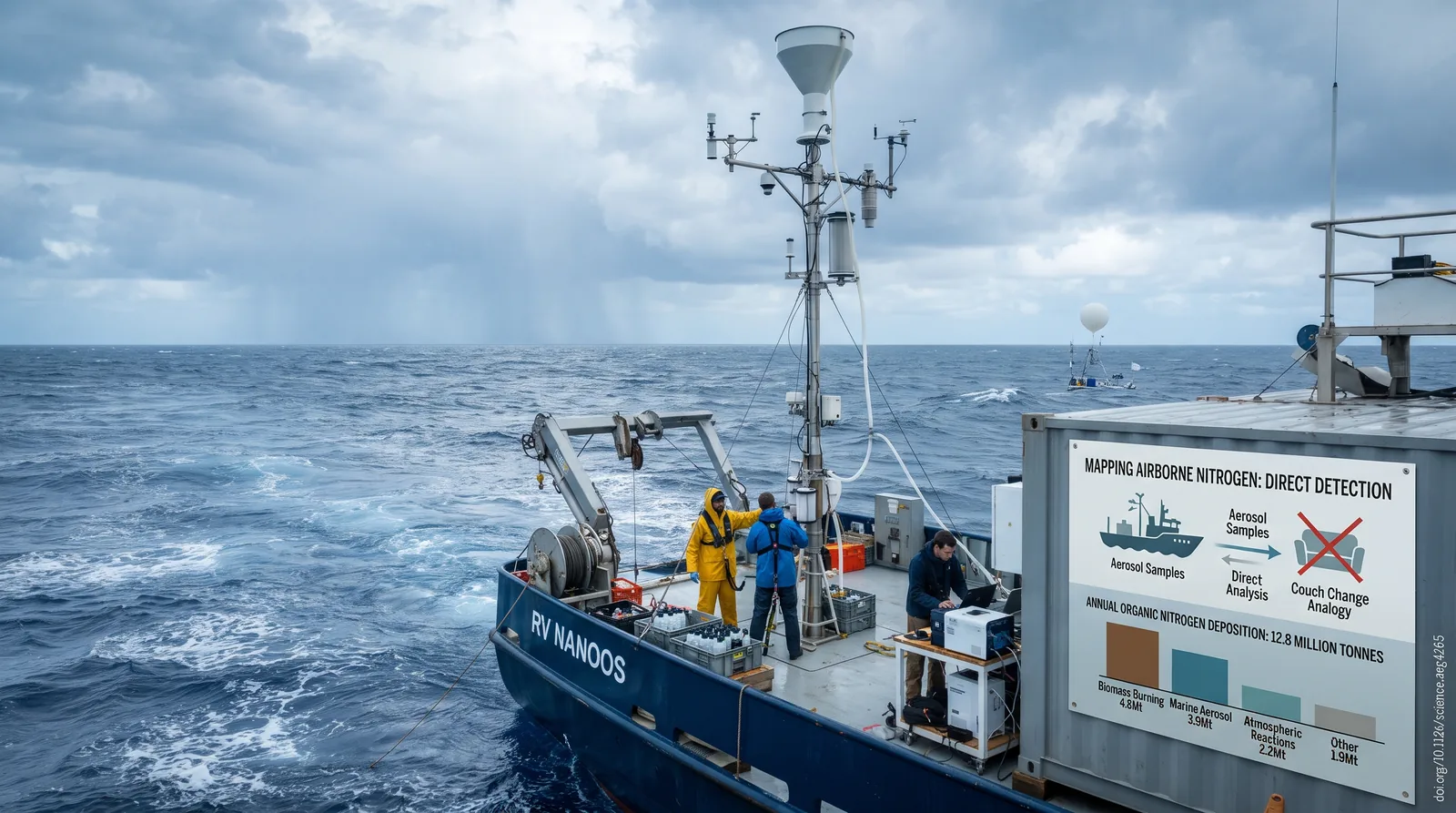
How direct chemical detection maps airborne nitrogen The research team combined a high-sensitivity analytical method with extensive open-ocean and polar sampling and a three-dimensional atmospheric chemistry model. The method measures aerosol organic nitrogen and inorganic nitrogen simultaneously, avoiding the error-prone subtraction approach used in many earlier studies.
Field teams collected 418 marine aerosol samples during 21 research cruises. The expeditions covered tropical and polar waters, including the Arctic and Southern Oceans, producing the most comprehensive atmospheric organic-nitrogen dataset reported to date.
The direct measurements were then used to constrain the atmospheric chemistry model. This combination of observations and modeling allowed the researchers to estimate both the concentration of organic nitrogen in marine air and its annual deposition into the global oceans.
The analogy to weighing a couch before and after is imperfect: atmospheric chemistry involves chemical transformations, reactions, and multiple nitrogen species, not simply a fixed amount of material hidden in one place. The key advance is that the method directly identifies and measures organic nitrogen rather than treating it as a residual difference between two larger measurements.
Quantifying annual organic-nitrogen deposition The study estimates that 12.8 million tonnes of organic nitrogen are deposited from the atmosphere into the global oceans each year. This represents approximately 27% of total atmospheric nitrogen deposition to the oceans.
In nitrogen-limited regions, the contribution is even larger. In the central Atlantic Ocean and the Indonesian seas, atmospheric organic nitrogen accounts for about half of total nitrogen deposition.
These results indicate that organic nitrogen is not a minor or secondary pathway. It is a substantial external nutrient source for marine ecosystems, particularly in waters where nitrogen availability can constrain biological productivity.
Measure Finding Annual atmospheric organic-nitrogen deposition to oceans 12.8 million tonnes. Share of total nitrogen deposition About 27%. Organic-nitrogen share of sampled aerosol nitrogen 30% on average. Concentration range Below 0.01 to above 10 micrograms nitrogen per cubic meter. Share in nitrogen-limited waters About half of total nitrogen deposition. Non-marine contribution 8.9 million tonnes annually, or 70% of deposited organic nitrogen. Overcoming subtraction-based estimates Traditional methods estimated organic nitrogen by subtracting inorganic nitrogen from total nitrogen. That approach is laborious and error-prone because both the total and inorganic measurements can contain uncertainty, and the resulting difference can be unreliable when the organic fraction is relatively small.
The new method measures aerosol organic nitrogen and inorganic nitrogen directly and simultaneously. This reduces reliance on a difference-based calculation and provides a more robust observational basis for atmospheric models. [page11]
The study’s measurements show that organic nitrogen concentrations vary by more than three orders of magnitude across ocean regions. They fall below 0.01 micrograms of nitrogen per cubic meter over the remote Southern Ocean and exceed 10 micrograms of nitrogen per cubic meter over the Yellow Sea.
On average, organic nitrogen made up 30% of total aerosol nitrogen in the samples. This high average share helps explain why earlier subtraction-based estimates may have underestimated the importance of this nutrient pathway.
Tracing sources from fires to marine aerosols The researchers identified three major sources of atmospheric organic nitrogen reaching the oceans. Biomass burning contributed 4.8 million tonnes annually, marine aerosol emissions contributed 3.9 million tonnes, and chemically produced imines contributed 2.2 million tonnes.
Together, non-marine sources—including wildfires and human activities—supply 8.9 million tonnes of organic nitrogen annually. This equals 70% of the organic nitrogen deposited into the oceans.
These findings show that land-based emissions can be an important external nutrient input to open-ocean ecosystems. Changes in wildfire activity, industrial emissions, agricultural practices, or atmospheric chemistry could therefore alter the amount and form of nitrogen delivered to marine waters.
What the study does not establish The study quantifies atmospheric organic-nitrogen deposition and identifies major sources. It does not directly measure how individual phytoplankton species respond to the different organic nitrogen compounds delivered to the ocean.
The source states that terrestrial inputs can stimulate open-ocean productivity, but it does not test specific ecological outcomes such as changes in fish populations, food-web structure, carbon export, or ecosystem resilience. Those outcomes would require additional biological and oceanographic research.
The announcement also does not provide the financial cost of implementing the high-sensitivity analytical method across routine monitoring networks. Widespread adoption would depend on instrumentation, laboratory capacity, sampling logistics, calibration, and long-term operational support—factors outside the scope of the reported geochemical measurements.
What the 418 samples do not show It may seem that the data prove that reducing wildfire emissions will immediately increase fish populations. In fact: the study calculates annual nitrogen deposition and identifies sources, but it does not measure fish populations or test the downstream ecological effects of emission reductions.
It may seem that the 418 samples alone determine global deposition. In fact: the global estimate comes from using the samples to constrain a three-dimensional atmospheric chemistry model, not from direct deposition measurements at every ocean location.
It may seem that all organic nitrogen has the same biological effect. In fact: the study quantifies total organic-nitrogen deposition and sources, but does not establish how individual organic compounds affect particular phytoplankton species.
It may seem that the study proves that atmospheric organic nitrogen is beneficial in every marine setting. In fact: it establishes a major nutrient input, especially in nitrogen-limited regions, but does not evaluate ecosystem-specific responses or potential negative consequences.
Verdict: Direct aerosol measurements from 418 samples across 21 marine expeditions, combined with a constrained global atmospheric chemistry model, show that 12.8 million tonnes of organic nitrogen enter the global oceans annually, representing about 27% of total atmospheric nitrogen deposition. The findings identify biomass burning, marine aerosols, and atmospheric imine formation as major sources, with non-marine sources supplying 70% of the total. However, the specific ecological consequences for individual phytoplankton species, marine food webs, and fish populations remain unmeasured.
Based on reporting from HKUST. This is an independent explainer, written in our own words with AI assistance; HKUST has not reviewed or endorsed it. Read the original for the full details.