Simulating reduced bladder tumor surveillance to cut costs and emissions
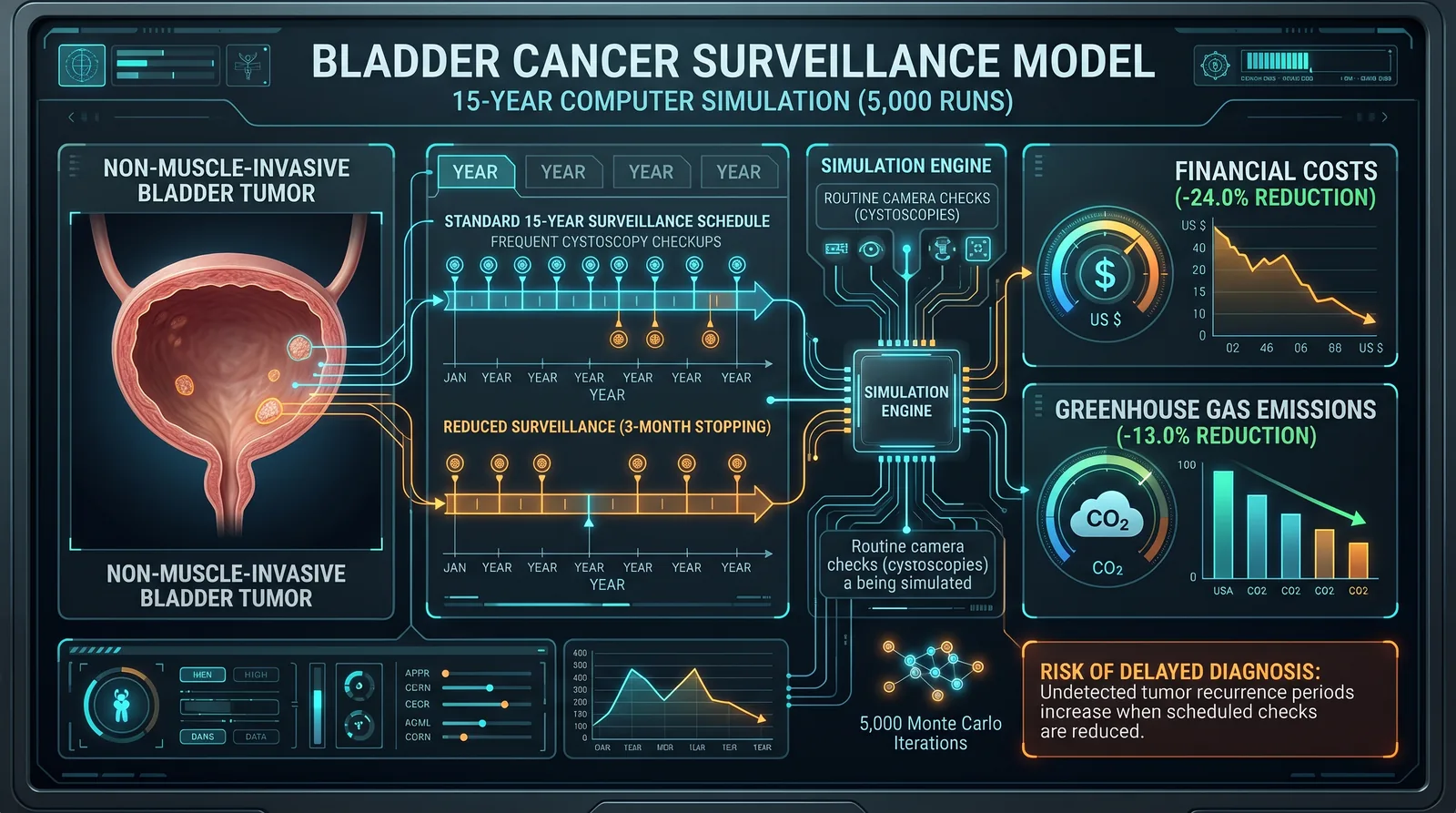
Researchers used a 15-year computer simulation to test whether reducing routine medical checkups for low-risk bladder tumors could cut financial costs and greenhouse gas emissions. The findings show significant reductions in expenses and carbon output, alongside a trade-off of delayed cancer detection.
Reviewed by Matheus Grangeiro
- Peer reviewed
- Yes
- Sample size
- 5000
Key numbers
15years
cohort model duration
2021year
United States costs baseline
3months
examination time point for ending scheduled surveillance
24.0%
reduction in modelled costs
13.0%
reduction in inventoried emissions
5000simulations
paired simulation runs
0.009quality-adjusted life-years
mean difference per patient
-0.260quality-adjusted life-years
lower bound of 95% uncertainty interval
Evidence level: Simulation or model
Why it matters: Non-muscle-invasive bladder cancer often requires repeated cystoscopic surveillance, in which clinicians insert a camera into the bladder to check for tumor recurrence. These procedures consume clinical resources, generate costs, and contribute to healthcare-related greenhouse-gas emissions. However, reducing surveillance too aggressively could delay detection of recurrent or progressing tumors. A decision-analytic model can estimate the trade-off between fewer procedures, lower costs, lower emissions, and possible delays in diagnosis, but it cannot by itself establish that a revised schedule is safe for patients.
How the 15-year model was built Researchers compared nine cystoscopic surveillance schedules using a monthly cohort model simulated over 15 years. The model was stratified by European Association of Urology risk group, allowing different assumptions and outcomes for patients at different recurrence and progression risks.
The study used 2021 United States costs and an international emissions inventory. It relied on published aggregate inputs and model-generated outputs, with no living human participants, tissue samples, identifiable personal information, or animals involved.
Clinical colleagues at Shandong Zaozhuang Municipal Hospital reviewed the original surveillance schedules and clinical assumptions. The authors also state that the study received no specific funding from public, commercial, or not-for-profit sources.
What the low-risk comparison found For patients classified as low risk, the model compared a schedule that ended routine surveillance after the three-month examination with standard guideline-based follow-up. Importantly, the reduced schedule retained investigation of symptoms, meaning patients could still be evaluated if they developed signs of recurrence.
In 5,000 paired simulations, ending scheduled surveillance after the three-month checkup reduced modeled costs by 24.0% and inventoried emissions by 13.0% relative to guideline follow-up. The savings came largely from performing fewer cystoscopies.
The estimated effect on quality-adjusted life-years was very small on average: 0.009 per patient. However, the 95% uncertainty interval ranged from -0.260 to 0.291, meaning the model could not rule out clinically meaningful losses or gains in quality-adjusted life-years.
Outcome Low-risk reduced-surveillance schedule Cost reduction 24.0% versus guideline follow-up. Emissions reduction 13.0% versus guideline follow-up. Mean quality-adjusted life-year difference 0.009 per patient. 95% uncertainty interval -0.260 to 0.291 quality-adjusted life-years. Time with undetected recurrence Increased. Clinical safety Not established by the model. Why emissions do not fall proportionally Although fewer cystoscopies reduce procedural costs and some emissions, recurrence treatment accounted for most of the modeled emissions. This limits the total carbon savings that can be achieved simply by reducing the number of surveillance examinations.
When surveillance is reduced, recurrent tumors may remain undetected for longer. If a recurrence is eventually diagnosed, it may require treatment that generates substantial emissions and costs. Therefore, the model’s 13.0% emissions reduction is smaller than the 24.0% cost reduction because treatment-related emissions remain a major component of the total footprint.
This finding is important for policy: reducing routine procedures may save money and avoid some procedural emissions, but it does not eliminate the environmental burden of bladder-cancer care if recurrences are diagnosed later or require more intensive treatment.
What the model does not prove The simulation does not prove that ending all scheduled surveillance after one examination is safe. The authors explicitly state that the model does not establish the safety of stopping scheduled surveillance after a single examination.
The results depend heavily on assumptions about whether tumors progress before recurrence is detected and whether symptoms prompt diagnosis. Under less favorable assumptions, the model predicted more tumor progression and more bladder-cancer deaths.
This means that the apparent small average quality-adjusted life-year benefit is not a guarantee of individual patient safety. It reflects model assumptions, uncertainty, and average outcomes across simulated cohorts, not direct evidence from a prospective clinical trial.
What remains unresolved The study did not perform sex-specific or distributional analyses. It therefore cannot show whether the costs, emissions, cancer outcomes, or quality-adjusted life-year effects differ for men and women or across other patient subgroups.
Patients and the public were not involved in the project. The authors state this directly, meaning the model’s assumptions and priorities were not shaped by patient preferences, lived experience, or stakeholder input.
The study also does not establish implementation requirements, such as how symptom-triggered follow-up would function in practice, how quickly patients would seek care after symptoms, or whether health systems could reliably identify and evaluate recurrences outside routine surveillance. Those factors would be essential in a real-world policy change.
Why prospective evaluation is needed The authors conclude that selected reductions in low-risk surveillance warrant prospective evaluation. This means that the modeled strategy should be tested in carefully designed clinical studies before guidelines or routine practice are changed.
A prospective study would need to measure recurrence detection, progression, cancer-specific survival, patient-reported outcomes, costs, emissions, and adherence to symptom-based follow-up. It would also need to determine whether the strategy works safely across different healthcare systems and patient populations.
Until such evidence exists, the model should be interpreted as a decision-support exercise that identifies a plausible trade-off—not as clinical proof that reduced surveillance is safe or appropriate for routine use.
Common misreadings It may seem that cutting routine checkups completely eliminates the carbon footprint associated with managing bladder tumors. In fact: recurrence treatment accounted for most of the modeled emissions, limiting the carbon savings achieved by performing fewer cystoscopies.
It may seem that stopping scheduled surveillance after three months has been proven safe in clinical practice. In fact: the simulation does not establish the safety of stopping scheduled surveillance after one examination, and less favorable assumptions increased progression and bladder-cancer deaths.
It may seem that a mean gain of 0.009 quality-adjusted life-years means all patients benefit. In fact: the 95% uncertainty interval ranged from -0.260 to 0.291, so the model cannot rule out clinically meaningful losses or gains.
It may seem that the model reflects real-world patient experiences. In fact: it used published aggregate inputs and model-generated outputs, did not involve patients or the public, and did not perform sex-specific or distributional analyses.
Verdict: A 15-year monthly cohort simulation found that, for low-risk non-muscle-invasive bladder cancer, ending scheduled surveillance after the three-month examination while retaining symptom-based evaluation reduced modeled costs by 24.0% and inventoried emissions by 13.0%. However, the strategy increased the time that recurrent tumors remained undetected, and the model does not establish clinical safety or support an immediate change to surveillance guidelines. Selected reductions in low-risk surveillance warrant prospective evaluation before implementation.
Source: Scientific Reports. The original is licensed CC BY. This text is an AI-assisted adaptation (summarized, simplified and translated) and may differ from the original.