Genome-wide screen uncovers hidden carbon-fixing microbes
Scientists analyzed the complete genomic data of nearly 6800 prokaryotic strains to search for pathways that absorb carbon dioxide. The findings expand our understanding of microbial metabolic diversity and point to new candidates for greenhouse gas reduction strategies.
Reviewed by Matheus Grangeiro
- Peer reviewed
- Yes
- Sample size
- 6749
Key numbers
6700strains
microbial strains analyzed in the genome study
300strains
strains possessing CO2 fixation genes
32000strains
total microbial strains in the JCM collection
21000strains
publicly available microbial strains with published data
4000strains/year
strains provided annually to researchers
15000strains
prokaryotic strains made available by JCM
6749strains
prokaryotic strains with analyzed full genomic data
6262strains
bacterial strains with analyzed genomic data
Evidence level: Simulation or model
Why it matters: Greenhouse gas emissions continue to raise global temperatures, creating demand for biological and industrial approaches that can capture or convert carbon dioxide. Microorganisms may offer a route to CO2 fixation that does not require sunlight, because some bacteria and archaea can use chemical energy sources such as hydrogen or sulfur compounds. A genome-wide screen of a large microbial collection can therefore help researchers identify promising organisms for future carbon-capture research, even before those organisms have been tested in industrial systems.
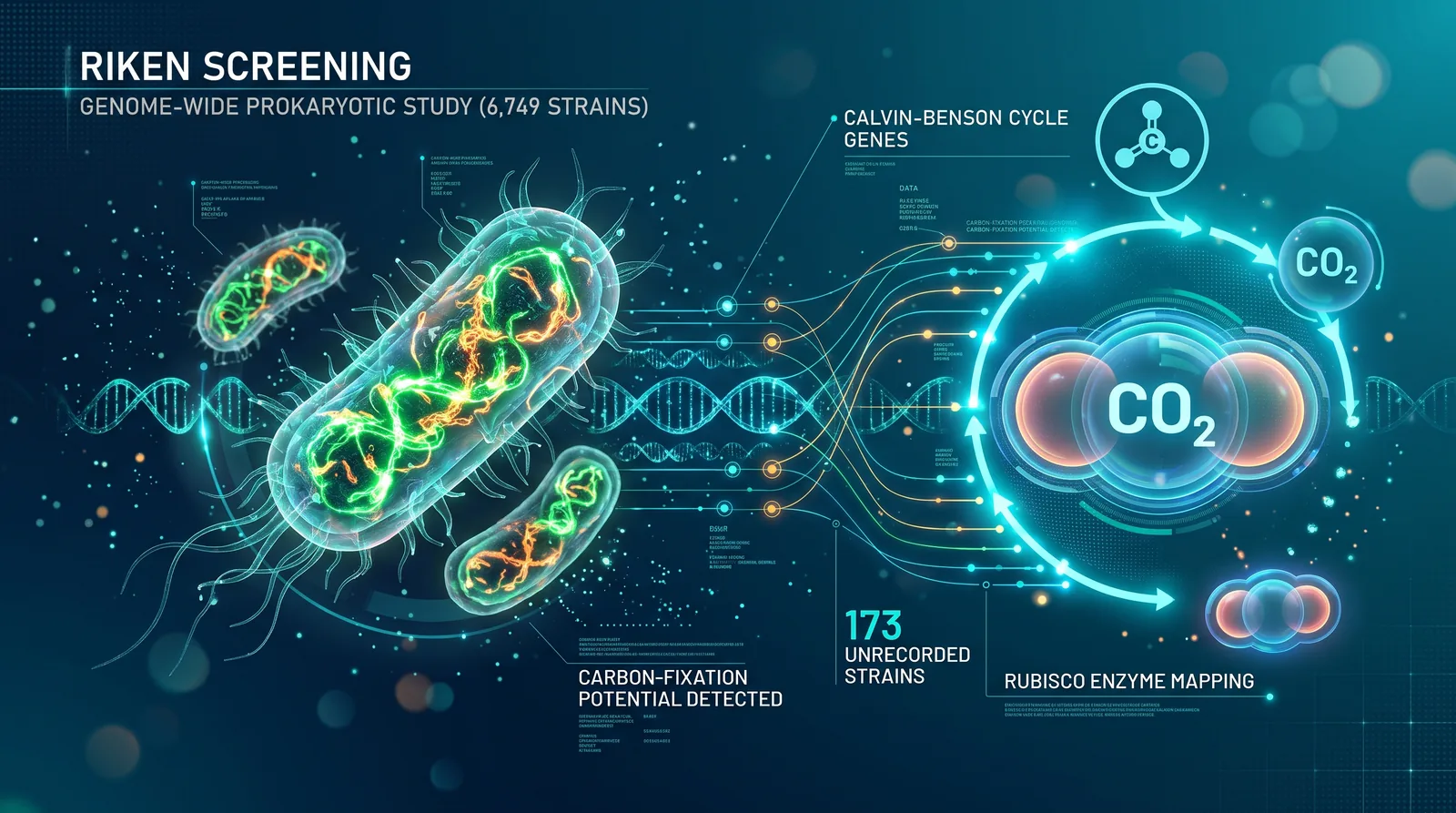
What the genomic screen examined Researchers at the RIKEN BioResource Research Center in Tsukuba analyzed the genomes of 6,749 prokaryotic strains held by the Japan Collection of Microorganisms. The sample included 6,262 bacterial strains and 487 archaeal strains, all of which had complete genomic data available for analysis.
The team searched specifically for genes associated with the Calvin–Benson cycle, the major biological pathway through which CO2 is converted into organic carbon compounds. They also cross-referenced the genomic findings with published scientific literature to determine whether carbon fixation had already been reported for the organisms or genera identified.
This was primarily a computational and resource-cataloging study. It identified genetic potential and prior literature evidence, rather than directly measuring how much CO2 each strain captures under industrial conditions.
What the screen found The search identified 306 strains carrying genes associated with the Calvin–Benson cycle. These strains belonged to 147 genera.
When the researchers searched the literature, they found prior evidence of CO2 fixation in 74 of those genera. The remaining 73 genera had not previously been reported to fix CO2, making them promising but unproven candidates for further investigation.
Using genetic data, the team then identified 173 strains within those previously unreported genera that appeared to have potential for CO2 fixation. The researchers suggest that many of these organisms may be able to use hydrogen or sulfur compounds as energy sources, potentially allowing carbon fixation in dark or oxygen-limited environments.
Measure Finding Prokaryotic genomes analyzed 6,749 strains: 6,262 bacteria and 487 archaea. Strains with Calvin–Benson-cycle genes 306 strains. Genera represented by those strains 147 genera. Genera with prior literature evidence of CO2 fixation 74 genera. Genera without prior reported CO2 fixation 73 genera. Strains with predicted fixation potential in unreported genera 173 strains. Rubisco and carbon fixation Rubisco is an enzyme that catalyzes a key step in the Calvin–Benson cycle. It is central to carbon fixation in plants, algae, and many microorganisms, but its presence or predicted function in a genome does not by itself prove that a particular organism actively fixes CO2 under real-world conditions.
The researchers classified the 306 candidate strains according to type, habitat, and metabolic properties. They found substantial differences in the energy sources these organisms use and the environments in which they live.
Some microbes prefer hydrogen, some use sulfur compounds, and some thrive without oxygen. This variation means that standard laboratory media may fail to support organisms whose carbon-fixing abilities emerge only under more specialized nutrient, gas, temperature, or chemical conditions.
What the study does not establish The study does not demonstrate active CO2 fixation for all 173 strains identified in previously unreported genera. Genetic evidence can indicate potential, but confirming fixation requires cultivation and direct metabolic testing under appropriate conditions.
It also does not assess the economic cost, engineering requirements, scalability, or timeline needed to deploy these organisms in commercial carbon-capture facilities. Those questions involve reactor design, feedstock supply, energy use, contamination control, biomass handling, and product recovery—issues outside the scope of a genomic catalog.
The work does not establish that these microbes can meaningfully reduce atmospheric CO2 at a climate-relevant scale. Even if individual strains fix carbon in the laboratory, their contribution to emissions reduction would depend on growth rate, carbon-fixation efficiency, stability, energy input, and the ability to operate reliably in engineered systems.
Microbial dark matter and cultivation “Microbial dark matter” refers to the large fraction of microbial life that remains poorly characterized, including organisms that have not been formally described or successfully grown in the laboratory. Many such organisms may possess useful metabolic abilities, but those abilities cannot be confirmed until researchers find conditions that allow them to grow and express those functions.
The RIKEN team notes that changing culture conditions may reveal CO2-fixing activity in organisms that do not grow or express the relevant pathways in standard media. This makes the 173 predicted strains a starting point for targeted cultivation experiments, not a list of ready-to-use industrial microbes.
Repository context and future work The Japan Collection of Microorganisms contains more than 32,000 microbial strains. Approximately 21,000 of these are publicly available because they have published literature or genetic-sequence information, and the center distributes more than 4,000 strains annually to researchers in Japan and abroad.
The current analysis used only the 6,749 prokaryotic strains for which complete genomic data had already been analyzed. The broader collection therefore contains many additional organisms that were not part of this particular screen.
The researchers’ stated priority is to compile high-quality primary data on microbial habitats, culture conditions, and related factors. They also see future potential in using artificial intelligence to predict how particular microorganisms could be used in research or industry, but that remains a forward-looking research direction rather than a demonstrated outcome.
Common misconceptions It may seem that finding carbon-fixation genes in thousands of strains means these microbes are ready for industrial carbon-capture facilities. In fact: the study is a computational and repository-based screen; the lead researcher explicitly describes applied industrial research as outside her current area of focus.
It may seem that all 306 candidate strains actively fix CO2. In fact: the screen identified genes associated with the Calvin–Benson cycle; literature evidence supported fixation for strains in 74 genera, while 73 genera lacked prior reported evidence.
It may seem that the 173 strains in unreported genera have been proven to capture CO2. In fact: they have predicted potential based on genetic analysis, but their actual fixation activity has not been demonstrated for every strain.
It may seem that the study evaluated all microbes in the RIKEN collection. In fact: it analyzed 6,749 prokaryotic strains with complete genomic data, while the full collection contains more than 32,000 strains.
Verdict: The study successfully mapped Calvin–Benson-cycle genes across 6,749 prokaryotic genomes and identified 306 candidate strains across 147 genera. It uncovered 73 genera with no prior reported CO2 fixation and flagged 173 strains with predicted fixation potential, creating a valuable starting point for future cultivation and metabolic testing. However, because the work is limited to genomic screening and literature cross-referencing rather than applied scaling tests, industrial deployment and measurable climate impact remain distant.
Based on reporting from RIKEN. This is an independent explainer, written in our own words with AI assistance; RIKEN has not reviewed or endorsed it. Read the original for the full details