Tracking rhythmic starlight exposes a heavy, invisible companion
Astronomers tracked rhythmic brightness fluctuations of the delta Scuti star TIC 160582982, located 860 light-years away, and detected a massive hidden partner orbiting every 89.29 days. This approach offers a reliable way to spot dark compact objects that lack the glowing accretion disks usually required for detection.
Reviewed by Matheus Grangeiro
- Peer reviewed
- Yes
- Sample size
- 1
Key numbers
1.8solar masses
minimum mass of the unseen companion
860light-years
distance from Earth to TIC 160582982
6modes
high-frequency pulsation modes analyzed
89.29days
orbital period of the system
0.54
orbital eccentricity
20-25%
expected optical and near-infrared flux contribution from an ordinary main-sequence companion
Evidence level: Observation or measurement
Why it matters: Massive stellar companions can be difficult to detect because they may emit little visible light and show no obvious signs of accretion. Their gravitational influence, however, can be traced through the motion of a nearby luminous star. In pulsating stars, regular brightness variations act as natural clocks, allowing researchers to detect hidden companions and constrain their masses without directly imaging them.
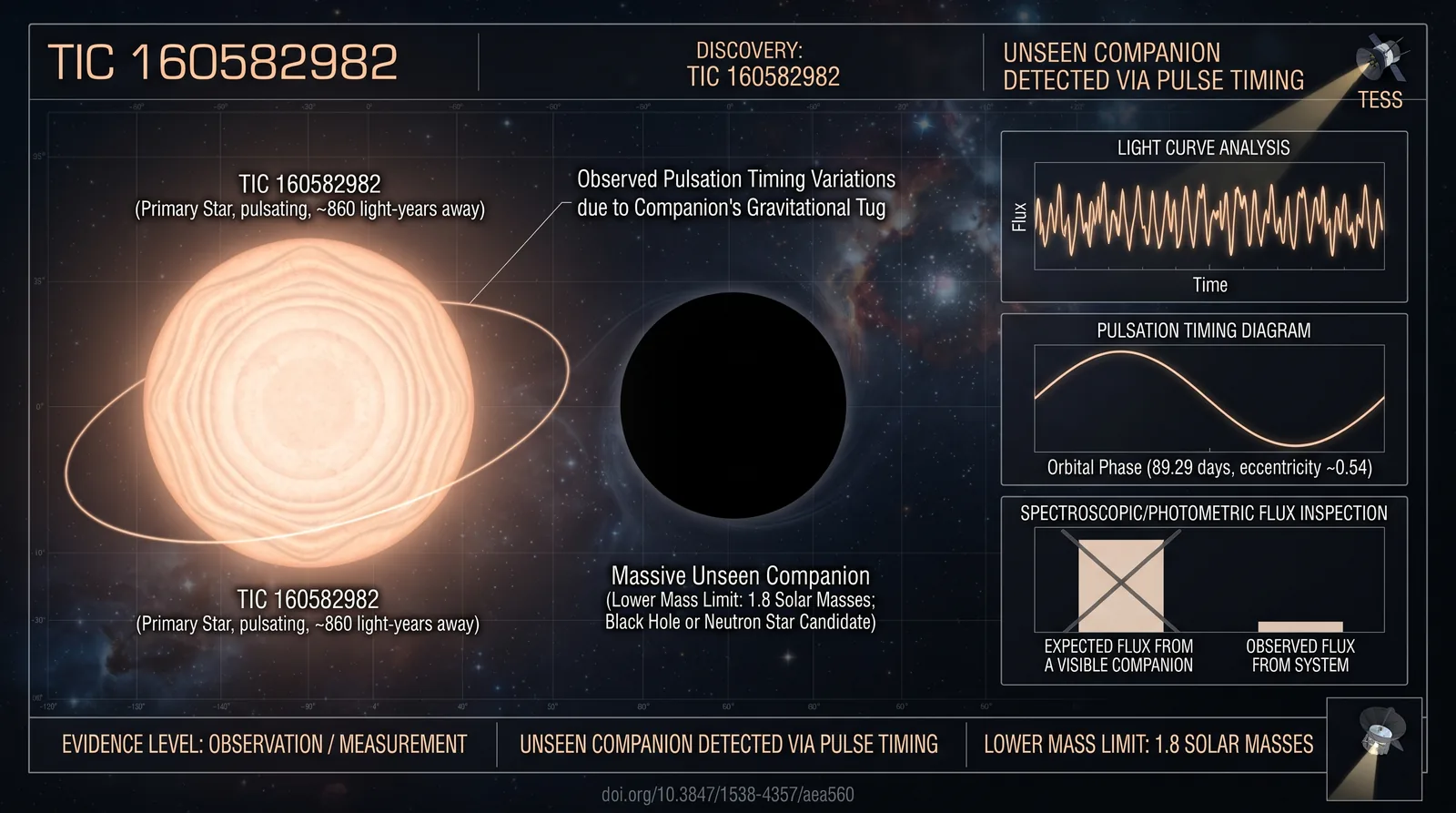
Detecting hidden mass through stellar pulse timing Massive stellar companions often remain hard to detect because they produce minimal optical radiation and lack accretion indicators. Their gravitational pull can nevertheless be identified by tracking the movement of a neighboring luminous star.
Periodic brightness fluctuations in pulsating stars serve as natural timing mechanisms. By monitoring the primary star’s orbital motion through these pulsations, researchers can infer the presence and properties of an unseen companion.
This method does not rely on seeing the companion directly. It infers the companion’s presence from periodic changes in the primary star’s pulsation timing and frequency, which are caused by the orbital motion of the binary system.
Uncovering the binary system TIC 160582982 Researchers used high-precision photometric data from NASA’s TESS spacecraft to study the delta Scuti star TIC 160582982, located approximately 860 light-years from Earth. Delta Scuti stars are pulsating stars whose brightness varies regularly, making them useful as natural clocks.
By analyzing six high-frequency pulsation modes, the researchers derived an orbital period of 89.29 days and an orbital eccentricity of about 0.54. An independent frequency-modulation analysis confirmed the orbital solution.
These measurements provide reliable dynamical constraints on the companion’s mass. The study reports a minimum companion mass of 1.8 solar masses, suggesting that the system may contain a neutron star or a stellar-mass black hole.
Measurement Result Primary star Delta Scuti star TIC 160582982. Distance from Earth About 860 light-years. Orbital period 89.29 days. Orbital eccentricity About 0.54. Minimum companion mass 1.8 solar masses. Possible companion type Neutron star or stellar-mass black hole. Ruling out ordinary stars through flux inspection An ordinary main-sequence companion in that position would be expected to contribute about 20% to 25% of the system’s optical and near-infrared flux. No such excess appears in the available photometric or spectroscopic data.
This absence of excess flux makes a single ordinary main-sequence star an unlikely explanation for the observed companion. The result supports the interpretation that the unseen object is compact or otherwise difficult to detect in visible and near-infrared light.
However, the flux analysis does not directly determine whether the companion is a neutron star or a black hole. It only helps rule out a normal main-sequence star as the most likely explanation.
Evaluating the nature of the massive unseen partner The study does not directly image the companion or observe it glowing in space. Instead, the companion’s presence is inferred entirely from the gravitational and timing effects it exerts on the primary star’s pulsations.
The reported minimum mass of 1.8 solar masses is consistent with either a neutron star or a stellar-mass black hole. The source does not claim that the companion’s identity has been definitively established.
The findings demonstrate the potential of stellar pulsation timing for identifying massive unseen companions and searching for compact objects that lack obvious accretion signatures. The study also provides new constraints for understanding how binary star systems evolve.
What the stellar observations do not show It may seem that the companion object was directly imaged or observed glowing in space. In fact: the companion remains hidden and was inferred entirely through the gravitational and timing effects it exerts on the primary star’s pulsations.
It may seem that the companion is confirmed to be a black hole or neutron star beyond any doubt. In fact: the study establishes a lower mass limit of 1.8 solar masses and rules out a normal main-sequence star via flux data, but leaves open whether the remnant is a neutron star or a black hole.
It may seem that the orbital solution’s statistical significance or false-positive probability is known. In fact: the source does not specify these values, so the strength of the orbital detection cannot be independently quantified from the available information.
It may seem that the companion’s mass is precisely measured. In fact: the study reports a minimum mass of 1.8 solar masses, not a definitive mass measurement.
Verdict: Precise TESS photometry and pulsation timing revealed a massive hidden companion with a minimum mass of 1.8 solar masses orbiting the delta Scuti star TIC 160582982. The orbital period is 89.29 days, with an eccentricity of about 0.54, and the absence of expected optical or near-infrared flux makes a normal main-sequence companion unlikely. However, the companion has not been directly imaged, and its exact nature—neutron star or black hole—remains unresolved.
Based on reporting from Chinese Academy of Sciences. This is an independent explainer, written in our own words with AI assistance; Chinese Academy of Sciences has not reviewed or endorsed it. Read the original for the full details.