Diamond spin states power a new cryogenic microwave amplifier
Researchers have built a microwave amplifier using spin states inside diamond crystals that boosts signals over a thousand times. This development offers a way to improve sensitive detection tools and advanced computing architectures without collapsing under high signal inputs.
Reviewed by Matheus Grangeiro
- Peer reviewed
- Yes
Key numbers
1,000fold
signal amplification magnitude
1954year
first demonstration of masers
6years
time gap between maser and laser demonstrations
2.55quanta
added noise level
0.5quanta
absolute quantum limit
Press versus study
Equivalent
What the press says
The device achieves more than 1,000-fold amplification of microwave signals.
What the study shows
The study reports a maximum power gain exceeding 30 dB (which mathematically corresponds to a factor of 1,000).
Evidence level: Prototype or demonstration
Why it matters: Cryogenic microwave amplifiers are essential for reading extremely weak signals from superconducting quantum processors, resonance spectroscopy systems, and dark-matter detectors. Existing quantum-limited amplifiers often face a trade-off: Josephson parametric amplifiers can saturate when many qubits are read out simultaneously, while kinetic-inductance amplifiers can tolerate stronger signals but may require additional wiring and electrical power. A diamond-based maser amplifier that provides strong gain, low added noise, magnetic-field compatibility, and high input-signal tolerance could make it easier to scale quantum readout systems—if it can be manufactured and integrated reliably.
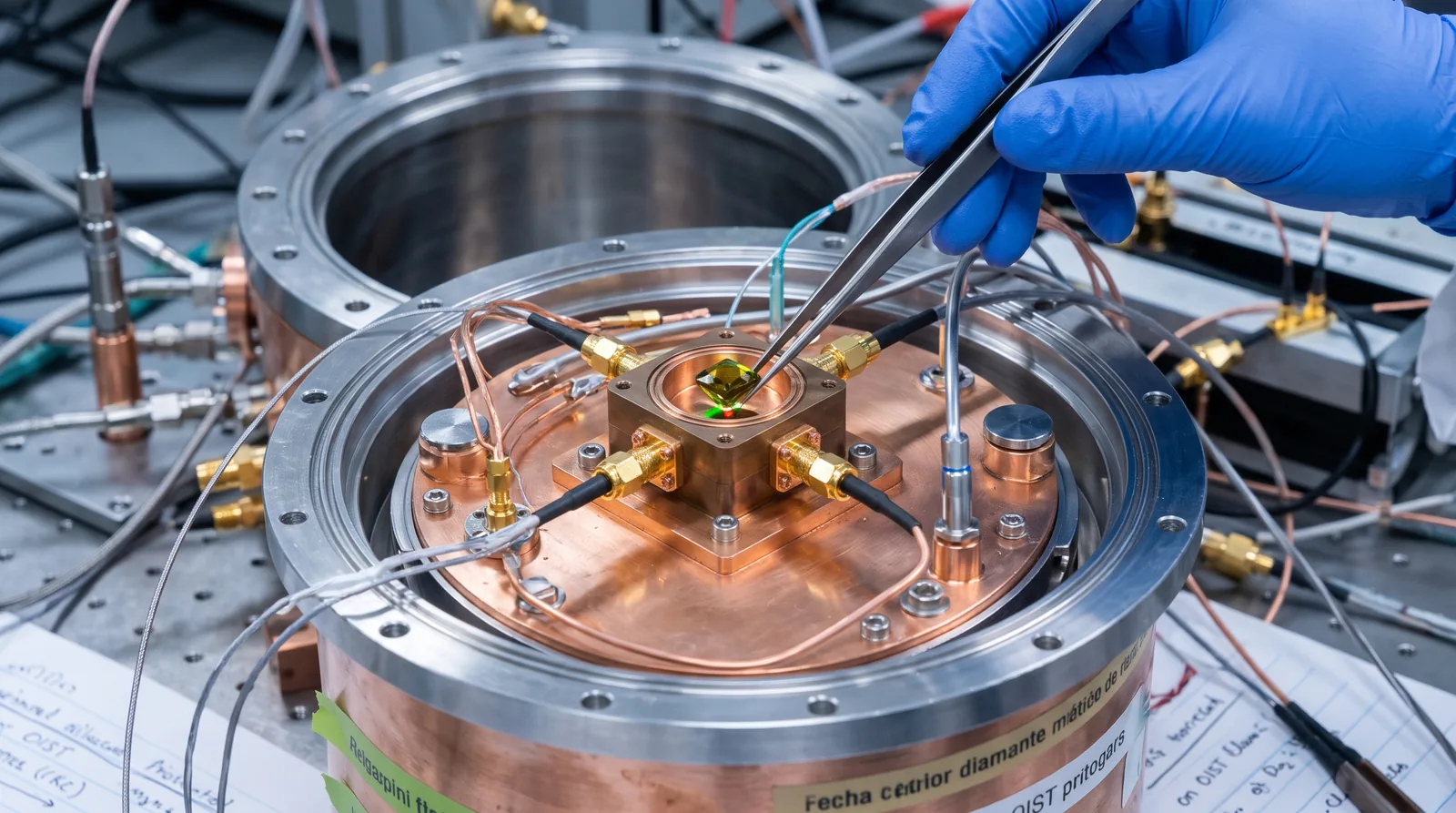
How nitrogen defects amplify microwaves The amplifier’s active medium is a diamond containing substitutional nitrogen impurities, known as P1 centers. These impurities host electron spins that interact with the microwave magnetic field inside a copper microwave resonator.
A relatively weak microwave pump field drives many of the electron spins into a higher-energy state, creating a population inversion. When an incoming microwave signal enters the device, it stimulates excited spins to fall back to lower-energy states and emit identical microwave photons. This is stimulated emission—the same basic physical principle underlying lasers, but operating at microwave frequencies.
The result is amplification of the incoming signal at its original frequency. Unlike a mechanical analogy, the device does not store energy like a spring and release it in a simple mechanical push; it relies on quantum spin populations, microwave pumping, and stimulated emission within a resonator.
Performance relative to existing devices The prototype achieves more than 1,000-fold amplification of microwave signals, equivalent to a power gain exceeding 30 dB. It adds 2.55 quanta of noise, only modestly above the absolute quantum limit of 0.5 quanta that any physical amplifier must add simply by existing.
Capability Diamond maser amplifier Conventional Josephson parametric amplifier Kinetic-inductance amplifier Signal gain More than 1,000-fold, or over 30 dB. Can provide quantum-limited amplification. Can provide amplification, with higher input tolerance. Added noise 2.55 quanta, near the 0.5-quantum physical limit. Very low noise, but can saturate with multiple simultaneous readouts. Not specified in the source. Input-signal tolerance Handles much stronger inputs than conventional Josephson parametric amplifiers. Prone to saturation during simultaneous multi-qubit readout. Handles stronger input signals. Wiring and power Presented as a potentially simpler alternative, though scaling requirements remain unquantified. May face scaling constraints from saturation. Typically needs more electrical power and additional wiring. Magnetic-field compatibility Operates in magnetic fields, making it relevant to spin-qubit platforms. Can be overwhelmed by magnetic fields required by some spin-qubit platforms. Not specified in the source. The device’s ability to operate in magnetic fields is particularly relevant for semiconductor spin-qubit platforms, which often require magnetic fields that can interfere with conventional superconducting amplifiers.
What the gain figure means A power gain above 30 dB means that the microwave signal’s power is increased by a factor greater than 1,000. This is not the same as saying that the voltage amplitude increases by more than 1,000 times; power and voltage scale differently. The “1,000-fold” description refers to microwave signal amplification in the power-gain sense reported by OIST.
The 2.55-quanta noise figure is also important. It means the amplifier adds a small but nonzero amount of noise to the signal it amplifies. Being “close” to the quantum limit does not mean the device is noiseless; it means its added noise is only moderately above the minimum imposed by quantum mechanics.
What the prototype does not establish The result demonstrates a functioning laboratory prototype, not a commercially qualified component. OIST states that the device is undergoing further development toward commercialization, but the announcement does not provide manufacturing yields, unit costs, long-term reliability data, or demonstrated performance in a large multi-qubit processor.
The claim that it “surpasses current technologies” should be read narrowly. The source supports that it can handle stronger input signals than conventional Josephson parametric amplifiers and operate in magnetic fields. It does not establish that the diamond maser outperforms every existing amplifier in every metric, nor does it quantify its performance across large-scale quantum computing systems.
The prototype still requires millikelvin-scale temperatures near absolute zero. This is compatible with many superconducting quantum-computing platforms, but it means the amplifier is not a room-temperature solution and will still need specialized cryogenic infrastructure.
Potential applications Beyond quantum computing, low-noise microwave amplification is relevant to spectroscopy, nuclear magnetic resonance—the physical basis of MRI—and fundamental-physics experiments including dark-matter searches. In each case, the value of the amplifier depends on its ability to preserve weak signals while adding minimal noise.
The research group is led by Yuimaru Kubo of the Hybrid Quantum Device Team at OIST. The work was published in Nature Communications on November 16, 2026, under the title “A near-quantum-limited diamond maser amplifier operating at millikelvin temperatures.”
Common misreadings It may seem that the diamond amplifier operates at room temperature because it uses diamond and laser-like physics. In fact: it operates at millikelvin temperatures near absolute zero to preserve its quantum-spin-based amplification mechanism.
It may seem that “more than 1,000-fold amplification” means the signal voltage becomes more than 1,000 times larger. In fact: the reported figure is a power gain exceeding 30 dB, corresponding to more than a 1,000-fold increase in microwave signal power.
It may seem that the device eliminates amplifier noise. In fact: it adds 2.55 quanta of noise, slightly above the absolute quantum limit of 0.5 quanta.
It may seem that the prototype is ready for large-scale quantum computers. In fact: it is an early demonstration undergoing further commercialization development, with scaling, manufacturing, reliability, and integration requirements still unresolved.
Verdict: The study successfully demonstrates a functional diamond-based microwave maser amplifier that achieves more than 1,000-fold signal amplification, adds 2.55 quanta of noise, tolerates stronger input signals than conventional Josephson parametric amplifiers, and operates in magnetic fields at millikelvin temperatures. However, it remains an early prototype: its scalability, manufacturing cost, long-term reliability, and performance in large multi-qubit systems have not yet been demonstrated.
Based on reporting from OIST. This is an independent explainer, written in our own words with AI assistance; OIST has not reviewed or endorsed it. Read the original for the full details.