Mapping temporal exclusivity graphs to rethink quantum and classical limits
Researchers investigated an extension of exclusivity graphs over time to see how active event collections and exclusivity connections shift dynamically. This matters because understanding whether temporal constraints truly alter quantum-classical boundaries or merely reflect underlying subexperiments clarifies the mathematical limits of probabilistic frameworks.
Reviewed by Matheus Grangeiro
- Peer reviewed
- Yes
Key numbers
2
classical bound for independent snapshots
2.079
approximate quantum bound for independent snapshots
2.167
approximate fractional bound for independent snapshots
2
global weighted graph bounds after adding one inter-temporal exclusivity edge
5/3
first weighted bound of the second protocol
11/6
third weighted bound of the second protocol
Evidence level: Simulation or model
Why it matters: Distinguishing genuine temporal quantum phenomena from mathematical artifacts created by the way cross-time constraints are defined is important for researchers studying quantum foundations, contextuality, and generalized probabilistic theories. Exclusivity graphs provide a mathematical language for comparing classical, quantum, and generalized-probabilistic limits. By extending these graphs across time, researchers can ask whether constraints connecting events at different moments create new quantum behavior or merely reproduce effects already present in separate subexperiments.
How temporal exclusivity graphs work Exclusivity graphs encode classical, quantum, and generalized-probabilistic bounds through graph invariants. In a temporal extension, the active set of events and the exclusivity relation may vary with time, allowing researchers to model scenarios in which measurement choices or exclusivity constraints change across successive time slices.
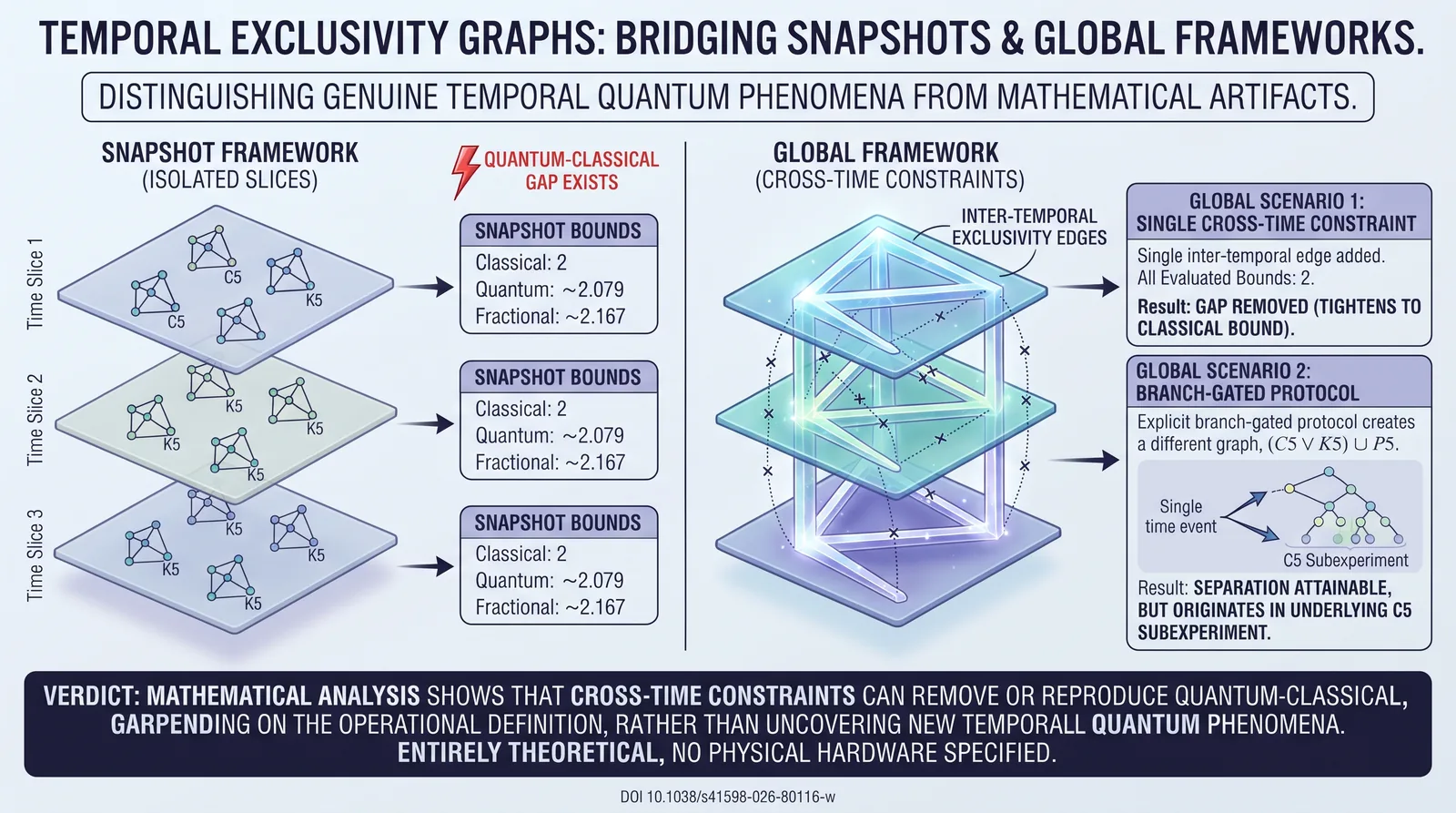
The study distinguishes two operational regimes. In the snapshot regime, exclusivity applies only within individual time slices, and the resulting time-weighted score is bounded by the weighted average of static graph parameters.
In the global regime, exclusivity relations may connect events occurring at different times. The appropriate graph-theoretic description is then a single graph whose vertices are time-stamped events, rather than a collection of independent snapshots.
The authors illustrate the distinction with a three-slice example based on the cycle graph 𝐶 5 C 5 , the path graph 𝑃 5 P 5 , and the complete graph 𝐾 5 K 5 . This construction provides a concrete mathematical setting in which snapshot-based and globally constrained temporal models can be compared.
Mathematical bounds in the snapshot framework For independent snapshots, the classical, quantum, and fractional bounds are 2, approximately 2.079, and approximately 2.167, respectively. These values show that, in the snapshot setting, the quantum and fractional bounds exceed the classical bound.
The quantum bound is calculated as ( 5 + 4 ) / 3 ( 5 +4)/3, which is approximately 2.079. The fractional bound is 13 / 6 13/6, which is approximately 2.167.
These are graph-theoretic bounds, not direct measurements from a physical experiment. They describe what is mathematically permitted under the specified exclusivity-graph framework.
Framework Classical bound Quantum bound Fractional bound Independent snapshots 2. Approximately 2.079. Approximately 2.167. Global graph with one inter-temporal exclusivity edge 2. 2. 2. Branch-gated global protocol 5/3. Approximately 1.744. 11/6. What one cross-time constraint changes Adding a single inter-temporal exclusivity edge creates a global weighted graph in which all three evaluated bounds equal 2. The classical bound remains unchanged, while the quantum and fractional bounds tighten to match it.
This result shows that a cross-time constraint can remove the snapshot-level quantum-classical gap in this particular example. It does not show that all cross-time constraints eliminate quantum-classical separation, nor does it establish a new physical temporal quantum effect.
The outcome depends heavily on how the temporal constraint is operationally defined. The same broad idea of connecting events across time can produce very different graph structures and therefore very different mathematical bounds.
Why the second protocol differs The authors also analyze an explicitly branch-gated protocol that produces a different global graph, ( 𝐶 5 ∨ 𝐾 5 ) ⊔ 𝑃 5 (C 5 ∨K 5 )⊔P 5 . This structure has weighted classical, quantum, and fractional bounds of 5/3, approximately 1.744, and 11/6, respectively.
In this second example, the quantum-classical separation is attainable within the stated idealized protocol. However, the authors identify its origin in the familiar 𝐶 5 C 5 subexperiment rather than in a new temporal quantum effect.
This is the central interpretive point: observing a quantum-classical separation in a temporal protocol does not automatically mean that time itself has produced a new quantum phenomenon. The separation may instead arise from the structure of an underlying non-temporal subexperiment.
What the study does not address The paper is theoretical and mathematical. It does not discuss physical implementation details, experimental hardware requirements, or laboratory procedures for realizing temporal exclusivity graphs in physical systems.
The authors also do not claim that their examples demonstrate new temporal quantum correlations in a physical experiment. Instead, they show that the effect of cross-time constraints depends on the operational definition of those constraints.
The work uses idealized graph-theoretic protocols and weighted graph invariants. Translating these results into laboratory tests would require specifying a physical system, measurement sequence, timing structure, noise model, and a way to implement the required exclusivity constraints.
Common misreadings It may seem that adding cross-time constraints universally uncovers new temporal quantum phenomena. In fact: in one example, a cross-time constraint removes the quantum-classical gap, while in another the separation arises from an underlying 𝐶 5 C 5 subexperiment rather than a new temporal effect.
It may seem that the reported bounds are experimental measurements. In fact: they are mathematical graph-theoretic bounds derived within idealized snapshot and global exclusivity-graph frameworks.
It may seem that the study proves that temporal quantum correlations exist in physical devices. In fact: the paper does not address physical implementation, experimental hardware, or laboratory validation.
It may seem that all global temporal frameworks behave the same way. In fact: the study shows that the global graph structure and operational definition of cross-time constraints can produce different bounds and different interpretations.
Verdict: The study demonstrates through mathematical graph-theoretic analysis how cross-time constraints and operational definitions alter classical, quantum, and fractional bounds in temporal exclusivity graphs. One example shows that a single inter-temporal exclusivity edge can remove a snapshot-level quantum-classical gap, while another shows that apparent quantum-classical separation can originate from an underlying subexperiment rather than a new temporal quantum effect. The work remains entirely theoretical and does not address physical implementation or experimental hardware requirements.
Based on reporting from Scientific Reports. This is an independent explainer, written in our own words with AI assistance; Scientific Reports has not reviewed or endorsed it. Read the original for the full details.