Mapping silicon quantum dot energy landscapes with advanced spectroscopy
Researchers demonstrated a spectroscopy approach that charts energy levels across a wide parameter space in silicon double quantum dot systems. This method matters because fully understanding orbital, spin, and valley states is essential for building reliable silicon-based quantum processors.
Reviewed by Matheus Grangeiro
- Peer reviewed
- Yes
Key numbers
4.0
Creative Commons International License version
W911NF-22-2-0037
Army Research Office Cooperative Agreement Number
W911NF-23-1-0104
Army Research Office Grant Number
10.1038/s41467-026-79672-6
Digital Object Identifier for the published article
Evidence level: Observation or measurement
Why it matters: Silicon quantum dots are a leading platform for semiconductor spin qubits, but designing and operating them requires detailed knowledge of how orbital, spin, and valley energy levels shift under electric and magnetic fields. Historically, probing that energy landscape across a wide range of operating conditions has been difficult. A spectroscopy method that directly maps these levels could make qubit characterization more systematic, helping researchers identify operating regimes, diagnose device behavior, and understand multi-electron states relevant to quantum information processing.
How spectroscopy charts energy landscapes Silicon quantum dots possess orbital, spin, and valley degrees of freedom. These degrees of freedom support several approaches to spin-qubit operation, but they also make the energy-level structure more complex than in a simple single-level system.
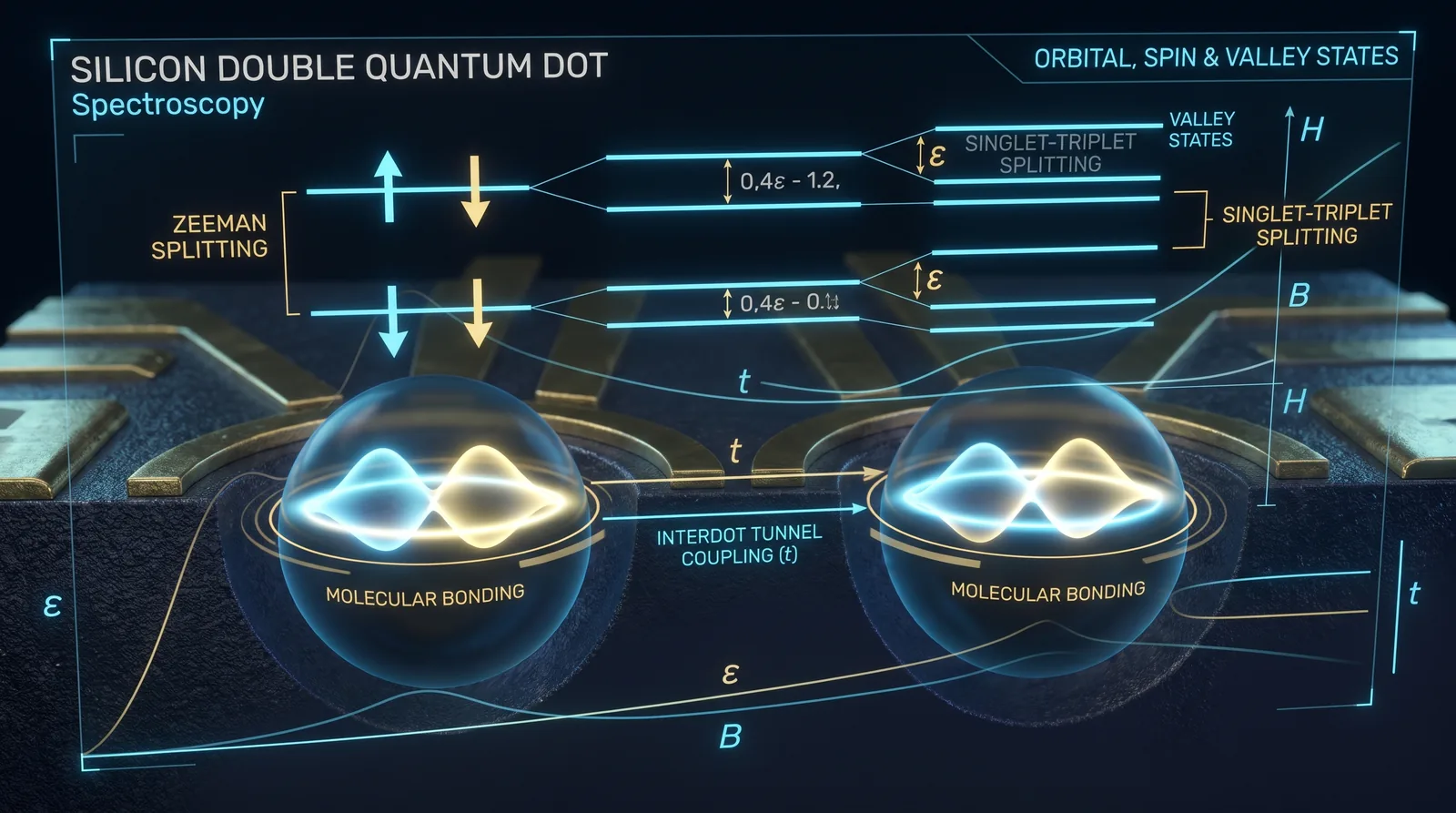
The study demonstrates a spectroscopic technique that maps the energy-level structure of a silicon double quantum dot as a function of three key control parameters: level detuning, interdot tunnel coupling, and magnetic field. This allows researchers to observe how the electronic states evolve as the two dots are brought into stronger interaction.
Rather than measuring only a narrow set of operating points, the method is designed to explore a broad parameter space. That capability is important because qubit performance can depend sensitively on detuning, tunnel coupling, magnetic field, and the detailed structure of valley states.
Single-electron molecular states In the one-electron regime, the researchers directly observed the transition from atom-like energy levels in isolated quantum dots to molecular-like bonding and anti-bonding states as interdot tunnel coupling increased. This is analogous to how two atomic orbitals combine into bonding and anti-bonding molecular orbitals when atoms are brought close together.
The observation shows that the double quantum dot can be treated as a controllable artificial molecule. By changing the tunnel coupling, researchers can tune how strongly the electron’s wavefunction is shared between the two dots, thereby changing the energy splitting between bonding and anti-bonding configurations.
This capability provides a direct way to characterize the coupling between dots, which is central to two-qubit gate operations and to understanding how electrons move or interact across a quantum-dot array.
Zeeman splitting and valley states Under an applied magnetic field, the team resolved Zeeman splitting for both ground and excited valley states. Zeeman splitting occurs because electron spin states with different orientations acquire different energies in a magnetic field.
Resolving this splitting in both ground and excited valley states is significant because silicon spin qubits rely on spin states, while valley states can introduce additional energy levels that affect qubit control and coherence. Mapping these splittings across magnetic-field conditions gives researchers a more complete picture of the device’s energy landscape.
The method therefore goes beyond simply detecting whether an electron is present in one dot or the other. It provides direct spectral information about the internal spin and valley structure of the quantum-dot system.
Two-electron singlet-triplet splitting In the two-electron regime, the technique provided access to the detuning-dependent singlet-triplet splitting. Singlet and triplet states are different two-electron spin configurations, and their energy separation is a key parameter for exchange-based two-qubit gates.
Being able to observe how this splitting changes with detuning gives researchers a way to characterize the interaction between two electrons as their spatial distribution and interdot coupling are varied. This is directly relevant to controlling two-qubit interactions in silicon spin-qubit devices.
The result does not by itself demonstrate high-fidelity qubit gates or a scalable quantum processor. It demonstrates that the spectroscopy method can resolve energy-level features that are important inputs for designing and calibrating such operations.
What the prototype demonstrates The work demonstrates a measurement and characterization method on a silicon double quantum dot device supplied by Intel Corporation. The published article acknowledges Intel for providing the device and lists technical discussions with Nathan Bishop, Joelle Corrigan, Matthew Curry, and Rene Otten.
The research was sponsored by the Army Research Office under Cooperative Agreement W911NF-22-2-0037 and Grant W911NF-23-1-0104. The authors state that the views and conclusions are their own and should not be interpreted as representing the policies of the Army Research Office or the U.S. government.
The method may be extendable beyond silicon quantum dots. The authors suggest that it could be applied to broader classes of systems, including materials with strong spin-orbit coupling and proximitized quantum dots, where direct extraction of energy gaps would be valuable.
What remains unproven The study does not report commercial manufacturing yield, production timelines, or evidence that the spectroscopy approach has been integrated into a commercial quantum processor. The experiment was performed on a specialized prototype device, not on a production-scale quantum computing platform.
The available article information also does not establish absolute precision limits for the measured energy levels, measurement speed, scalability across large qubit arrays, or performance under the full range of conditions encountered in a real quantum computer. These are important questions for determining whether the method can become a standard industrial characterization tool.
The result should therefore be understood as a demonstration of a powerful diagnostic technique, rather than as evidence that silicon quantum-dot processors have overcome their scaling or manufacturing challenges.
Common misreadings It may seem that this spectroscopy method is already integrated into commercial quantum processors. In fact: the study evaluates a prototype setup using a specialized device supplied by Intel Corporation and does not address commercial manufacturing yield or deployment timelines.
It may seem that observing bonding and anti-bonding states proves that the system can perform high-fidelity two-qubit gates. In fact: the study characterizes energy levels and singlet-triplet splitting, but does not report gate fidelity or full processor-level performance.
It may seem that the method measures all qubit-relevant properties automatically. In fact: it maps energy-level structure as a function of detuning, tunnel coupling, and magnetic field; it does not by itself establish scalability, speed, or precision limits across large arrays.
It may seem that the technique is limited to silicon. In fact: the authors propose that the approach could be extended to strong spin-orbit materials and proximitized quantum dots, although those extensions remain prospective rather than demonstrated.
Verdict: The study successfully demonstrated a spectroscopy approach for directly mapping complex energy levels, molecular-like bonding and anti-bonding states, Zeeman splitting, and detuning-dependent singlet-triplet splitting in silicon double quantum dots. However, because absolute precision limits, measurement throughput, scalability metrics, and commercial integration remain unmeasured, its immediate utility is restricted to prototype-scale device characterization rather than production quantum-computing deployment.
Source: Nature Communications. The original is licensed CC BY. This text is an AI-assisted adaptation (summarized, simplified and translated) and may differ from the original.