Tracking a Mystery Beep With an AI-Built Acoustic Array
An author experiencing a mysterious intermittent beeping sound built a software application using Claude Code to locate it. By coordinating multiple household devices, the system triangulated the sound and found an old carbon monoxide detector within roughly 40 centimeters.
Reviewed by Matheus Grangeiro
Key numbers
40cm
Localization accuracy achieved by the system
2007year
Publication year of the BeepBeep paper
60seconds
Duration of the recent audio buffer recorded by listeners
0.6seconds
Time offset before the beep for uploaded audio clips
0.8seconds
Time offset after the chirp for uploaded audio clips
5.5version
Opus model version used initially
5.2version
Fable model version released during the project
3.8version
Qwen model version mentioned in recent articles
Evidence level: Prototype or demonstration
Why it matters: Locating intermittent, hidden sounds in cluttered spaces is difficult using human hearing alone, affecting anyone trying to track down failing batteries or forgotten devices. A software-based approach that turns ordinary consumer devices into a temporary acoustic sensor network could make such searches more systematic.
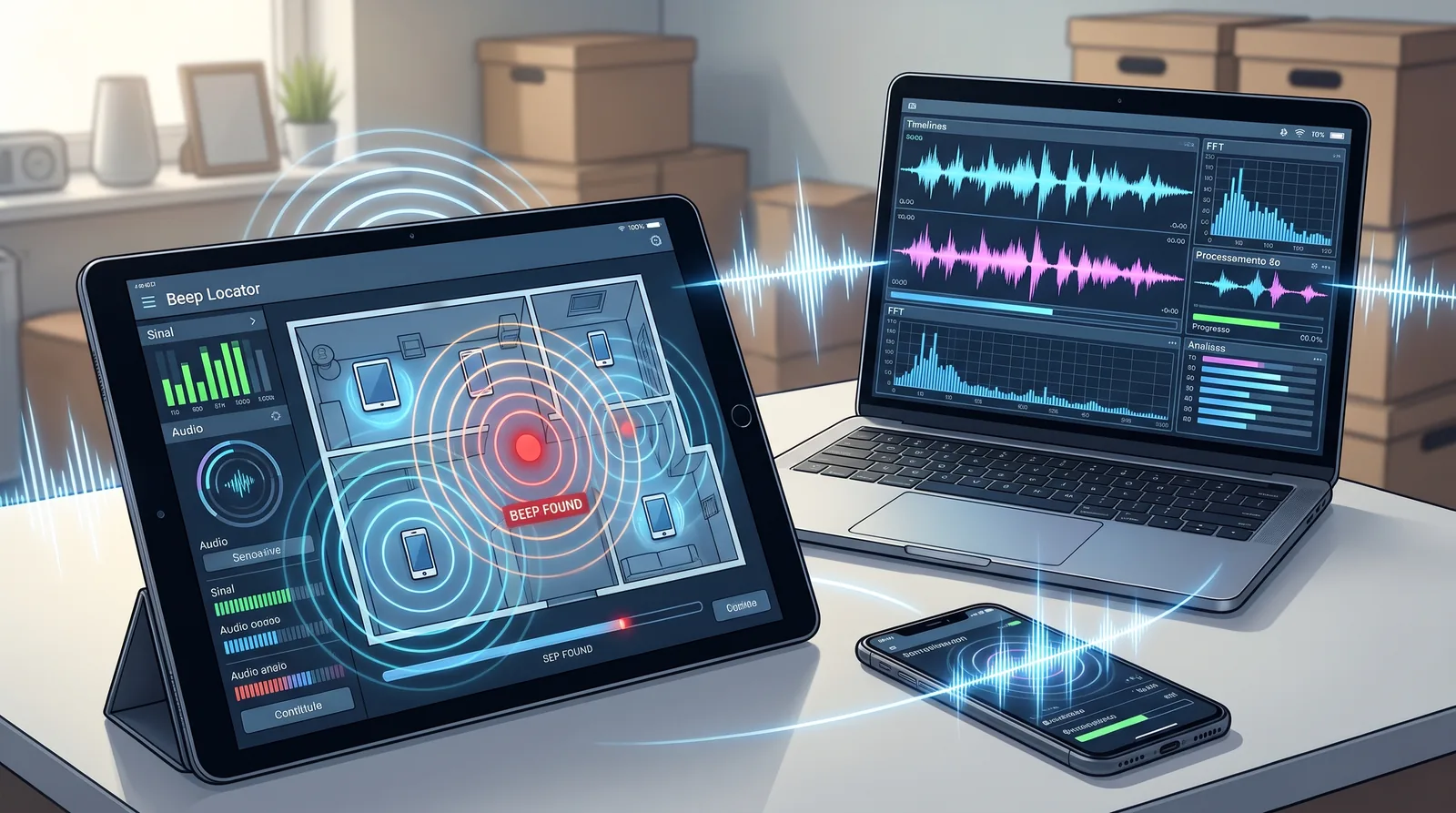
How multiple household devices listen and coordinate The hardware setup included two iPads, a smartphone, a MacBook Pro and a Surface Ultra serving as listening units. They connected through a browser to a Python web server, accessed by URL or QR code, and communicated with the server over WebSockets while using browser microphone access.
Development began in Claude Code Cloud on an iPhone, using Opus 5.5 in “Extra thinking effort” mode, before the work continued locally on a laptop after Fable 5.2 was released. An installModule() method allowed the administrative server to push and execute new code on listening devices through WebSockets, avoiding the need to reload or manually reconfigure each device.
Listening nodes maintained a 60-second rolling audio buffer and ran a beep-detection algorithm based on a Fast Fourier Transform and high-pass filtering. When a candidate beep was reported, the server made the device with the lowest round-trip time play a short chirp; every listener then uploaded an audio clip spanning approximately 0.6 seconds before the beep to 0.8 seconds after the chirp. The chirp provided a common timing reference for aligning the clips.
Adapting academic acoustic ranging into a practical tool The system drew on BeepBeep: A High-Accuracy Acoustic-Based System for Ranging and Localization Using COTS Devices, a 2007 paper by Chunyi Peng, Guobin Shen, Yongguang Zhang, Yanlin Li and Kun Tan. BeepBeep uses software-based acoustic ranging with commodity hardware—a speaker, a microphone and device-to-device communication—rather than specialized infrastructure.
Beep Locator adapted that principle for a household setting: several ordinary devices listened simultaneously, exchanged timing references through chirps and contributed recordings that could be aligned and used to estimate the beep’s likely position. The result was a temporary, software-defined acoustic sensor array rather than a permanently installed hardware system.
Evaluating the prototype’s performance and limitations The system replaced manual searching by ear with multi-device acoustic localization. It was tested in a cluttered storage room, where an intermittent beep had been difficult to trace among boxes. The user first used a “Rough mode” to place listener icons at approximate positions, after which the system refined those positions using the devices’ exchanged sounds.
A clapping mode provided a controlled way to validate the localization workflow: claps appeared as distinct map markers, and replaying recordings from individual devices helped identify which captured sound was the target beep. Once the user confirmed the beep’s frequency, the system measured the interval between occurrences and used the aligned multi-device recordings to estimate its most likely location.
In the reported demonstration, the system located the source within about 40 centimetres, leading to the discovery of an old carbon monoxide detector that needed replacement batteries. This is a single successful demonstration rather than a measured average across repeated trials, and the exact financial cost and algorithm execution time were not reported.
What the consumer hardware setup does not show It may seem that the system operates using specialized acoustic hardware installed throughout the building. In fact: the setup relies entirely on ordinary consumer electronics—tablets, phones and laptops—acting as temporary listening nodes.
The initial automated device-positioning approach did not perform well enough on its own; the user supplied rough positions manually, which the system then refined acoustically.
The reported result does not establish accuracy across rooms, device configurations, beep frequencies, reverberant spaces or high-background-noise environments.
The system depends on browser microphone permissions, WebSocket connectivity and user confirmation of the target sound; it is not an autonomous, plug-and-play consumer product.
Verdict: The application successfully coordinated multiple consumer devices to estimate and locate an intermittent household beep within roughly 40 centimetres in one demonstration. However, it relied on an ad-hoc prototype workflow, approximate manual placement of listeners and iterative refinement; its robustness under high background noise, different room geometries and repeated trials remains untested.
Based on reporting from Simon Willison. This is an independent explainer, written in our own words with AI assistance; Simon Willison has not reviewed or endorsed it. Read the original for the full details.