Automating Robot Code Generation Through Simulation and Agentic AI
Researchers introduced agentic robotics, a methodology where teams of artificial intelligence agents write, test, and debug robot operation software in simulation. This approach bypasses traditional heavy manual programming and large data requirements, successfully updating commercial parcel-sorting fleets.
Reviewed by Matheus Grangeiro
Key numbers
100,000years
data gap preventing robots from gaining real-world skills quickly
less than an hourhour
time taken by AI tool to create and fine-tune a physics simulation
15,000packages
increased annual sorting capacity per robot at Ambi Robotics
30percent
portion of Ambi Robotics U.S. fleet running the updated behavior
40years
Ken Goldberg's career duration in robotics
1993year
public release of the World Wide Web
2022year
debut of ChatGPT
Evidence level: Prototype or demonstration
Why it matters: Physical robots have long demanded exhaustive data collection and hand-tuned behaviors, a bottleneck that Ken Goldberg of the University of California, Berkeley, has described as a 100,000-year data gap relative to the internet-scale corpora that taught language models to write. Agentic robotics, in which coding agents write and debug control software in simulation, offers a route around that gap without collecting additional demonstrations.
How agentic robotics automates code generation and simulation
Goldberg and Spencer Huang, director of robotics engineering at NVIDIA, together with colleagues, propose that groups of artificial intelligence (AI) agents can write robot-control programs, rehearse them in simulated environments and revise the code when it fails. The approach targets two obstacles at once: the enormous datasets required to train robots and the intensive engineering required to program them by hand.
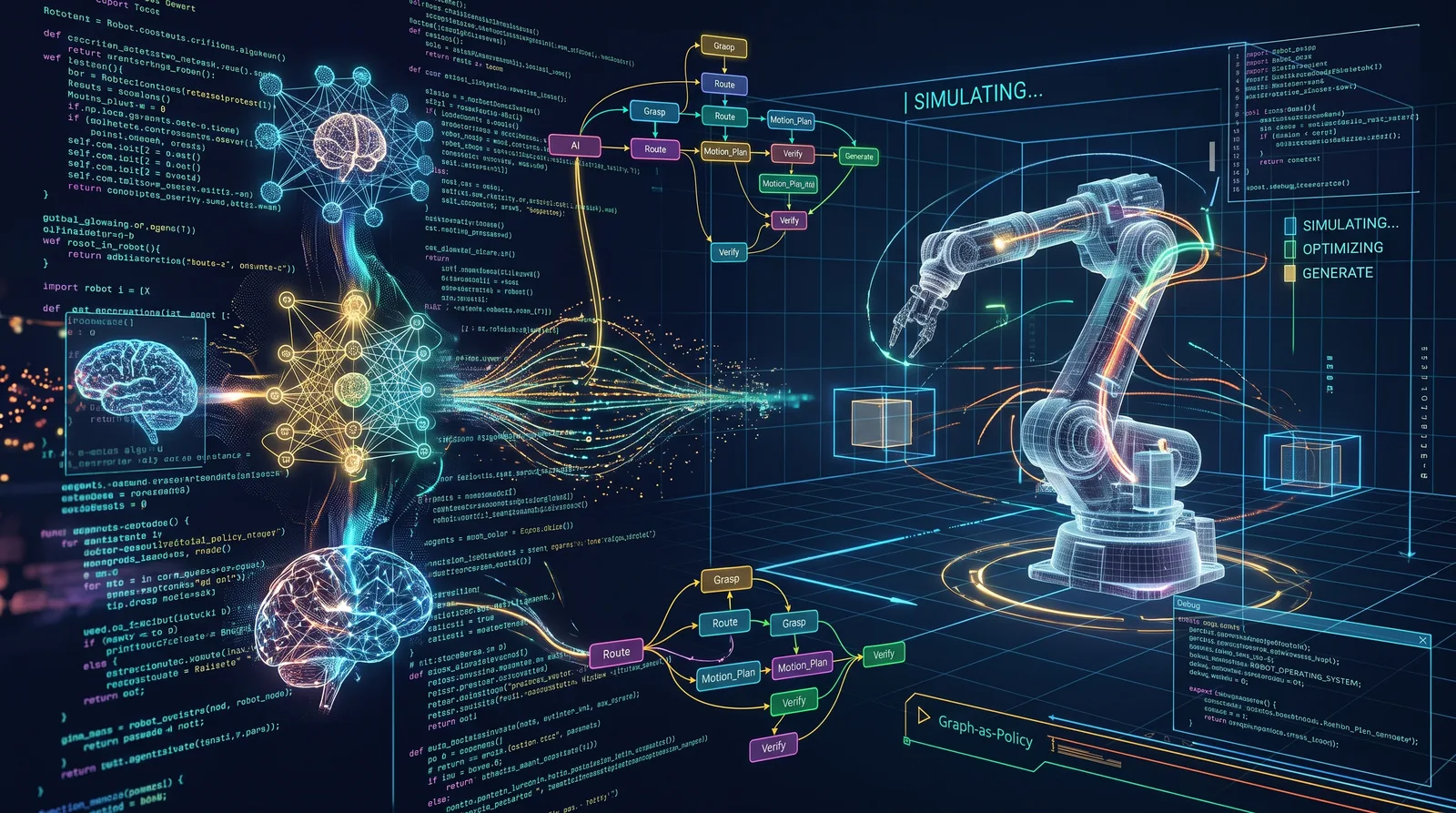
Its enabling device is a framework termed Graph-as-Policy (GaP). Rather than asking one large model to emit an entire program, GaP decomposes a task into modular skills (locating an object, planning a grasp, moving the gripper without collisions) and links them as nodes in a directed graph. Each node can be assigned to a separate agent, which keeps individual context windows small; generation is also separated from testing, a design choice intended to discourage agents from gaming their objectives.
A demonstration illustrates the pipeline. Postdoctoral researchers Eric Kaiyuan Chen and Shuangyu Xie gave OpenAI’s Astra model access to a simulation interface and a short video of a robot wiping ink from a metal bar with a sponge. In under an hour, the model built and tuned a physics simulation that reproduced the footage, including realistic sponge deformation. Supplied with that simulation and the GaP framework, it then wrote, tested and repeatedly refined a control program; executed on a physical robot, the code succeeded.
Evaluating the shift from physical data collection to automated simulation
Robot software creation thus moves from manual adjustment to automated program generation with human verification. The shift matters because both conventional routes are costly. Model-based robotics, in which engineers program perception, motion planning and control directly, demands extensive engineering; model-free imitation learning, in which robots learn from demonstrations, demands data and time that cannot easily be collected at scale. Goldberg positions agentic robotics as the missing link between the two, one that requires no additional data because its product is interpretable code that engineers can inspect, fine-tune and verify.
Failure, in this framework, becomes usable evidence. In one trial the robot toppled the metal bar because it had not reliably inferred the bar’s mass. Footage of the misstep allowed the agent to correct its simulation, revise the control program and test a new approach. The episode also exposes the central vulnerability of simulation-based development: small errors in friction, mass or contact behavior can turn a policy that succeeds virtually into one that fails on hardware.
Reported performance suggests that the loop is effective. According to IEEE Spectrum, agentic approaches reached success rates of up to 99 percent in Berkeley’s testing, matching human hand-engineered programs, on tasks where baseline imitation learning succeeded only about 20 percent of the time.
From industrial testing to commercial parcel sorting fleets
Ambi Robotics, a Berkeley-based logistics company whose co-founders include Goldberg and chief technology officer Jeff Mahler, applied the methods earlier this year to parcel-sorting records, testing behavioral revisions before release. Tests showed a capacity gain of more than 15,000 packages sorted annually per robot, and the update is now deployed across 30 percent of the company’s United States fleet. Mahler stated that the approach converted production data into behavioral updates while keeping engineers in control. The company separately reports that its agents resolved a package-placement problem in about ten hours that would have occupied engineers for several weeks.
The team is also releasing open-source code built on NVIDIA’s Isaac simulation framework, together with an industry-standard benchmark for evaluating robot performance across industrial tasks. Other laboratories can therefore test the method and compare results on common ground. The work was presented at the 2026 Conference on Robot Learning in Austin, Texas, and the framework is described in an arXiv preprint (arXiv:2607.05369).
What remains unknown about computational requirements and error rates
The computational costs and hardware requirements of running teams of AI agents remain unspecified. Operating several models simultaneously for code generation, simulation building and debugging demands considerable computing power, yet no figures appear in the public reports.
Error statistics are similarly sparse. The press materials do not state how often simulated debugging fails before a physical execution succeeds, nor what margins of error accompany simulation-to-real transfer. Because the deployment evidence is company-reported and derives from tests rather than measured fleet output, these missing figures leave the headline gains difficult to interpret.
What the fleet deployment does not show It may seem that robots can now autonomously learn any physical task in home environments. In fact: home assistants are not yet ready to fold laundry, and Goldberg cautions against expecting otherwise soon. The gains were obtained in industrial settings, where tasks are repetitive and performed at scale; as Huang observes, developing robots for real-world environments remains slow, data-intensive and difficult to scale. Self-improvement of key task elements is a genuine advance, but it has not been shown to survive the variability of domestic spaces.
Verdict: Under controlled industrial conditions, combining modular control graphs generated by artificial intelligence agents with simulation-based refinement is reported to yield executable robot programs and higher parcel-sorting throughput. However, applicability to unstructured household tasks, such as laundry folding, remains to be demonstrated.
Based on reporting from UC Berkeley. This is an independent explainer, written in our own words with AI assistance; UC Berkeley has not reviewed or endorsed it. Read the original for the full details.