Simulating flaw detection in additive manufacturing with deep learning
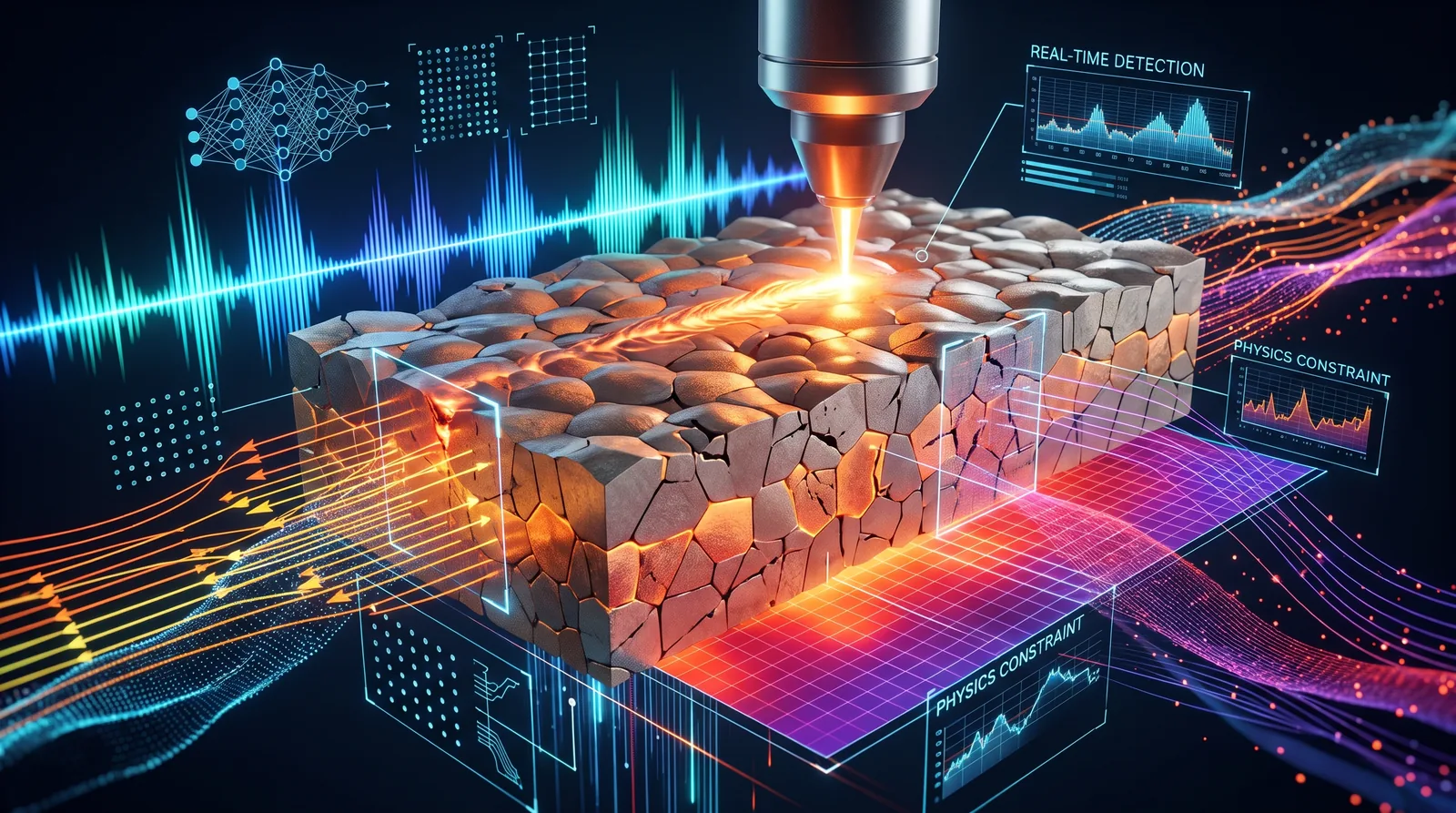
Researchers introduced a physics-informed multimodal deep learning architecture called MCAT-Phys to detect manufacturing anomalies. This matters because flaw detection remains a primary obstacle for commercializing solid-state additive manufacturing.
Reviewed by Matheus Grangeiro
- Peer reviewed
- Yes
Key numbers
5folds
five-fold cross-validation used for statistical robustness analysis
94.2%
accuracy achieved by the MCAT-Phys framework
0.88
F1-score achieved by the MCAT-Phys framework
0.97
AUROC achieved by the MCAT-Phys framework
0.96
AUPRC achieved by the MCAT-Phys framework
30%
reduction in false negatives in error analysis
40%
improvement in crack-boundary continuity
4.0
Creative Commons International License version
Evidence level: Computational model evaluated on process and microscopy data; not an industrial deployment
Why it matters: Thermal and mechanical interactions during layer-by-layer fabrication can generate defects in solid-state additive manufacturing (SSAM) that conventional monitoring tools may miss. Signal-based methods can be insensitive to subtle defect precursors, while image-based inspection is often limited to offline validation. A framework that combines process signals with microstructural information could improve early defect identification and crack-boundary characterization.
How MCAT-Phys fuses multimodal signals and physical constraints Tulala Rajasanthosh Kumar, Palaniradja Kichena and Pramod Singh Rathore proposed MCAT-Phys, a physics-informed multimodal cross-attention Transformer framework for defect detection and process monitoring in solid-state additive manufacturing. The model learns joint relationships among acoustic-emission, torque and infrared-thermography signals, together with microstructural information from field-emission scanning electron microscopy (FESEM) and optical microscopy.
The framework incorporates process metadata and physical constraints into its cross-modal fusion. Rather than treating acoustic, mechanical, thermal and imaging channels independently, MCAT-Phys is designed to relate process dynamics to microstructural evidence of process-induced defects.
Statistical validation used five-fold cross-validation, confidence-interval analysis and paired t-tests. These procedures were used to assess the robustness and statistical significance of the model’s reported performance.
Benchmarking MCAT-Phys against unimodal baselines The authors compared MCAT-Phys with conventional unimodal baselines—CNN, ResNet and U-Net—and with more advanced unimodal models: a Temporal Transformer for process signals and SegFormer for microstructural images. The comparison tested whether cross-modal fusion outperformed architectures that relied on a single data stream.
MCAT-Phys achieved 94.2% accuracy, an F1-score of 0.88, an AUROC of 0.97 and an AUPRC of 0.96, outperforming the evaluated unimodal baselines. Error analysis indicated an approximately 30% reduction in false negatives and an approximately 40% improvement in crack-boundary continuity.
These results support the authors’ argument that physics-informed cross-modal fusion can improve defect monitoring, but they do not by themselves demonstrate that the gains arise solely from the physical constraints. The reported comparison supports the multimodal architecture’s advantage over the tested unimodal alternatives.
Evaluating the model’s performance and current limits Achieving defect-free SSAM remains difficult because thermomechanical interactions during layer construction can create defects that are hard to capture with conventional monitoring. Signal-only models may overlook subtle precursors, while image-based approaches often provide fine morphological detail but are generally used in offline validation.
MCAT-Phys addresses this limitation by combining acoustic emission, torque, infrared thermography, microstructural imaging and process metadata. The framework is presented as a promising and interpretable basis for SSAM defect monitoring, rather than as a finished industrial monitoring system.
Despite strong reported metrics, the work remains a computational framework that has not been validated across the range of machines, materials and processing conditions required for factory deployment. The authors explicitly state that further validation across machines, materials and processing conditions is needed before industrial implementation.
Open questions regarding materials, machinery, and computational cost The available article record does not specify the exact materials, machine types or processing conditions used in the experimental setup. Without these details, independent researchers cannot readily reproduce the precise baseline environment or assess how sensitive the results are to particular equipment and material systems.
The computational cost, latency and inference time required to operate MCAT-Phys during live manufacturing are also not quantified in the available record. Although the title refers to real-time monitoring, the study does not demonstrate real-time deployment on an active production line.
What the model stage does not show It may seem that MCAT-Phys is already deployed in commercial factories to monitor live additive manufacturing. In fact: the study evaluates a computational framework and states that broader validation across machines, materials and processing conditions is required before industrial implementation.
The reported metrics come from the authors’ benchmarking protocol, not from an independent industrial trial or a production-line deployment.
The claimed real-time capability remains to be demonstrated under factory conditions, including the required inference speed, sensor integration and robustness to industrial electromagnetic, thermal and acoustic interference.
The reported reduction in false negatives concerns the evaluated dataset and model comparison; it does not establish performance across unseen factories, alloys, process windows or defect types.
Verdict: The study reports that a physics-informed multimodal deep-learning framework can outperform tested unimodal baselines for defect detection in solid-state additive manufacturing, achieving 94.2% accuracy, an F1-score of 0.88, an AUROC of 0.97 and an AUPRC of 0.96. However, the work is not an industrial deployment or simulation; broader validation across machinery, materials, processing conditions and real-time operating constraints is required before commercial use.
Based on reporting from Scientific Reports. This is an independent explainer, written in our own words with AI assistance; Scientific Reports has not reviewed or endorsed it. Read the original for the full details.