Pricing updates and performance shifts in recent artificial intelligence model releases
OpenAI has rolled out two new artificial intelligence model variants along with an updated software tool version. Early evaluations reveal distinct pricing changes and specific behavioral quirks during complex tasks.
Reviewed by Matheus Grangeiro
Key numbers
6.2
GPT model version
0.38
LLM software version
80percent
Price proportion relative to previous model
8dollars per million tokens
40dollars per million tokens
5.2
Competing model version
10dollars per million tokens
50dollars per million tokens
Evidence level: Prototype or demonstration
Why it matters: Users adopting new generative AI model versions face changing application programming interface costs, uncertain performance trade-offs, and limited public information about architectural changes. OpenAI’s release of GPT-6.2 Astra and GPT-6.2 Sol introduces two distinct API-accessible models: Astra is positioned for demanding projects, while Sol is positioned as an efficient, versatile option for everyday work. The available evidence supports claims about pricing and early informal evaluations, but not claims of broad benchmark superiority or detailed architectural improvements.
How the new variants are accessed and priced OpenAI made GPT-6.2 Astra and GPT-6.2 Sol available through its API under the identifiers gpt-6.2-astra and gpt-6.2-sol. The LLM software tool version 0.38 added support for both models.
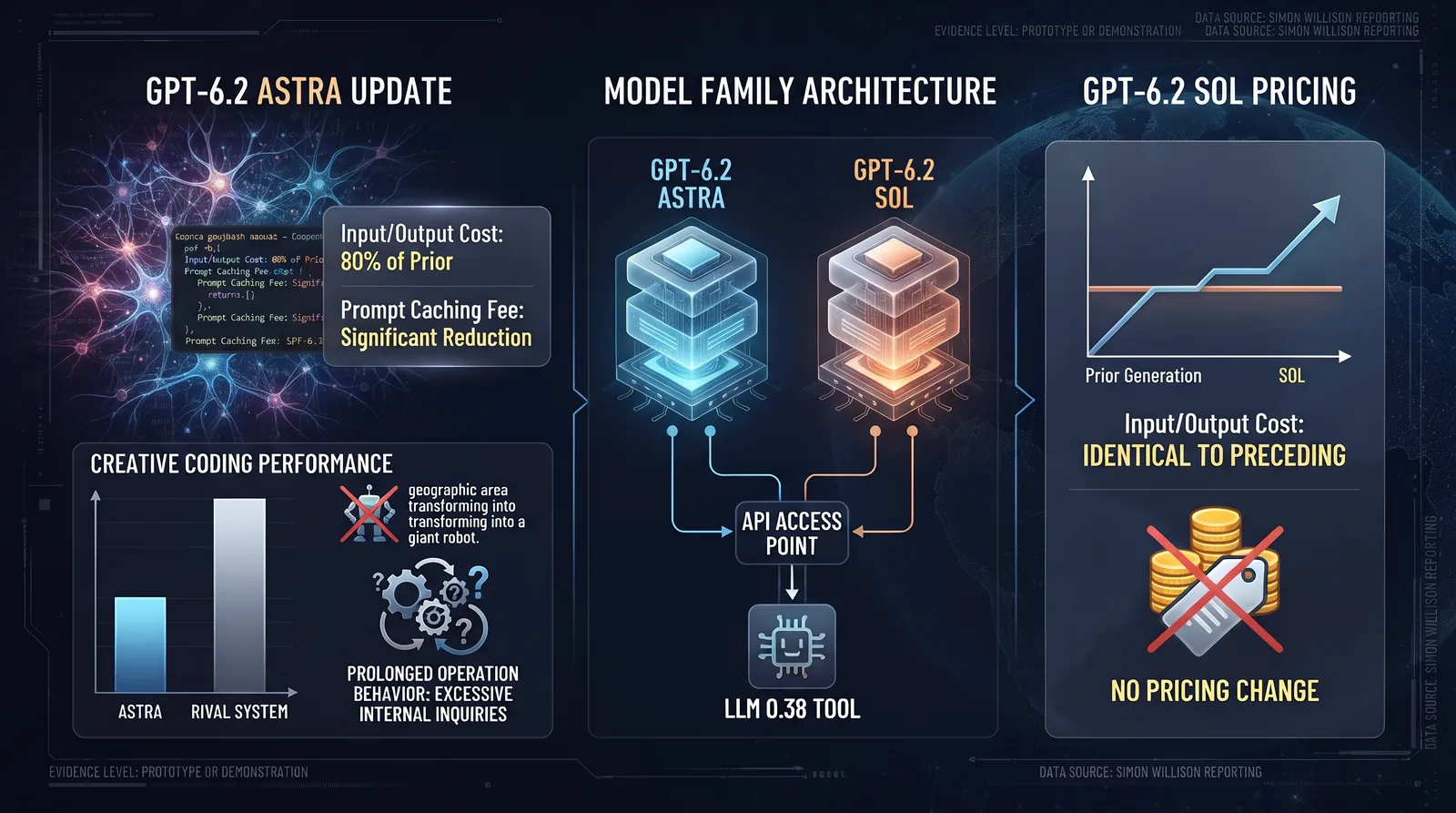
GPT-6.2 Astra is priced at $8 per million input tokens and $40 per million output tokens. This is 80% of the price of the prior GPT-6 Astra model, which was priced at $10 per million input tokens and $50 per million output tokens.
Astra’s cached-input price is $0.40 per million tokens, down from $1 per million tokens for the previous version. This reduction is particularly relevant for longer-running agentic sessions, where repeated context and prompt caching can affect total cost.
GPT-6.2 Sol retains the same pricing as GPT-6.1 Sol and GPT-6 Sol: $2 per million input tokens and $10 per million output tokens. This is half the price of GPT-5.6 Sol, which was priced at $4 per million input tokens and $20 per million output tokens.
Model Input price per million tokens Output price per million tokens Cached-input price per million tokens GPT-6.2 Astra $8. $40. $0.40. GPT-6 Astra $10. $50. $1. GPT-6.2 Sol $2. $10. Not specified in the source. GPT-6.1 Sol / GPT-6 Sol $2. $10. Not specified in the source. What the early evaluations show The reviewer generated pelican images using both GPT-6.2 Sol and GPT-6.2 Astra, including high, extra-high, and maximum effort settings. These outputs provide an informal visual comparison, not a standardized benchmark across a broad set of image-generation tasks.
The reviewer also ran a creative coding prompt using “Ultra” effort levels in the Codex CLI. The prompt asked for a Three.js animation in which Yonkers stands up as a large mech and moves through Manhattan, Queens, and Brooklyn using OpenStreetMap data.
Neither GPT-6.2 Sol nor GPT-6.2 Astra produced a result the reviewer considered good enough at morphing Yonkers into a large mech, especially compared with Claude Fable 5.2 and Gemini 4 Carbon. This is an informal qualitative assessment of one creative coding task, not evidence that the models are generally inferior for all coding workloads.
The reviewer also created a comparison video showing Astra and Sol animations side by side. The video was generated using GPT-6.2 Astra at the Ultra effort level in the Codex desktop app.
What the release does not disclose The release information does not provide comprehensive benchmark suites or standardized test metrics comparing GPT-6.2 Astra and Sol against the entire market. It also does not specify detailed technical architecture changes or exact parameter counts for either model.
The available evidence therefore cannot establish that Astra is better than competing frontier models across all tasks. It can only support limited observations about pricing, API availability, and selected informal evaluations.
The reviewer notes that the initial reception is mixed. Astra is reported not to score as highly as Claude Fable 5.2 on various benchmarks, though the source does not provide the underlying benchmark results or methodology.
Communication behavior during long tasks Early evaluators reported that GPT-6.2 Astra may ask confusing questions about internal implementation details during prolonged operations. Theo Browne’s pre-release feedback to OpenAI included an example in which the model became blocked after two hours and asked about an internal file-naming detail that the user could not reasonably understand or influence.
This is a reported user-experience issue, not a controlled measurement of communication quality. It suggests that Astra’s behavior during long agentic tasks may require further refinement, but it does not establish how often the problem occurs or how it compares systematically with other models.
The source also states that Astra can pull in many subagents and manage them reasonably well during long tasks. This observation is qualitative and should not be interpreted as a validated benchmark result.
Pricing consistency across model families It may seem that all new model variants feature reduced pricing structures. In fact: GPT-6.2 Astra has lower input, output, and cached-input prices than its predecessor, while GPT-6.2 Sol retains the same pricing as earlier Sol versions.
It may seem that Astra’s lower price proves it is more cost-effective for every workload. In fact: cost-effectiveness depends on token volume, caching behavior, task complexity, latency requirements, and the quality needed for a given application.
It may seem that the creative coding comparison proves Astra and Sol are generally inferior to Claude Fable 5.2 and Gemini 4 Carbon. In fact: it reflects one informal Three.js animation prompt evaluated by one reviewer, not a standardized benchmark across coding tasks.
It may seem that the reported communication issue is a verified, quantified defect. In fact: it is an early evaluator’s reported experience, not a controlled study measuring the frequency or severity of the behavior.
Verdict: OpenAI’s release of GPT-6.2 Astra and GPT-6.2 Sol provides updated API access and a meaningful price reduction for Astra, including an 80% reduction in cached-input cost. However, early informal evaluations show that Astra may trail competing systems on selected creative coding tasks and may exhibit confusing communication behavior during prolonged operations. The release does not provide comprehensive benchmarks, architecture details, or parameter counts, so broad performance claims remain unverified.
Based on reporting from Simon Willison. This is an independent explainer, written in our own words with AI assistance; Simon Willison has not reviewed or endorsed it. Read the original for the full details.