Google launches Gemini 4 Hydrogen with an unusual pricing strategy
Google has released a new artificial intelligence model named Gemini 4 Hydrogen, designed to handle routine programming and power search features. However, its current launch pricing sits just twenty-five percent below its more powerful counterparts before a planned price restructuring.
Reviewed by Matheus Grangeiro
Key numbers
12day
Launch date of Gemini 4 Hydrogen
4generation
Gemini model family version
1month
Price doubling schedule date
25%
Current discount of Hydrogen compared to peers
75%
Future discount of Hydrogen after December 1st
5.5version
Claude Haiku version
6version
GPT version
0.10USD
Price of Claude Haiku 5.5 and GPT-6 Luna
Evidence level: Product announcement and independent pricing analysis
Why it matters: Routine programming tasks, test execution and search-related AI features require models that are fast and inexpensive enough for high-volume use. Pricing can determine whether a model is practical for everyday work, even when it offers strong capabilities.
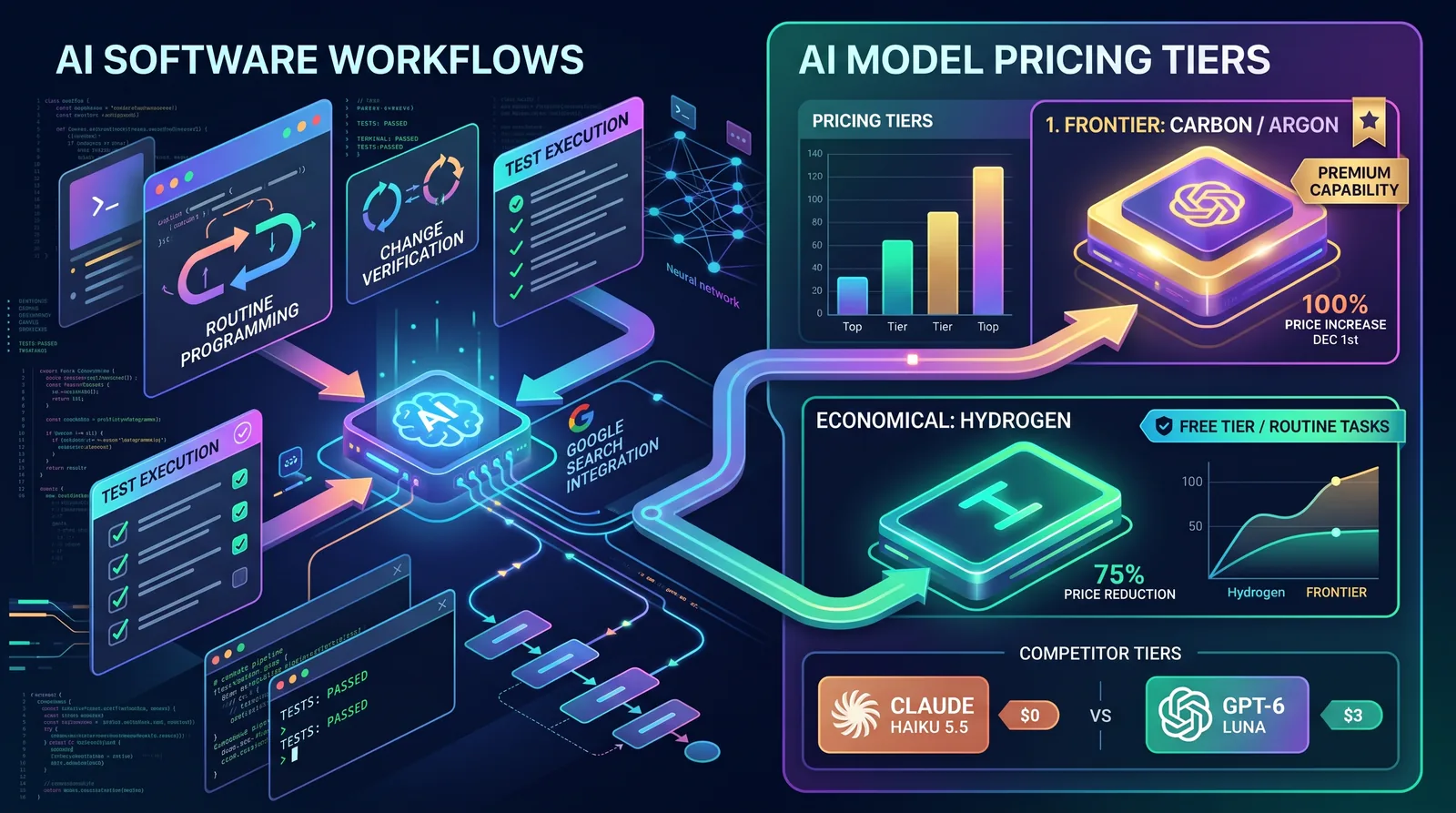
How Gemini 4 Hydrogen handles routine tasks and search integration Google launched Gemini 4 Hydrogen on 12 November 2026 as the lowest-cost member of the Gemini 4 family. It is intended to handle everyday work independently or to serve as a high-efficiency execution model alongside the more capable Carbon and Argon models in multi-model workflows.
Google positions Hydrogen for software-development tasks such as writing code, running tests and verifying changes, while Carbon and Argon are intended for deeper architectural judgement and difficult debugging. Hydrogen is also the new free-tier model and will power AI features in Google Search.
Google says that Argon delivers Gemini 4 intelligence with faster responses and lower token use per turn than Carbon. The announcement does not make the same “identical intelligence” claim for Hydrogen.
Pricing disparities between Gemini 4 variants and competitors At launch, Gemini 4 Hydrogen costs US$ 1.50 per million input tokens and US$ 7.50 per million output tokens. Carbon and Argon both cost US$ 2.00 per million input tokens and US$ 10.00 per million output tokens until 30 November 2026.
From 1 December 2026, Carbon and Argon are scheduled to double to US$ 4.00 per million input tokens and US$ 20.00 per million output tokens. Hydrogen’s listed price remains US$ 1.50 and US$ 7.50, making it 75% cheaper than Carbon and Argon after that date.
At launch, however, Hydrogen is only 25% cheaper than Carbon and Argon. Its relative discount therefore triples after 1 December—not because Hydrogen becomes cheaper, but because its siblings become more expensive.
Claude Haiku 5.5 and GPT-6 Luna are priced at US$ 0.10 per million input tokens and US$ 0.50 per million output tokens. Hydrogen is therefore 15 times more expensive than either competitor on both input and output pricing.
Evaluating the market positioning and visual generation Willison describes Gemini 4’s pricing as confusing because Carbon and Argon have identical list prices despite being different models. The practical difference may lie in token consumption: Argon is advertised as using fewer tokens per turn, which could reduce total cost even at the same per-token rate.
The author also tested image generation across the Gemini 4 family. He found the difference in pelican-image quality for Hydrogen “quite stark,” especially considering how close its launch price is to Carbon and Argon.
This observation is anecdotal and based on a specific image-generation test. It does not establish a general ranking of visual quality across prompts, aspect ratios, image types or repeated generations.
What the launch pricing does not show about market value It may seem that Gemini 4 Hydrogen is competitively priced from day one. In fact: it is 15 times more expensive than Claude Haiku 5.5 and GPT-6 Luna at launch, although it becomes 75% cheaper than Carbon and Argon after 1 December.
The published prices do not establish total cost of ownership: token consumption, caching, latency, failure rates, workflow integration and the need for a more capable model can all affect real-world expense.
The announcement does not provide independent benchmark results, reliability measurements or evidence that Hydrogen matches Carbon or Argon on coding, search or general reasoning tasks.
Willison’s pelican comparison is a single qualitative test, not a systematic evaluation of image-generation quality.
Hydrogen’s role as the free-tier and Google Search model does not by itself establish that it is suitable for production software engineering, autonomous agents or high-stakes automated workflows.
Verdict: Google launched Gemini 4 Hydrogen as a lower-cost model for routine coding, test execution, change verification, the free tier and Google Search AI features. At launch it costs US$ 1.50 per million input tokens and US$ 7.50 per million output tokens—25% less than Carbon and Argon, but 15 times more than Claude Haiku 5.5 and GPT-6 Luna; after 1 December, it becomes 75% cheaper than its Gemini 4 siblings.
Based on reporting from Simon Willison. This is an independent explainer, written in our own words with AI assistance; Simon Willison has not reviewed or endorsed it. Read the original for the full details.