Pinball Machines Teach Science to Students in Brazil
A university extension project uses pinball machines to teach science and programming concepts to public school students. The evidence so far consists of planned activities and upcoming research rather than finished test results.
Reviewed by Matheus Grangeiro
In short: A university extension project uses pinball machines to teach science and programming concepts to public school students. The evidence so far consists of planned activities and upcoming research rather than finished test results.
Flashing lights and rolling metal balls might hold the secret to understanding physics, electricity, and programming.
What happened, in plain words
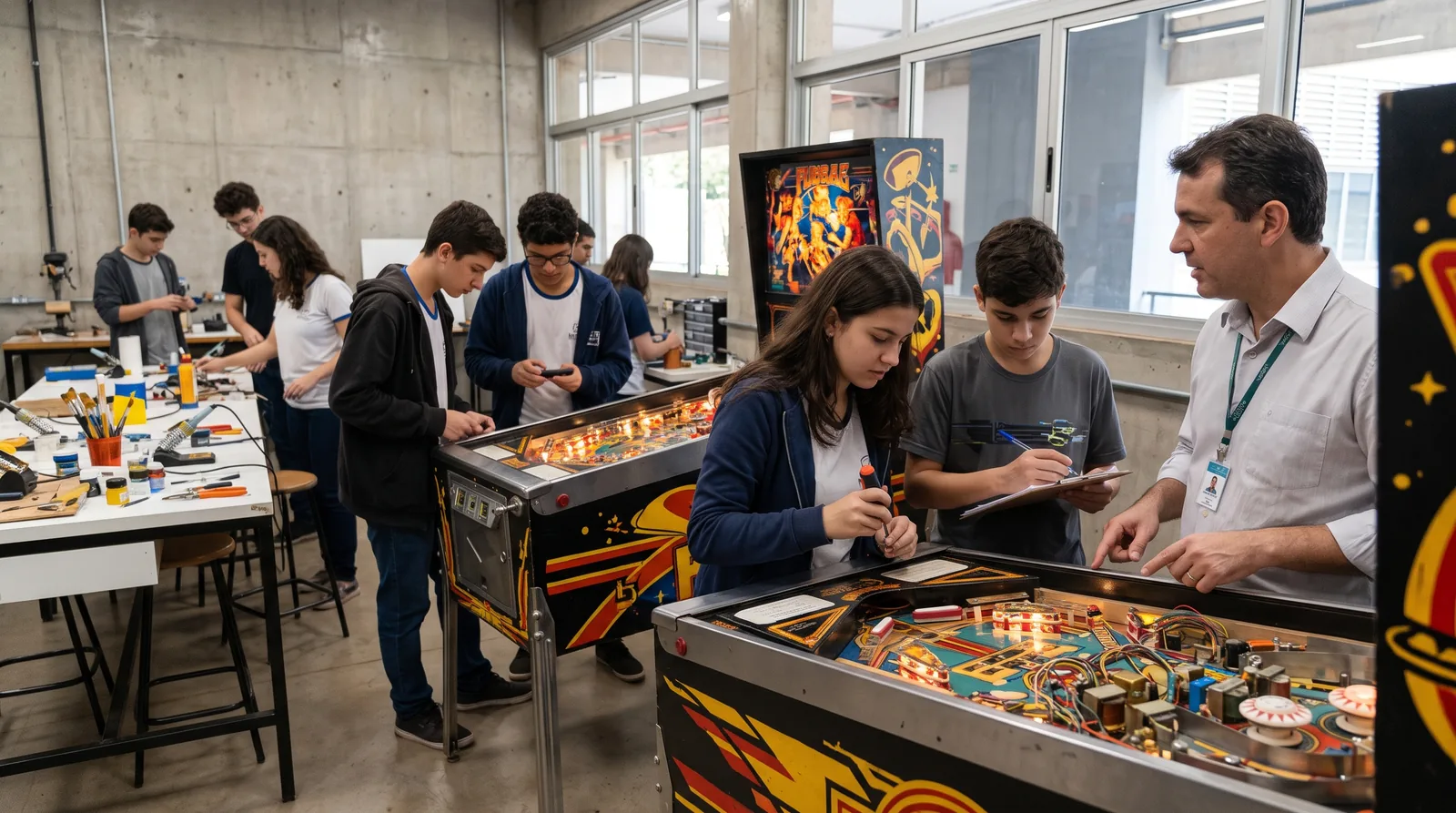
The Pinball4Science project, created by the Faculty of Economics, Administration and Accounting of Ribeirão Preto of USP, uses pinball machines to connect classroom science with hands-on learning. Led by professor Alexandre Pereira Salgado Junior alongside researchers, technicians, and students, the project plans to welcome about public schools. High school students are already helping restore vintage machines by painting cabinets, fixing power supplies, and checking circuits. When school visits start, students will study physical components and operate the machines using mobile phones. Afterward, students and teachers will answer questionnaires so the team can study how the practical activities affect learning and motivation.
Key points
- Connecting theory with practice: The project uses the physical parts of pinball games to explain classroom topics like electromagnetism and programming.
- Old technology made visible: Machines built between the decades of and allow students to directly view and touch internal wires and electrical parts.
- Student involvement in restoration: High school students already help paint cabinets, repair power sources, and look at the circuits beneath the game boards.
- Research on the experience: Participants will fill out questionnaires at the end of the sessions so researchers can measure motivation and learning.
Terms explained
- Capacitor — A small electronic part that stores and releases electrical energy. Example: Think of it like a tiny bucket that collects electricity and splashes it out when needed.
- Solenoid — A coil of wire that creates a magnetic field when electricity flows through it, often used to push or pull things. Example: Imagine a metal spring that snaps forward quickly when you turn on a switch.
- Transformer — A device that changes the voltage level of electrical power. Example: It acts like a gear shifter on a bicycle, changing how much electrical force moves through the system.
Critical analysis
What is encouraging. The project creatively repurposes older technology with visible physical parts, making abstract subjects like electricity much easier for students to see and touch.
What deserves caution:
- Activities have not started yet. The school meetings and questionnaires are planned for the future, so no actual student learning outcomes have been measured yet.
- Small and specific group. The project focuses on a limited number of public schools from one region, meaning the findings may not apply everywhere.
- Funding is still needed. Future steps like a pilot laboratory or teacher training depend on getting money from outside research funding groups.
Bottom line: An interesting university project plans to use pinball machines for science education, but formal study results are still in the future.
What we still don't know
The source does not provide any finished data, test scores, or final conclusions about whether the pinball machines actually improve student grades or long-term interest in science.
Based on reporting from Jornal da USP. This is an independent explainer, written in our own words with AI assistance; Jornal da USP has not reviewed or endorsed it. Read the original for the full details.