Directly Programming Materials with Carbon Dioxide Gas
Researchers have demonstrated that carbon dioxide can act as a direct and reversible trigger to manipulate materials from the nanoscale up to centimeter-sized hydrogels. This discovery introduces a universal method for controlling matter using gaseous stimuli, which have been largely overlooked compared to light or pH.
Reviewed by Matheus Grangeiro
- Peer reviewed
- Yes
Key numbers
6principles
number of design principles describing aggregation sequence-dependence
1R15GM155859award number
NIH funding grant identifier
SA-NES-2023-103agrant number
Research Corporation for Science Advancement grant identifier
4.0version
Creative Commons International License version
January 16, 2026date
provisional patent application filing date
Evidence level: Prototype or demonstration
Why it matters: Most stimuli-responsive soft materials in use today depend on liquid-phase chemistry: pH gradients, ionic concentrations, electrical fields conducted through aqueous media, or solvent swelling. These requirements are not incidental limitations — they reflect the fundamental mechanism by which the material senses its environment and actuates a response. As a consequence, entire application domains remain inaccessible: gas-phase environments, materials that must function across permeable membranes, devices where electrical wiring is impractical, and biological interfaces where solvent composition cannot be freely manipulated. A material that responds directly to gaseous CO₂ — biocompatible, atmospherically abundant, and reversibly switchable by purging with an inert gas — would remove these constraints simultaneously, opening design space that has been largely unexplored in the stimuli-responsive materials literature.
How Peptide Sequences Translate Gas Flow Into Physical Structure
The organizing principle of Farrokhi’s work is that CO₂ responsiveness in peptide-functionalized nanoparticles is not an intrinsic property of the material class but a consequence of sequence-specific positioning and conformational features within the amino acid chain. By encoding responsiveness at the sequence level rather than through bulk chemistry, the system allows the nature, magnitude, and reversibility of the aggregation response to be tuned by design. Six foundational sequence-dependent rules govern how aggregation behavior depends on peptide arrangement — a combinatorial framework that, in principle, enables the construction of materials with tailored response profiles without requiring new chemistry for each target application.
A particularly consequential finding concerns the kinetics of assembly: mathematical simulations reveal that the rate of nanoparticle aggregation scales with gas flow velocity rather than with the cumulative volume of CO₂ delivered. This distinguishes the system from most CO₂-responsive materials in the literature, where the response is driven by dissolved carbonic acid equilibria and therefore depends on total gas exposure. The velocity-dependence implies that the material effectively encodes information about dynamic gas flow rather than merely detecting the presence or absence of the gas — a distinction with direct relevance to atmospheric sensing applications where flow rate, not total concentration, is the variable of interest.
Gaseous Triggers Versus Traditional Environmental Stimuli
The stimuli-responsive materials field has built a rich toolkit around pH, temperature, light, and electromagnetic fields as actuation mechanisms; gaseous triggers have received comparatively little systematic attention outside CO₂ capture chemistry and industrial process control. The neglect is partly historical — liquid-phase systems were technically accessible earlier — and partly structural: most responsive polymers and hydrogels are designed around aqueous swelling or ion-exchange mechanisms that have no natural gas-phase analogue. The consequence is that gas-phase actuation, permeable-barrier operation, and non-conductive environment compatibility represent genuine white space rather than merely underexplored territory.
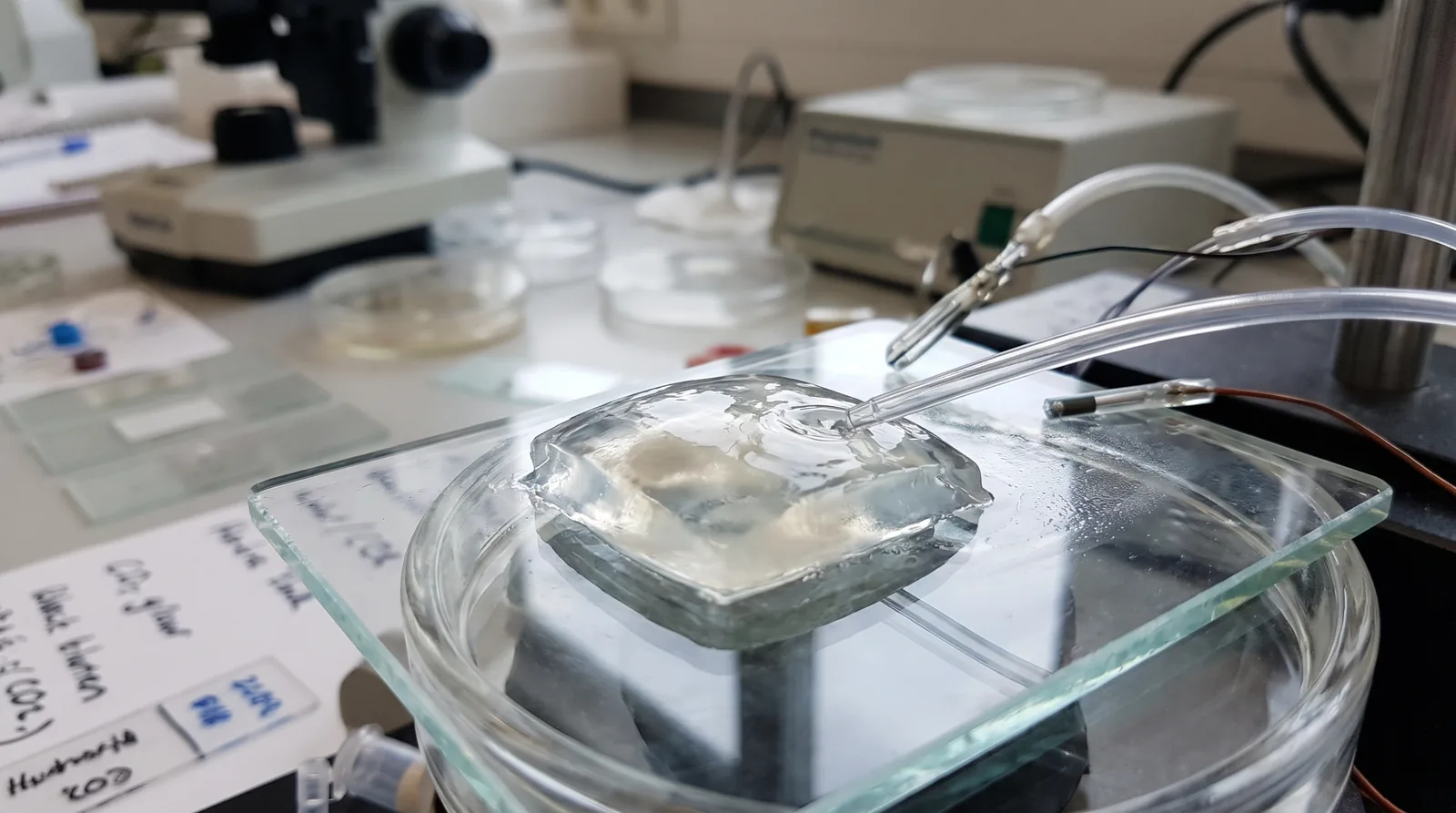
CO₂ as a direct structural switch addresses this gap through a mechanism that bypasses fluid restrictions entirely: the gas diffuses through permeable barriers, reaches the peptide-functionalized surfaces, and triggers structural rearrangement without requiring a liquid medium to carry the signal. This architecture makes spatial patterning possible through selective gas delivery — a capability demonstrated here by using a gas-permeable barrier to achieve defined structural organization within the hydrogel matrix.
What Remains Unverified in Current Tests
Three specific gaps limit the current state of knowledge. The colorimetric responses observed in the hydrogels lack a reported mechanistic explanation; the chemical pathway by which structural rearrangement produces a visual signal has not been characterized, leaving the colorimetric behavior empirically documented but not understood at a molecular level. Practical manufacturing costs and process parameters for the peptide-functionalized materials are not addressed — an omission consequential for translational feasibility, given that custom peptide synthesis at scale remains expensive relative to synthetic polymer alternatives. Most significantly, the specific peptide sequences designed and tested in the experiments are withheld from the reported findings, preventing independent replication, sequence-activity analysis, and direct comparison with the broader peptide self-assembly literature.
Evaluating the Transition From Molecular Design to Macroscopic Hydrogels
The central translational claim is that the gas-driven response demonstrated at the nanoparticle level carries forward to centimeter-scale hydrogels under biologically compatible conditions — a scale-bridging that many stimuli-responsive systems fail to achieve without loss of response fidelity or introduction of cytotoxic components. The successful demonstration of spatial organization within macroscopic hydrogels using a gas-permeable barrier represents a meaningful proof-of-concept for programmable, gas-driven material structuring at a clinically relevant size regime. T. Farrokhi, primary author and researcher at the Department of Chemistry, University of Massachusetts Lowell, filed a patent on January 16, 2026, to protect the responsive nanomaterials and solutions derived from these sequence-specific designs; this filing simultaneously signals commercial intent and provides context for the non-disclosure of specific peptide sequences in the published findings.
Verdict: This prototype, published in Nature Communications on November 7, 2026, demonstrates that CO₂ gas flow velocity can directly program peptide-driven aggregation behavior across scales — from colloidal nanoparticles to centimeter-scale biologically compatible hydrogels — through a mechanism with no analogue in existing liquid-phase responsive material systems; colorimetric mechanisms, specific peptide sequences, and manufacturing parameters remain undisclosed or uncharacterized.
Based on reporting from Nature Communications. This is an independent explainer, written in our own words with AI assistance; Nature Communications has not reviewed or endorsed it. Read the original for the full details.