How smartphone video analysis aims to streamline autism screening
Researchers have engineered a smartphone software tool called ASD Super Agent to screen for autism and plan home therapies. The platform matters because it aims to bypass extended waiting periods for clinical evaluations that delay early help.
Reviewed by Matheus Grangeiro
- Sample size
- 500
Key numbers
100children
Global autism prevalence ratio
500parents
Number of autism parents engaged during development
0.92AUC score
Preliminary system discriminative precision score
20models
Internationally recognized autism intervention models in framework
1.1 millionrecords
Size of multimodal autism database
33rank
HKUST global ranking in QS World University Rankings
6rank
HKUST Asian ranking in QS Asia University Rankings
20rank
Sustainability impact global rank
Evidence level: Prototype under preliminary testing; no peer-reviewed clinical validation reported in the source
Why it matters: Families frequently encounter lengthy waits for clinical assessment, high intervention costs and fragmented information about available services. Autism spectrum disorder (ASD) affects approximately 1 in 100 children worldwide, and delays in identification can mean missed opportunities during a period when early support may be especially valuable.
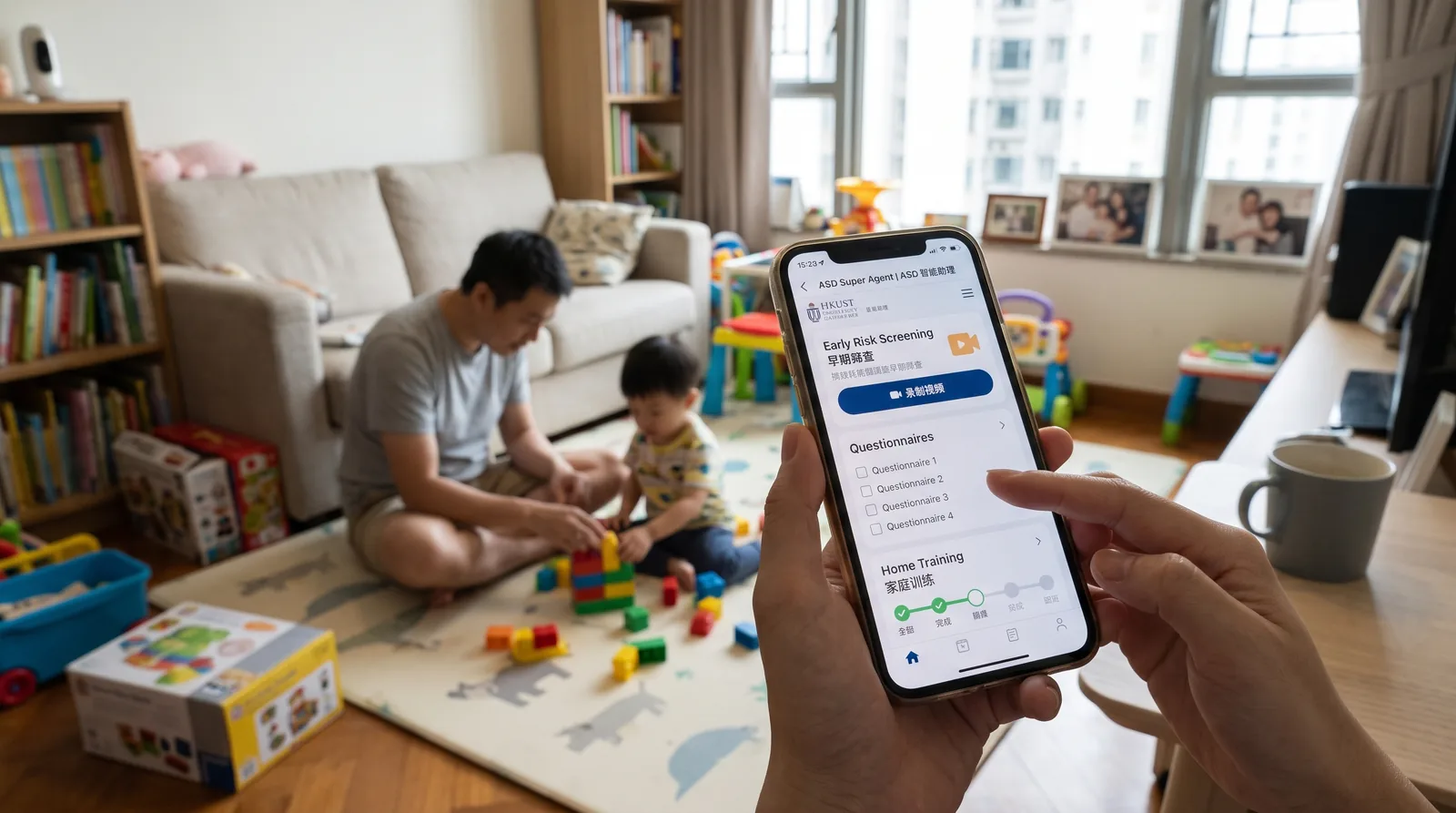
How the ASD Super Agent supports families Researchers at The Hong Kong University of Science and Technology (HKUST) developed ASD Super Agent, described as Asia’s first integrated AI platform for autism support. The system combines three core functions: early risk screening, personalized intervention recommendations and continuous family follow-up. It is intended to support families while they seek professional assessment, not to replace it.
The project was led by Prof. Kani Chen, a professor in HKUST’s Department of Mathematics and Department of Industrial Engineering and Decision Analytics. During development, the team consulted special-education institutions, child-development centres and psychiatric hospitals across Hong Kong, the Greater Bay Area and Beijing, and engaged with nearly 500 parents of children with autism.
Parents reported lengthy assessment waiting times, high treatment costs and fragmented information about intervention services. These findings motivated a platform designed to provide one-stop support from initial risk assessment to home-based training recommendations.
How smartphone recordings and therapeutic frameworks drive the system For screening, parents can record short videos of a child’s everyday activities, complete standardized questionnaires and provide basic developmental information. The system then generates a risk assessment and analytical report that families can use as a reference when seeking professional evaluation.
To protect privacy, the platform follows a data-minimization approach: it prioritizes on-device extraction of posture features and processes only the information required for analysis. The available announcement does not describe the underlying computational architecture, the posture-extraction algorithm, the demographic composition of the preliminary test set or the age range of participating children.
The intervention component uses a “20+1” framework. The “20” refers to more than 20 internationally recognized autism-intervention models embedded in the system; the “+1” allows therapists, special-education providers and organizations to incorporate their own proven methods and practical experience into the knowledge base.
Incorporated approaches include Applied Behaviour Analysis (ABA), Naturalistic Developmental Behavioural Interventions (NDBI), TEACCH Structured Teaching and the Localized BSR Model, among others. Parents can describe challenges such as emotional-regulation difficulties, limited eye contact, communication difficulties or repetitive behaviours and receive tailored support suggestions.
How the platform tracks development The platform builds a dynamic developmental profile from text records, video assessments and developmental information supplied by families and professionals. It can divide long-term goals into manageable daily actions, track progress over time and support discussions between families and healthcare or education professionals.
Recommendations can be accompanied by academic literature and background references, which may help families prepare more informed conversations with clinicians and educators. The system supports voice interaction in Cantonese, Putonghua (Mandarin) and English.
The research team also established a multimodal autism database containing video, posture and behavioural data, now exceeding 1.1 million records. This resource is intended to support model development and autism research, rather than to serve as a public clinical diagnostic tool.
What the preliminary evaluation shows—and does not show In preliminary testing, ASD Super Agent achieved an area under the curve (AUC) of 0.92, a measure of discriminative performance in which values closer to 1 indicate stronger separation between groups. The announcement does not specify the test cohort’s size, age range, demographic composition, reference standard, sensitivity, specificity, calibration or performance across subgroups.
It is therefore inaccurate to state that the AUC was obtained from “nearly 500 guardians.” The HKUST release says that the team engaged with nearly 500 parents during development; it separately reports the 0.92 AUC as a result of preliminary testing.
The platform remains under development and testing. HKUST states that further clinical studies and real-world validation will be conducted before deployment, so the reported AUC should not be interpreted as evidence of diagnostic accuracy in routine clinical practice.
What the prototype does not replace It may seem that the smartphone software can provide a formal autism diagnosis. In fact: it is designed to generate a preliminary risk assessment and analytical report for families to use as a reference when seeking professional evaluation.
The platform does not establish that its recommendations improve developmental outcomes, diagnostic timeliness, access to services or family well-being; those outcomes have not been reported.
The announcement does not disclose the model architecture, training and validation procedures, demographic characteristics of the preliminary evaluation, cost to families or institutions, or performance across different devices and home environments.
The database’s 1.1 million records do not establish that every record contains both video and movement metrics; the release describes a multimodal resource containing video, posture and behavioural data.
Verdict: ASD Super Agent is a prototype that combines preliminary AI-assisted risk screening, personalized intervention recommendations and continuous family follow-up. Its preliminary testing reported an AUC of 0.92, but the announcement does not provide the evaluation cohort, validation methods or clinical outcomes needed to establish diagnostic accuracy, effectiveness or readiness for deployment.
Based on reporting from HKUST. This is an independent explainer, written in our own words with AI assistance; HKUST has not reviewed or endorsed it. Read the original for the full details.