A new matrix-free computational scheme bypasses memory limits in biomedical clustering
Researchers developed an algorithm called GMMFAD to optimize Gaussian mixture of factor analyzers without storing massive covariance matrices. This approach accelerates runtime and handles complex biomedical datasets like single-cell RNA sequencing more efficiently than existing methods.
Reviewed by Matheus Grangeiro
- Peer reviewed
- Yes
- Sample size
- 569
Key numbers
300samples
sample size for first simulation setting
10dimensions
variable dimension for first simulation setting
150samples and dimensions
sample size and variable dimension in higher-dimensional setting
180samples
sample size in high-dimensional setting
200dimensions
variable dimension in high-dimensional setting
100replications
number of simulation replications
500iterations
maximum iteration threshold
10-6tolerance
stopping criteria tolerance level
Evidence level: Simulation or model
Why it matters: High-dimensional biomedical data—such as gene-expression profiles, single-cell RNA sequencing, and medical imaging features—can overwhelm traditional model-based clustering methods. Standard maximum-likelihood approaches often rely on Expectation-Maximization algorithms that require repeated updates of large covariance matrices, making them slow and memory-intensive when the number of variables is large. A matrix-free method that avoids storing those matrices could make it easier to identify biologically meaningful groups in large datasets, but its practical value in clinical settings depends on scalability, hardware requirements, and validation beyond the datasets tested here.
How matrix-free computation avoids covariance limits Model-based clustering assumes that observations arise from a probabilistic mixture of groups. A Gaussian mixture model represents each group with a mean vector and covariance matrix, while a mixture of factor analyzers extends this framework by describing each group’s covariance through a smaller set of latent factors.
This factor-analytic structure reduces the number of covariance parameters and provides an interpretable summary of variation within each cluster. However, many existing implementations still use nested EM-type algorithms, which can converge slowly and become computationally impractical in high-dimensional settings, particularly when the number of variables exceeds the number of samples.
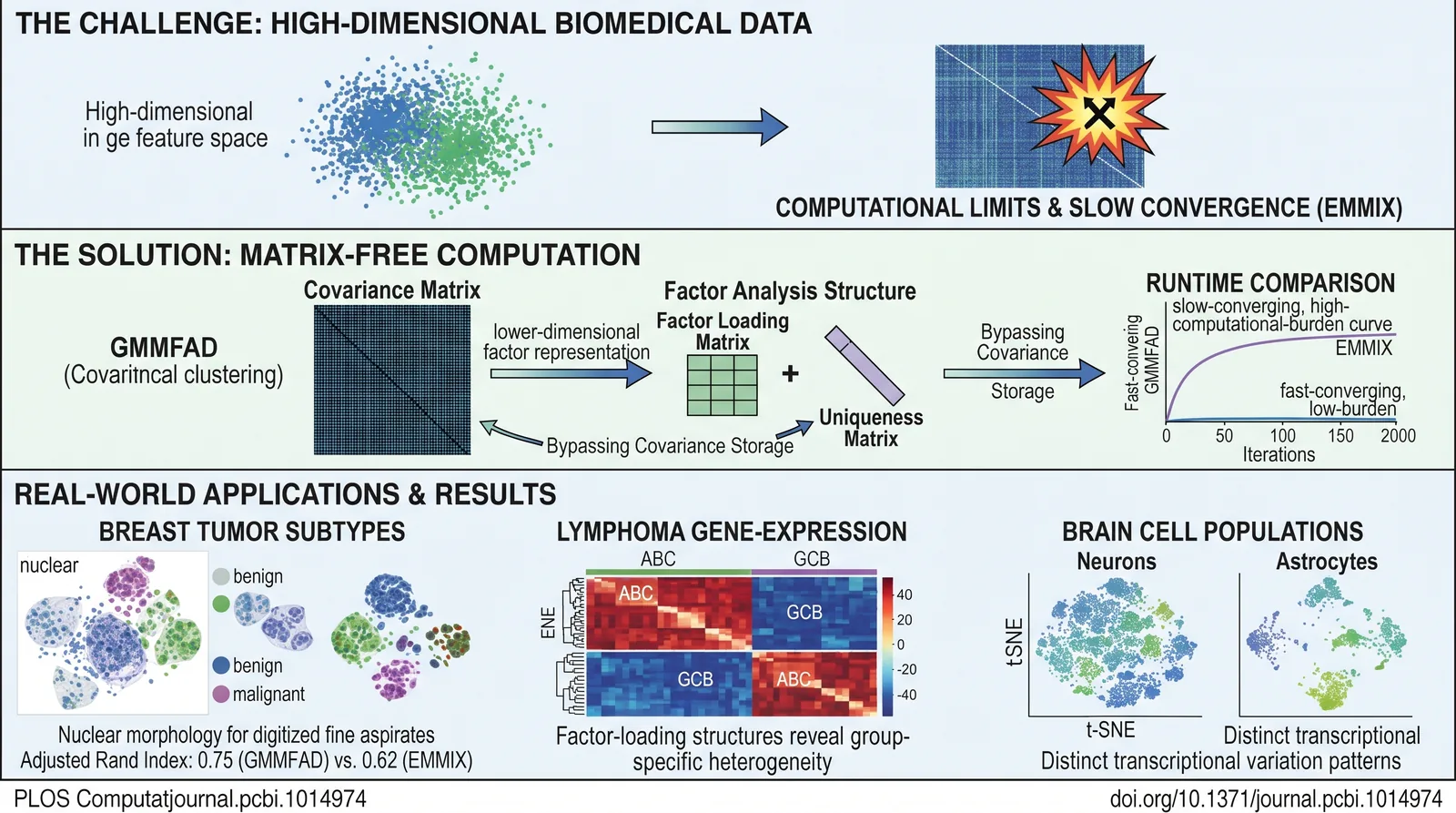
The proposed method, GMMFAD—Gaussian Mixture Model with Factor Analyzer Decomposition—retains the EM framework for mixture components but replaces EM-based covariance updates with matrix-free profile-likelihood computations. It uses the Lanczos algorithm to approximate leading eigenvalues and eigenvectors, then optimizes the profile objective using L-BFGS-B, avoiding explicit construction or storage of large covariance matrices.
The method also includes a generalized version, GMMFAD-q, which allows different clusters to have different numbers of latent factors. This is more flexible than many existing implementations, which require the same number of factors across all clusters and may underfit complex groups or overfit simpler ones.
Performance against the EMMIX benchmark The authors compared GMMFAD with EMMIX, an existing mixture-of-factor-analyzers implementation, using simulated Gaussian datasets generated with the MixSim R package. They ran 100 replications for each benchmark setting, using the same initialization and stopping rules for both methods.
In the benchmark settings with 300 samples and 10 variables, both methods achieved model-selection correctness rates above 98%. Given correctly selected models, their clustering accuracy and parameter-estimation accuracy were nearly identical.
The main advantage of GMMFAD was computational efficiency. It achieved clear runtime speedups over EMMIX across all scaled benchmark settings, with the advantage becoming more pronounced as the number of variables increased.
Evaluation setting GMMFAD mean runtime EMMIX mean runtime Approximate speedup 100 samples, 20 variables 0.81 seconds 20.91 seconds 26-fold. 100 samples, 50 variables 1.61 seconds 77.44 seconds 48-fold. 150 samples, 100 variables 4.42 seconds 966.16 seconds 218-fold. 300 samples, 150 variables 114.28 seconds 3,221.95 seconds Substantial, but exact multiplier not stated in the source. GMMFAD converged in all 30 replications at every scaling setting evaluated. EMMIX’s convergence rate fell to 96.7% at 150 samples and 100 variables, and to 93.3% at 300 samples and 150 variables, with failures occurring when fits exceeded the two-hour runtime limit or the maximum iteration limit.
Model selection and initialization Model complexity was selected using the Bayesian Information Criterion, which favors models with better likelihood while penalizing additional parameters. In the simulations, the method evaluated candidate models across ranges that included the true number of clusters and factors.
Because EM-type mixture methods can converge to local rather than global maxima, the authors used both random initialization and k-means-based initialization. The algorithm stops when the increase in log-likelihood falls below 10^-6 or after 500 iterations.
The Adjusted Rand Index was the primary metric for clustering accuracy because it measures agreement between estimated and known labels while correcting for agreement expected by chance. The study also used relative Frobenius errors to assess recovery of factor loadings, uniqueness variances, and covariance-related parameters.
Applications to biomedical datasets The researchers applied the method to three real datasets: the Wisconsin breast cancer diagnostic dataset, a lymphoma gene-expression dataset, and a human brain single-cell RNA sequencing dataset. These applications tested whether the method could recover biologically meaningful groups rather than merely perform well on synthetic data.
The Wisconsin breast cancer dataset contains 569 samples and 30 features derived from digitized images of fine-needle aspirates. The features describe cell-nucleus properties, including radius, texture, perimeter, area, smoothness, compactness, concavity, concave points, symmetry, and fractal dimension.
On this dataset, GMMFAD achieved an Adjusted Rand Index of 0.75, compared with 0.62 for EMMIX. Treating malignant tumors as the positive class, GMMFAD achieved sensitivity of 0.92 and specificity of 0.94.
The lymphoma analysis identified three lymphoma subtypes and revealed group-specific gene-expression heterogeneity. The brain single-cell RNA sequencing analysis distinguished neuronal and astrocytic cell populations, with neuronal variation reflecting a broader set of coordinated transcriptional directions and astrocytic variation concentrated in a more compact latent structure.
What the breast cancer result does not prove The breast cancer result shows stronger agreement between GMMFAD clusters and known benign or malignant diagnostic labels than EMMIX achieved. It does not prove that GMMFAD is a validated diagnostic test, a replacement for clinical diagnosis, or a tool ready for prospective patient care.
The Wisconsin dataset is a well-established benchmark with known labels, but it is not a large, multi-center, prospectively collected clinical cohort. The study’s sensitivity and specificity values are external-validation metrics comparing estimated clusters with diagnostic labels, not measures of performance in a new clinical deployment.
The fitted factor-loading structures suggest biologically meaningful differences in nuclear morphology, with malignant samples showing stronger irregularity-related variation. This is an interpretive finding based on the fitted model, not direct experimental proof that those factors cause malignancy or determine clinical outcomes.
What remains unknown about clinical scaling The study does not report the absolute financial cost of running these computations on massive datasets. It also does not establish the exact timeline or hardware requirements for processing multi-terabyte genomic cohorts in routine clinical settings.
The scaling analysis was conducted on simulated datasets with sample sizes up to 300 and feature dimensions up to 150, using a MacBook Pro with an Apple M3 Pro chip and 18 GB of RAM. These results demonstrate favorable scaling relative to EMMIX, but they do not establish performance on hospital-scale datasets with millions of cells, high-dimensional genomic features, distributed computing systems, or clinical privacy constraints.
The authors provide R code through a public GitHub repository, which supports reproducibility, but code availability does not by itself demonstrate clinical integration, regulatory compliance, cybersecurity, or operational reliability.
Common misreadings It may seem that removing covariance-matrix storage would compromise the ability to identify subtle biological subtypes. In fact: simulations and real-data applications show that GMMFAD maintains high clustering and estimation accuracy, achieving an Adjusted Rand Index of 0.75 on breast cancer data compared with 0.62 for EMMIX.
It may seem that the breast cancer result proves the method can diagnose cancer in patients. In fact: the result measures agreement between unsupervised clusters and known diagnostic labels in a benchmark dataset; it does not establish prospective clinical diagnostic validity.
It may seem that the method has been validated on multi-terabyte clinical genomic cohorts. In fact: the reported scaling analysis used simulated datasets with up to 300 samples and 150 variables, not hospital-scale genomic data.
It may seem that GMMFAD eliminates all computational constraints. In fact: it reduces runtime and memory use relative to EMMIX, but the study does not quantify cloud costs, distributed-computing requirements, or performance for massive real-world clinical datasets.
Verdict: Simulations and tests on benchmark biomedical datasets show that GMMFAD’s matrix-free computational scheme substantially accelerates convergence and runtime for mixtures of factor analyzers while preserving clustering and estimation accuracy. It also allows cluster-specific numbers of latent factors and identified biologically meaningful groups in breast cancer, lymphoma, and brain single-cell datasets. However, the study leaves open the absolute financial costs, hardware requirements, and real-world scalability needed to process multi-terabyte genomic cohorts in routine clinical environments.
Source: PLOS Computational Biology. The original is licensed CC BY 4.0. This text is an AI-assisted adaptation (summarized, simplified and translated) and may differ from the original.