How observing daily scientific workflows shapes academic publishing software
Software development for academic publishing is increasingly shaped by observing how authors, reviewers, and editors navigate daily workflows. This user-centric approach matters because it determines whether digital tools reduce friction or add administrative burdens to scientific research.
Reviewed by Matheus Grangeiro
Evidence level: Not specified in the source
Why it matters: Authors, reviewers, and editors navigating academic publishing platforms often face friction and time-consuming workflows during manuscript submission, peer review, and editorial decision-making. These tasks can require switching between documents, repeating work, reconstructing context, and completing administrative steps that take attention away from scientific work. A development approach that observes researchers in their real working conditions may identify problems that a conventional requirements document or isolated interface test would miss.
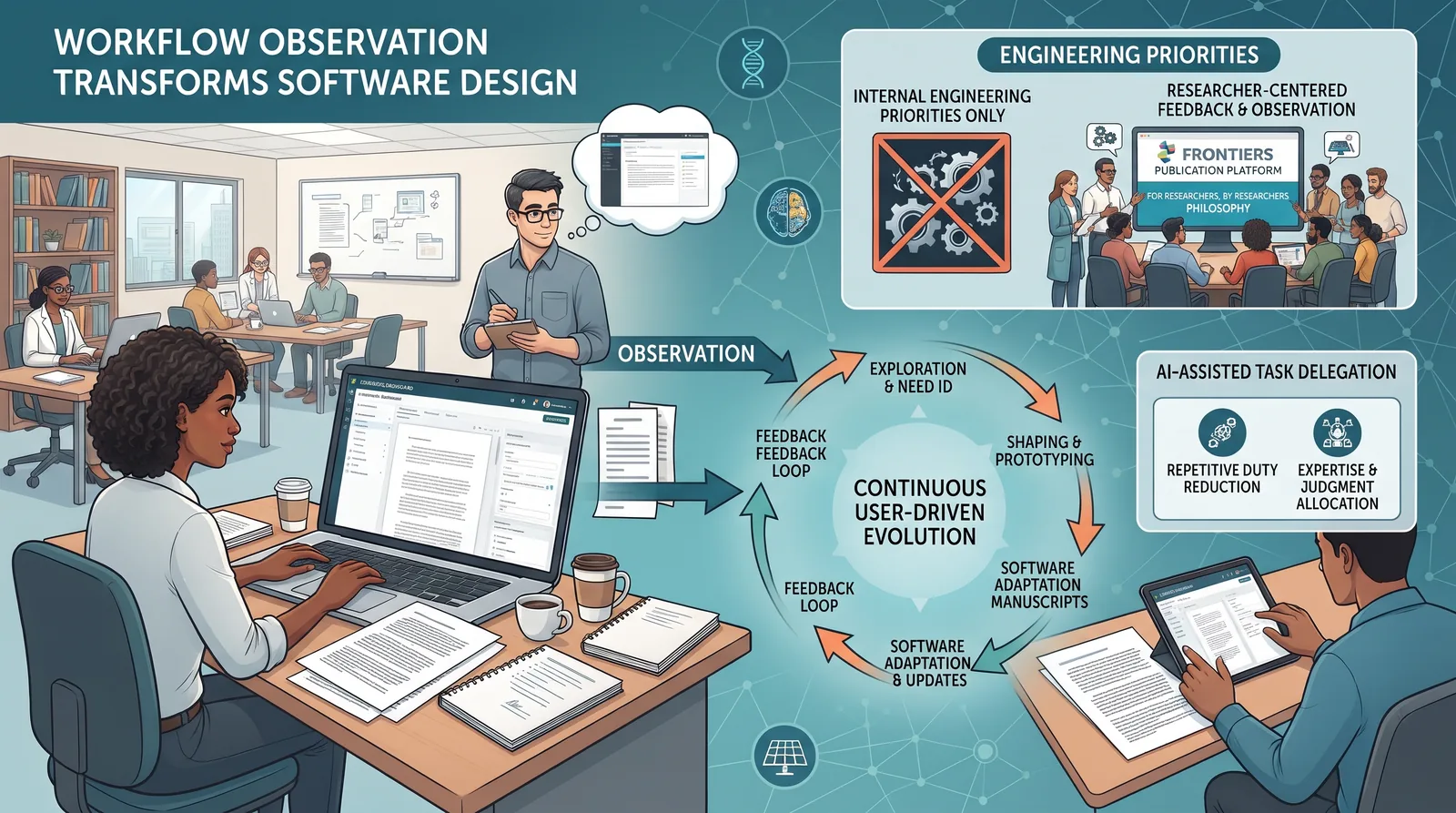
How workflow observation shapes software design Frontiers describes its approach as “for researchers, by researchers,” placing researchers, their manuscripts, and their working conditions at the center of product development. The starting question is not which feature to build, but what researchers are trying to accomplish and what makes that work harder than necessary.
Andreas Schrafl, Head of Product User Experience, says the team aims to observe researchers “ideally in their natural habitat.” This means examining not only the steps a person takes on a screen, but also the surrounding conditions: available time, devices, location, information needs, and the other tasks competing for attention during a research day.
Product discovery therefore looks beyond digital navigation. A workflow may appear logical in isolation but fail when it requires users to switch documents, repeat actions, or reconstruct context they already understand. In such cases, the solution may be clearer guidance, fewer repeated steps, or better-timed information rather than an entirely new feature.
Different users, different goals Authors, reviewers, and editors may follow related procedural paths, but they have distinct goals and definitions of success. An author preparing a manuscript, a reviewer assessing it, and an editor making a recommendation do not necessarily need the same workflow or the same kind of support.
Even people in the same role can work differently depending on discipline, experience, geographic location, available time, and surrounding tools. This variation means a single standardized workflow may not serve every researcher equally well.
The development team gathers insights through consultations with product managers, user researchers, designers, and software engineers. Their initial task is to understand what researchers need to accomplish and where their existing workflows create obstacles.
User testing with real manuscripts The article argues that user testing is more informative when it uses authentic manuscripts rather than generic documents. Researchers know and care about the specific wording, claims, and evidence in their own papers, which can produce more realistic reactions to an interface or workflow.
Lukasz Urzedowski, Head of Software Engineering, describes the creation sequence as exploration, customer-need identification, shaping, prototyping, and user testing. The goal is to turn ideas into something researchers can respond to quickly, allowing the team to learn whether the proposed solution is useful before committing to it.
Julio Tejedo, Senior Software Engineer, emphasizes that software should evolve according to user feedback. In this framework, feedback is not a final approval step; it is an ongoing mechanism for identifying what works, what fails, and what needs to change.
Early submission-platform friction Robert Gregich, Senior Product Manager, describes early evaluations of Frontiers’ article-submission platform as painful because authors spent substantial time completing submissions. He says this observation helped the team prioritize the issues that mattered most to researchers: focusing on science rather than paperwork.
This example illustrates why workflow efficacy cannot be understood solely from internal engineering priorities. It depends on external variables such as academic discipline, prior experience, location, time availability, and the tools researchers already use.
The company’s stated challenge is to distinguish genuinely necessary steps from work that technology can responsibly take on. Publishing systems still support editorial assessment, integrity checks, and quality controls, so automation must be balanced against the responsibilities of the publishing process.
How artificial intelligence changes engineering work The article positions artificial intelligence as a tool for reducing repetitive work, not as an end in itself. Its value lies in allowing people to spend more time on tasks requiring expertise, judgment, and accountability.
Urzedowski describes engineering time with AI as focusing on solution design, generating instructions for AI systems, and reviewing their output. AI can help organize information, explore options, and develop prototypes quickly enough for researchers to react while the underlying question remains relevant.
However, the article stresses that greater efficiency does not remove the need for care. Faster output makes it more important to ask whether a result is useful, reliable, and appropriate; AI can assist development, but it does not take responsibility for defining the problem, setting standards, or deciding whether a result should be used.
Software updates and engineering priorities It may seem that software updates are driven entirely by internal engineering priorities. In fact: the described process relies on continuous user feedback, observation of researchers in their real working conditions, and iterative testing with authentic manuscripts.
It may seem that automation automatically improves a publishing workflow. In fact: the source argues that technology should remove unnecessary burden while preserving necessary editorial assessment, integrity checks, and quality controls.
It may seem that AI can take responsibility for product decisions. In fact: the article states that AI can assist with development, but humans remain responsible for defining the problem, setting standards, and evaluating whether outputs are appropriate.
It may seem that a single workflow can serve all researchers equally. In fact: authors, reviewers, and editors have different goals, and even people in the same role differ by discipline, experience, location, time availability, and tools.
Verdict: The development framework described by Frontiers operates through direct observation of researchers, user testing with real manuscripts, iterative prototyping, and continuous feedback in a production environment. It aims to reduce unnecessary workflow friction while preserving essential publishing responsibilities. However, the source does not specify the financial investment, development timelines, or quantitative metrics gathered during user observation, so its effectiveness and cost-effectiveness cannot be independently assessed from the available information.
Based on reporting from Frontiers Science News. This is an independent explainer, written in our own words with AI assistance; Frontiers Science News has not reviewed or endorsed it. Read the original for the full details.