Overcoming Parallel Control Limits in Silicon Spin Qubits
Researchers achieved high-fidelity control over a five-qubit silicon array operating simultaneously by implementing a scalable phase-calibration protocol. This matters because controlling multiple qubits in parallel without losing accuracy is a critical step toward scalable quantum processors.
Reviewed by Matheus Grangeiro
- Peer reviewed
- Yes
- Sample size
- 5
Key numbers
5qubits
size of the silicon array
99.99%
single-qubit gate fidelities achieved individually
99.999%
best individual single-qubit gate fidelity
3qubits
number of qubits operated simultaneously while maintaining fidelities above 99.99%
99.9%
fidelity during parallel operation of all five qubits
2026year
publication year of the study in Nature Physics
Press versus study
Simplification
What the press says
The press text states that during parallel operation of all five qubits, the fidelities remained at approximately 99.9%.
What the study shows
The paper states that during parallel five-qubit operation, fidelities remain above the widely targeted fault-tolerant threshold of 99.9%.
Evidence level: Prototype or demonstration
Why it matters: Silicon spin qubits are promising for scalable quantum computers because they can be fabricated using semiconductor manufacturing techniques. However, controlling several qubits at once with microwave signals can introduce errors, limiting the scalability of silicon-based quantum processors.
How silicon spin qubits handle concurrent microwaves Researchers from the RIKEN Center for Emergent Matter Science and collaborators demonstrated high-fidelity control of multiple silicon spin qubits operating in parallel. Their study, “Simultaneous High-Fidelity Single-Qubit Gates in a Spin Qubit Array,” was published in Nature Physics in 2026.
Silicon spin qubits encode information in the spin of an electron trapped in a silicon substrate. Quantum computers use qubits, which can represent combinations of the classical binary states 0 and 1.
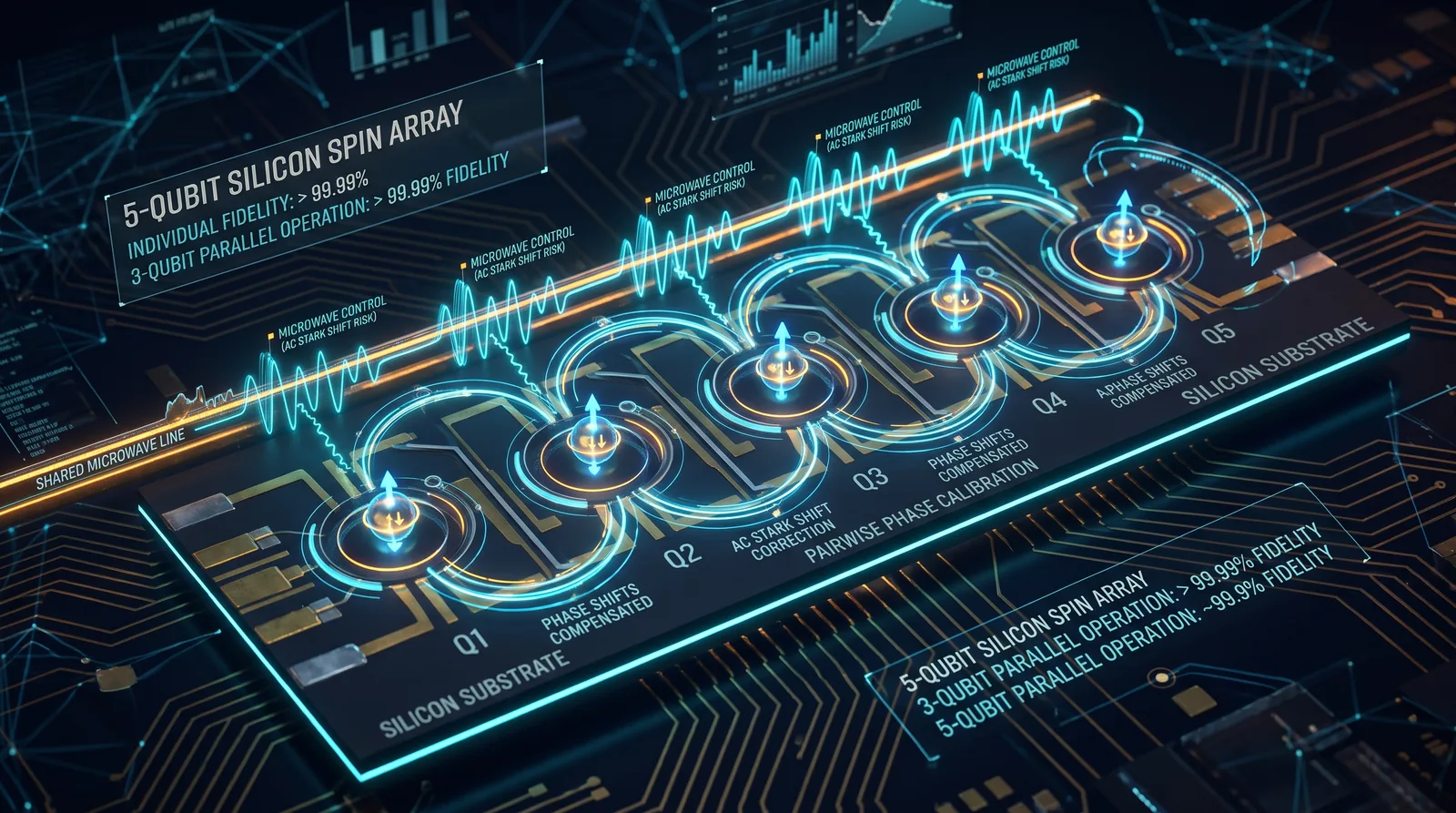
The experiment used a five-qubit silicon array controlled through a single shared microwave line. This shared-control architecture is relevant to scaling because it reduces the need for separate control hardware for every qubit.
Identifying the source of parallel-control errors When microwave control signals are applied to several qubits simultaneously, they can induce an AC Stark shift. This effect changes a qubit’s effective energy levels and shifts the phase of its quantum state, reducing operational accuracy.
The researchers identified this AC Stark shift as the major source of degradation during parallel operation. When multiple qubits are driven at once, these phase shifts can interfere with the intended control of each qubit.
To mitigate the problem, the team developed a scalable phase-calibration protocol. Instead of requiring a separate calibration for every possible combination of qubits, it uses calibrations between pairs of qubits to compensate for unwanted phase shifts.
Exact fidelities achieved in the five-qubit array Using an optimized device design and carefully calibrated microwave pulses, the researchers achieved single-qubit gate fidelities well above 99.99% for each of the five qubits when operated individually. The best result approached 99.999%.
With the calibration protocol, fidelities remained above 99.99% when up to three qubits were operated simultaneously. When all five qubits operated in parallel, fidelities remained at approximately 99.9%, close to the practical requirements of fault-tolerant quantum computing.
These are experimental results from a five-qubit demonstration, not a demonstration of fault-tolerant quantum computing. Fault tolerance requires error correction, repeated operations and scalable architectures beyond the scope of this experiment.
What drive-induced decoherence still limits The remaining degradation during five-qubit parallel operation was attributed to drive-induced decoherence, caused by the increased microwave power needed for simultaneous operation. Unlike the phase shifts addressed by the calibration protocol, this effect involves loss of quantum coherence.
The available release does not report the exact physical layout or architecture of the five-qubit array, nor does it provide a cost estimate or timeline for scaling to thousands of qubits.
Leon Camenzind, a RIKEN research scientist and co-first author who supervised the experiments, stated that maintaining high-fidelity control during simultaneous operation is an important step toward scaling silicon-based quantum processors.
Assessing parallel control in silicon processors The pairwise phase-calibration approach reduces the need for separate calibration procedures for every possible qubit combination. This makes shared microwave control lines more practical for multi-qubit silicon processors.
The remaining limitation is drive-induced decoherence from the higher microwave power required during parallel operation. Further improvements in device design may help mitigate this source of error, according to the researchers.
The result does not establish that silicon spin qubits can now support fault-tolerant quantum computing. It demonstrates that high-fidelity parallel control is achievable in a five-qubit array under the tested conditions.
What the pairwise calibration does not imply It may seem that the researchers calibrated every possible combination of qubits separately. In fact: the protocol uses pairwise calibrations to compensate for phase shifts, avoiding a separate calibration for every possible combination.
It may seem that the five-qubit result meets fault-tolerance requirements. In fact: it is close to the practical requirements cited by RIKEN, but fault tolerance also requires error correction and scalable architectures.
It may seem that the calibration protocol eliminates all parallel-control errors. In fact: it addresses AC Stark-shift-induced phase errors; drive-induced decoherence remains a limitation.
It may seem that the result proves silicon spin qubits can scale to thousands of qubits. In fact: it demonstrates parallel control in a five-qubit array; scaling, yield, wiring, cooling and error correction remain untested.
The release does not report the array’s physical layout, cost, manufacturing yield, long-term stability or performance beyond five qubits.
Verdict: The study demonstrates high-fidelity parallel control of a five-qubit silicon spin-qubit array using a scalable pairwise phase-calibration protocol. Individual gate fidelities exceeded 99.99%, three-qubit parallel operation remained above 99.99%, and five-qubit parallel operation reached approximately 99.9%; however, drive-induced decoherence from higher microwave power remains a limitation, and fault-tolerant operation has not been demonstrated.
Based on reporting from RIKEN. This is an independent explainer, written in our own words with AI assistance; RIKEN has not reviewed or endorsed it. Read the original for the full details.