Navigating the complex pricing and capabilities of Gemini 4 Neon
Google released a new artificial intelligence model variant named Gemini 4 Neon on November 18th, 2026, which inserts itself into an existing family of models with confusing pricing and overlapping capabilities. This launch matters because it rearranges cost structures and performance hierarchies for users relying on these commercial tokens.
Reviewed by Matheus Grangeiro
Key numbers
4
Gemini generation series version
3/4ratio
Hydrogen historical price ratio
1/4ratio
Hydrogen future price ratio
3dollars per million tokens
Neon input token price
15dollars per million tokens
Neon output token price
2dollars per million tokens
Carbon current input token price
10dollars per million tokens
Carbon current output token price
1.50dollars per million tokens
Hydrogen input token price
Evidence level: Observation or measurement
Why it matters: Navigating commercial AI pricing and selecting the right model variant is complicated by frequent new releases and shifting introductory discounts.
How Gemini 4 Neon handles reasoning and visual generation prompts
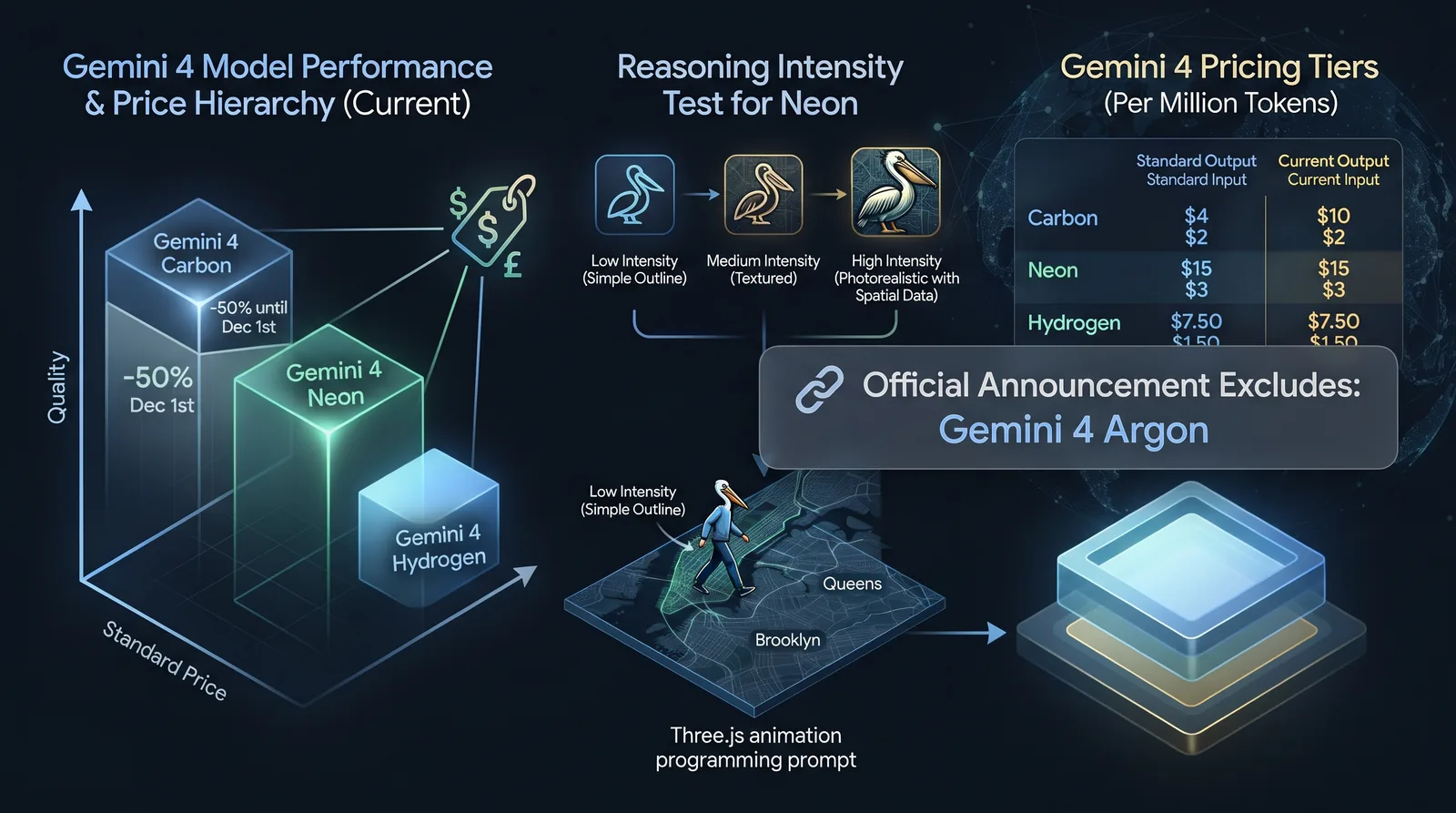
Evaluating artificial intelligence outputs requires testing specific visual generation tasks across varied operational parameters. Pelican images were tested across three distinct reasoning intensity settings for Neon: low, medium, and high. These settings help determine how effectively the model processes complex visual subject matter under varying computational constraints.
Beyond simple animal portraits, more demanding software development tasks test the limits of these systems. A specific programming prompt was submitted to Gemini 4 Neon utilizing extra effort within Google Antigravity to generate a Three.js animation featuring a character walking across Manhattan, Queens, and Brooklyn using OpenStreetMap data. This complex test highlights how the variant processes multi-step logic and spatial data inside an application.
How Gemini 4 Neon compares in quality and price hierarchy
Visual benchmarks reveal distinct performance gaps between sibling versions within the same generation. Visual outputs featuring pelicans generated by Neon appear superior to Hydrogen but fall behind Carbon in quality. Users trying to balance fidelity against expenditure must weigh these intermediate visual capabilities carefully.
Pricing tiers create an intricate landscape that shifts depending on promotional discounts. The revised hierarchy from highest to lowest standard price places Carbon first, Neon second, and Hydrogen third. Due to temporary discounting on Carbon, Neon currently stands as the most expensive option per token, priced at 3 dollars per million input tokens and 15 dollars per million output tokens.
Analyzing the evolving Gemini 4 pricing structure and model lineup
Commercial deployments of artificial intelligence rely heavily on predictable cost metrics, yet recent updates disrupt standard budgeting. The introduction of Neon complicates the already confusing pricing structure of the Gemini 4 family, which previously consisted of Hydrogen, Argon, and Carbon variants. Buyers must constantly re-evaluate their token expenses as new options enter the marketplace.
Pricing adjustments alter the relative value proposition of older products in the lineup. While Argon and Carbon previously shared identical pricing and Hydrogen cost three-quarters of that amount, discounting expiration on December 1st will double prices for Argon and Carbon. This abrupt shift realigns the financial burden for organizations processing massive volumes of text and code.
Current pricing sits at 2 dollars for input and 10 dollars for output per million tokens for Carbon, and 1.50 dollars for input and 7.50 dollars for output for Hydrogen, with Carbon expected to rise to 4 dollars and 20 dollars respectively. These numerical changes illustrate the volatility inherent in modern cloud-hosted machine learning services.
What official marketing materials omit about the model family
Official promotional messaging does not always provide a complete picture of a product ecosystem. The official announcement marketing materials for Neon completely omit any mention of the Argon model. This omission leaves a gap in public documentation regarding how older variants fit alongside recent additions.
Independent analysts must manually bridge these information gaps to maintain accurate technical comparisons. Consequently, Argon was excluded from the author's updated Gemini 4 comparison grid. Such exclusions highlight the discrepancy between polished vendor announcements and comprehensive technical overviews.
What the current token costs do not show
- It may seem that Neon is permanently the most expensive option in the Gemini 4 family. In fact: Neon only stands as the most expensive option per token currently due to temporary discounting on Carbon.
Verdict: Google's release of Gemini 4 Neon establishes a new commercial variant evaluated across reasoning settings and visual generation tasks. However, official marketing omissions and shifting introductory price tiers leave the broader model comparison and long-term cost predictability unclear.Evidence level: Observation or measurement
Why it matters: Commercial AI pricing and model selection are becoming increasingly difficult because vendors frequently release new variants, change introductory discounts, and omit older models from marketing materials. For developers and organizations that process large volumes of text, code, or images, these changes can materially affect cost predictability. This release adds Gemini 4 Neon to an already confusing Gemini 4 lineup, while temporary pricing discounts temporarily alter which model is most expensive per token.
How Gemini 4 Neon was evaluated The evaluation tested Gemini 4 Neon across three reasoning-intensity settings: low, medium, and high. The visual-generation test used pelican images, allowing a direct comparison of output quality across Neon’s different computational effort levels.
The reviewer also submitted a more demanding software-development prompt to Gemini 4 Neon using the “extra” effort level in Google Antigravity. The prompt requested a Three.js animation in which a character stands up as a large mech and moves through Manhattan, Queens, and Brooklyn using OpenStreetMap data.
This test was intended to probe how the model handles multi-step instructions, spatial data, and application-level code generation. It is an informal qualitative demonstration, not a standardized benchmark across a broad set of programming tasks.
Visual quality relative to sibling models In the pelican image comparison, Neon’s outputs appeared better than those from Gemini 4 Hydrogen but worse than those from Gemini 4 Carbon. This places Neon in an intermediate visual-quality position within the Gemini 4 family.
That result is based on the reviewer’s visual inspection of generated pelican images, rather than on a formal quantitative image-quality benchmark. It therefore supports a relative qualitative ranking, not a precise measurement of how much better or worse one model performs than another.
The comparison also does not establish that Neon is better or worse than Carbon or Hydrogen for every task. Visual generation, coding, reasoning, latency, and cost may rank differently depending on the workload.
Current pricing hierarchy At the time of the release, Neon was the most expensive Gemini 4 model per token. It was priced at $3 per million input tokens and $15 per million output tokens.
Carbon was temporarily discounted to $2 per million input tokens and $10 per million output tokens. Hydrogen was priced at $1.50 per million input tokens and $7.50 per million output tokens.
Model Current input price per million tokens Current output price per million tokens Position during discount period Gemini 4 Neon $3. $15. Most expensive per token. Gemini 4 Carbon $2. $10. Intermediate during temporary discount. Gemini 4 Hydrogen $1.50. $7.50. Least expensive. Why the hierarchy changes on December 1 Before Neon’s release, the Gemini 4 lineup consisted of Hydrogen, Argon, and Carbon. Argon and Carbon had the same price, while Hydrogen cost three-quarters as much.
On December 1, the introductory discount pricing for Argon and Carbon is scheduled to expire, causing their prices to double. Carbon is expected to rise to $4 per million input tokens and $20 per million output tokens.
After that change, the standard-price hierarchy from most to least expensive is expected to be Carbon, Neon, and Hydrogen. Neon will therefore no longer be the most expensive model per token once Carbon’s discount ends.
What official marketing omits The official announcement for Neon does not mention Argon. This creates a documentation gap because Argon remains part of the broader Gemini 4 model family and continues to affect the overall pricing landscape.
The reviewer removed Argon from his updated Gemini 4 comparison grid, reflecting the difficulty of maintaining a complete comparison when vendor announcements omit older variants. This does not mean Argon is unavailable or irrelevant; it means the public announcement does not provide a complete account of the model lineup.
This omission illustrates a broader issue in commercial AI products: polished marketing materials may emphasize new releases while leaving older models, pricing transitions, and comparative positioning unclear.
What current token costs do not show It may seem that Neon is permanently the most expensive option in the Gemini 4 family. In fact: Neon is only the most expensive per token during Carbon’s temporary discount period; after December 1, Carbon is expected to become more expensive.
It may seem that the pelican comparison proves Neon is universally better than Hydrogen and worse than Carbon. In fact: it supports only a qualitative visual-output ranking for that specific image-generation test, not a comprehensive performance benchmark.
It may seem that the Three.js animation demonstrates reliable production-ready coding ability. In fact: it is a single informal prompt run at an extra effort setting, not a standardized evaluation of coding accuracy, reliability, or cost-effectiveness.
It may seem that the current prices provide a stable basis for long-term budgeting. In fact: introductory discounts, scheduled price increases, and new model releases can rapidly change the relative cost of each variant.
Verdict: Google’s release of Gemini 4 Neon establishes a new commercial variant that was evaluated qualitatively across reasoning settings and visual-generation tasks. In the reported pelican comparison, Neon produced better images than Hydrogen but worse images than Carbon. However, official marketing omits Argon, and temporary discounts make the current pricing hierarchy misleading: Neon is currently the most expensive per token, but Carbon is expected to become more expensive after its discount expires on December 1.
Based on reporting from Simon Willison. This is an independent explainer, written in our own words with AI assistance; Simon Willison has not reviewed or endorsed it. Read the original for the full details.