Lightweight neural network brings fast voice control to humanoid robots
Researchers tested a compact neural network to process voice commands for humanoid robots, achieving an average response time under 160 milliseconds. However, the system relies on a tiny vocabulary and controlled laboratory conditions, remaining far from deployment in unpredictable environments.
Reviewed by Matheus Grangeiro
- Peer reviewed
- Yes
- Sample size
- 5000 utterances from 10 speakers
Key numbers
5000utterances
custom audio corpus size
5motion commands
vocabulary size
10speakers
number of participants supplying recordings
16kHz
recording sampling rate
30dB
minimum signal-to-noise ratio
4728utterances
retained utterances after cleaning pipeline
3771utterances
development pool size
14coefficients
Mel-frequency cepstral coefficients extracted
Evidence level: Prototype or demonstration
Why it matters: Voice-controlled robots need to convert spoken commands into motor actions quickly, reliably, and with limited onboard computing. Many existing prototypes link an Android interface to an Arduino controller through Bluetooth, which can obscure end-to-end timing and limit onboard signal processing. A compact speech-command classifier that runs in a single integrated software environment could reduce latency and computational burden, but its usefulness in hazardous defense or field settings depends on performance under realistic noise, distance, reverberation, and mission conditions—not merely controlled laboratory recordings.
How the neural network processes commands The researchers built a custom corpus of 5,000 utterances covering five motion commands. Ten speakers—five male and five female—recorded the commands at a 16 kHz sampling rate under controlled laboratory conditions with a signal-to-noise ratio of at least 30 dB.
A six-stage cleaning pipeline retained 4,728 utterances from the original 5,000. Two speakers, one male and one female, were held out entirely before any frame-level processing, while the remaining eight speakers formed a development pool of 3,771 utterances.
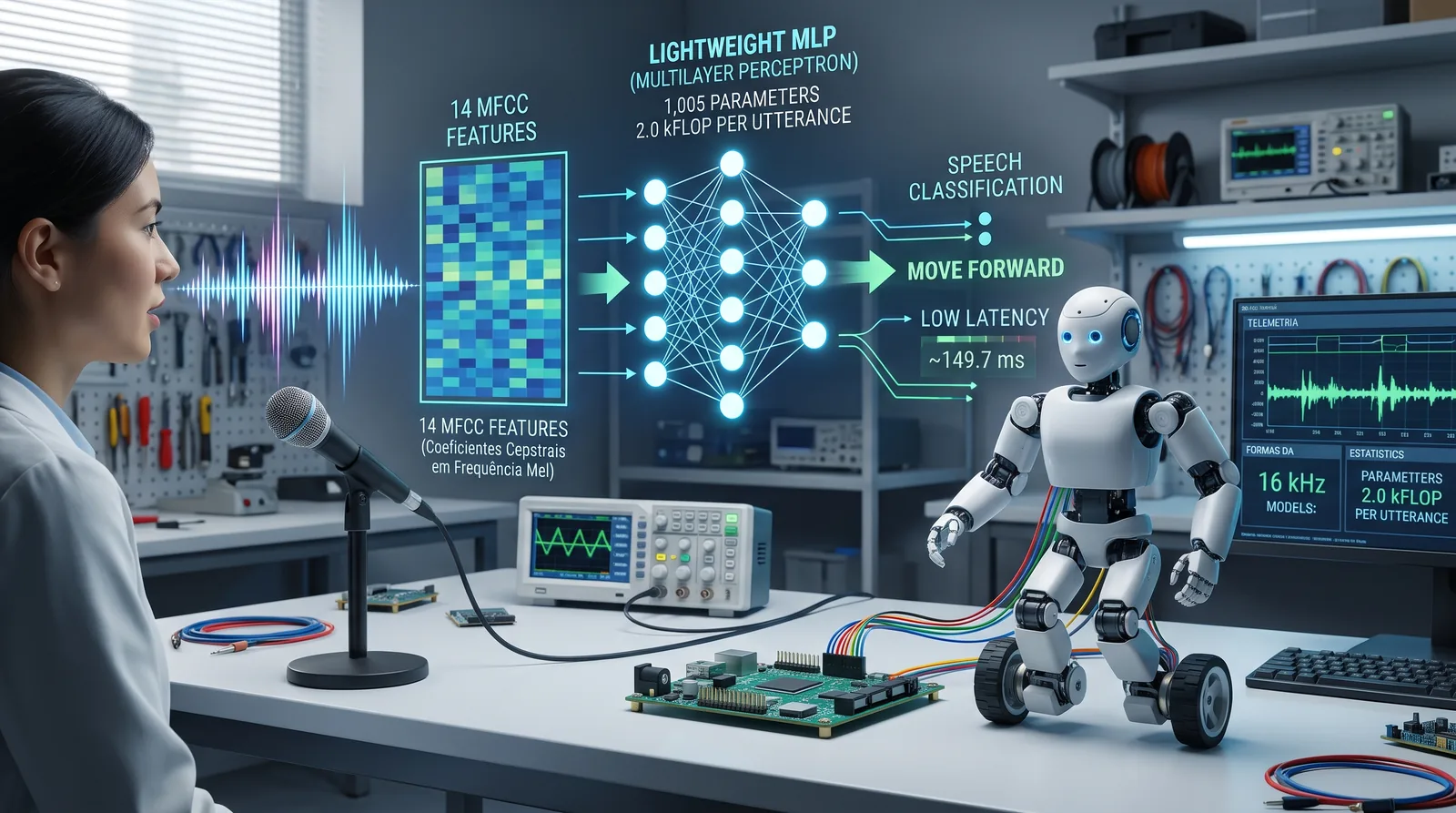
The audio was converted into 14 Mel-frequency cepstral coefficients from every 25 ms frame, using a 10 ms frame hop. These coefficients were then mean-pooled across voiced frames, producing a single 14-dimensional feature vector for each utterance.
A feedforward multilayer perceptron with 1,005 parameters classified those vectors. The network used rectified linear units, a softmax output layer, and scaled conjugate gradient backpropagation, with speaker-defined data partitioning and validation-based early stopping.
Performance on the custom dataset On a class-balanced, speaker-independent test set of 750 utterances—150 per command—the classifier correctly identified 651 utterances. This corresponds to an overall accuracy of 86.8%, with a 95% Wilson confidence interval of 0.842 to 0.890.
The model achieved a macro-averaged precision, recall, and F1 score of 0.87. Per-command recall ranged from 84.0% for “turn right” to 91.3% for “stop.” The directional commands were harder to distinguish because they shared a phonetic prefix.
Command latency, measured from end-of-speech detection to actuator acknowledgement, averaged 149.7 ms with a standard deviation of 3.9 ms. This is a laboratory result under controlled recording conditions, not a measurement of performance in noisy or dynamically changing field environments.
Metric Result Custom-corpus test accuracy 86.8% on 750 speaker-independent utterances. Macro-averaged F1 score 0.87. Best per-command recall 91.3% for “stop.” Lowest per-command recall 84.0% for “turn right.” Average command latency 149.7 ms, standard deviation 3.9 ms. Classifier size 1,005 parameters. Computational demand About 2.0 kFLOP per utterance. Comparison with larger models The compact classifier uses about 33 times fewer parameters than the one-dimensional convolutional neural-network baseline evaluated in the study and 53 times fewer than the long short-term memory baseline. This makes it attractive for embedded or low-power robotic systems where memory, processing capacity, and energy consumption are constrained.
However, the model’s advantage in size does not translate into superior recognition accuracy. When the same feature-extraction and classifier framework was applied to the public Google Speech Commands v0.02 corpus, it reached only 67.5% accuracy, with a 95% Wilson confidence interval of 0.640 to 0.707.
By contrast, the convolutional baseline achieved 95.2% accuracy on that public corpus. The authors state that this result shows the custom-corpus accuracy is specific to that dataset and suggest that utterance-level mean pooling may be an important limitation when the distinguishing acoustic information is brief.
What the laboratory tests do not establish The study does not demonstrate readiness for real-world deployment under realistic acoustic and mission conditions. The authors explicitly describe the work as a transparent, reproducible, speaker-independent laboratory baseline for small-vocabulary humanoid robot voice control, not as evidence of operational readiness.
The custom recordings were collected in a controlled environment with a minimum signal-to-noise ratio of 30 dB. This is substantially cleaner than many field settings, where background machinery, wind, distance from the microphone, reverberation, overlapping speech, and changing microphone placement can degrade recognition.
The vocabulary is also extremely limited: only five motion commands. This makes the task much easier than open-vocabulary speech recognition or natural-language robot control, where users may issue varied, unexpected, or context-dependent instructions.
Limits of mean pooling Mean pooling compresses an entire utterance into one 14-dimensional vector by averaging features across voiced frames. This discards temporal information, including the order and timing of speech sounds within the command.
That design choice reduces computation and makes the classifier very small, but it can weaken performance when commands differ mainly in a short segment. The lower accuracy on Google Speech Commands supports this concern, although the authors note that their experiments do not isolate mean pooling as the sole cause of the performance gap.
The result therefore represents a trade-off: the model gains extreme compactness and low latency at the cost of temporal resolution and reduced robustness outside its custom dataset.
What the humanoid prototype implies The system was implemented within a single integrated development environment rather than relying on an Android-to-Arduino Bluetooth link. This design makes the end-to-end timing more transparent and allows the speech classifier and robot-control logic to operate within one software environment.
The reported 149.7 ms average latency is measured from end-of-speech detection to actuator acknowledgement. It demonstrates that the prototype can respond quickly under laboratory conditions, but it does not establish how the system would perform with real-world microphone hardware, variable distances, background noise, or safety-critical latency requirements.
The study does not report absolute financial costs, manufacturing requirements, power consumption, environmental testing, cybersecurity assessment, or validation in defense or field deployments. Those factors would be essential before treating the system as operationally deployable.
Common misreadings It may seem that the high accuracy on the custom dataset proves the voice system is ready to direct robots in chaotic real-world environments. In fact: the study explicitly states that the setup is a laboratory baseline tested on controlled recordings, and testing on a public speech database produced much lower accuracy than a convolutional baseline.
It may seem that the 1,005-parameter model is universally better than larger models. In fact: it is far smaller and faster, but it reached 67.5% accuracy on Google Speech Commands v0.02 compared with 95.2% for the convolutional baseline.
It may seem that the 149.7 ms latency guarantees real-time field performance. In fact: the latency was measured from speech offset to actuator acknowledgement under controlled laboratory conditions, not in noisy or mission-representative environments.
It may seem that the system can understand broad natural-language instructions. In fact: it recognizes only five predefined motion commands from a small custom vocabulary.
Verdict: The study successfully demonstrates a lightweight neural-network prototype that recognizes five voice commands with 86.8% speaker-independent accuracy, 0.87 macro-averaged F1 score, and 149.7 ms average command latency under controlled laboratory conditions. Its 1,005-parameter footprint and roughly 2.0 kFLOP per-utterance demand make it promising for embedded robot control, but its much lower 67.5% accuracy on Google Speech Commands, reliance on a small custom dataset, loss of temporal information through mean pooling, and lack of field validation mean it is not yet ready for operational deployment.
Based on reporting from Scientific Reports. This is an independent explainer, written in our own words with AI assistance; Scientific Reports has not reviewed or endorsed it. Read the original for the full details.