Accelerating chemical reactor simulations with physics-guided machine learning
Researchers at Ghent University developed a physics-guided machine learning framework to model coke-accumulating cracking reactors. This approach bridges data efficiency and physical modeling, potentially transforming how industrial monitoring systems schedule maintenance.
Reviewed by Matheus Grangeiro
- Peer reviewed
- Yes
Key numbers
105fold
computational acceleration achieved by the framework
0.5%
error rate for maximum external wall temperature prediction
4.0version
Creative Commons International License version
Evidence level: Simulation or model
Why it matters: Determining spatial and temporal behavior inside complex chemical reactors is difficult for process engineering, especially in thermal cracking reactors prone to coke buildup. Coke deposits can alter heat transfer, increase wall temperatures, and affect safety and operating schedules. If physics-informed machine-learning models can reproduce reactor behavior quickly and accurately, they could support real-time monitoring and help operators schedule coke removal more effectively. However, this study is based on simulation data rather than physical reactor measurements, so its real-world applicability remains unproven.
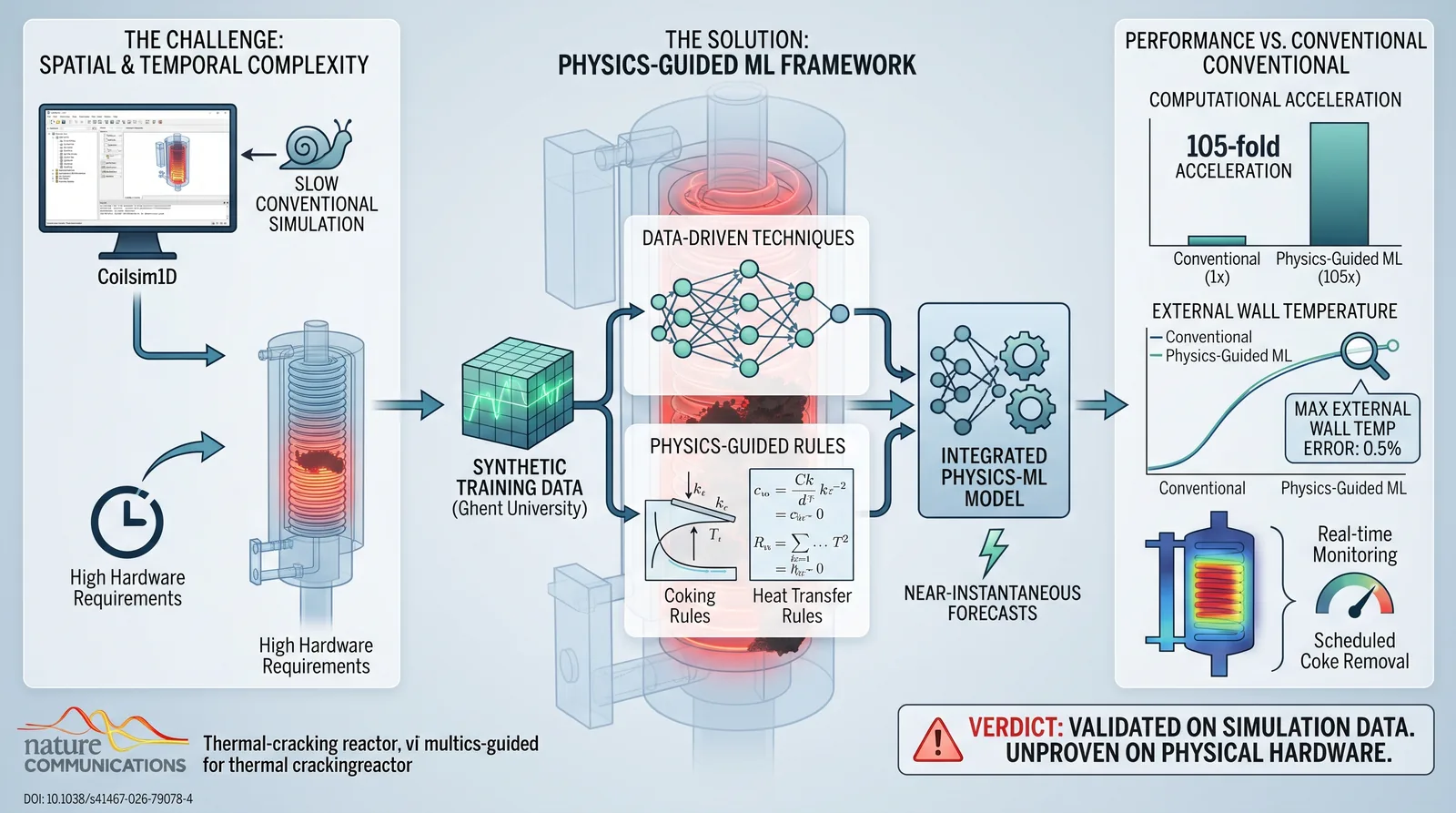
How physics-guided machine learning models coke buildup The researchers developed a physics-informed machine-learning framework that embeds coking mechanisms and heat-transfer principles into a neural-network architecture and its training constraints. This approach combines data-driven learning with domain-specific physical knowledge rather than relying solely on black-box pattern recognition.
The model system was a coke-accumulating cracking reactor. The study used simulation data generated by Coilsim1D, software developed by the Laboratory for Chemical Technology at Ghent University and AVGI.
The framework aims to reproduce the spatiotemporal distributions of key operational parameters inside the reactor. These distributions describe how conditions change across both space and time, which is essential for identifying localized regions where coke accumulation or overheating may become critical.
Performance versus conventional simulation The proposed approach reproduced the spatiotemporal distributions of key operational parameters obtained from conventional simulations with high fidelity. It also achieved a computational acceleration of 10 5 10 5 , or 100,000-fold, relative to the conventional simulation approach.
The incorporation of mechanistic knowledge improved prediction fidelity for safety-critical indicators. In particular, the model predicted the maximum external wall temperature with an error below 0.5%.
Metric Result Computational acceleration 10 5 10 5 -fold, or 100,000-fold. Maximum external wall temperature error Below 0.5%. Data source Coilsim1D simulation dataset. Physical validation Not reported. Reactor geometries tested Not specified in the abstract. Evaluating data efficiency and physical modeling Data-driven methods can offer computational advantages, but incorporating domain-specific physical knowledge can further improve predictive performance. In this study, coking mechanisms and heat-transfer principles were embedded directly into the neural-network architecture and training constraints.
This integration helps the model remain consistent with known physical behavior rather than relying exclusively on correlations in the training data. It also improves prediction fidelity for safety-related outputs, particularly maximum external wall temperature.
Accurate temperature forecasting can help determine optimal decoking intervals. By identifying when wall temperatures approach critical thresholds, operators may be able to schedule coke-removal interventions more precisely.
What remains unproven for industrial use The study relies on a simulation dataset generated by Coilsim1D rather than physical measurements from an operating reactor. This means the reported accuracy and acceleration apply to the simulated system, not directly to real-world hardware.
The abstract does not report hardware requirements, scaling properties, or performance across different reactor geometries. It also does not establish that the framework can operate reliably under real industrial conditions, where sensor noise, fouling, feed variability, and equipment degradation may affect model performance.
The authors state that the paradigm provides a useful reference for developing real-time monitoring and optimization models for complex industrial systems. This is a prospective application, not a demonstrated deployment.
Common misreadings It may seem that machine learning alone replaced conventional simulation software entirely. In fact: the methodology integrates physical principles and coking rules with data-driven techniques, and it relies on data generated by Coilsim1D.
It may seem that the 100,000-fold acceleration applies to real industrial reactors. In fact: the result applies to simulations based on Coilsim1D data, not to physical reactor measurements or deployed industrial systems.
It may seem that the 0.5% error rate proves the model is safe for operational use. In fact: the error rate applies to maximum external wall temperature prediction within the simulated dataset; real-world validation and safety analysis would be required before deployment.
It may seem that the framework has been tested across multiple reactor geometries. In fact: the abstract does not report such testing, and the study’s evidence is limited to the simulated coke-accumulating cracking-reactor case.
Verdict: Simulations show that a physics-informed machine-learning framework can reproduce key spatiotemporal distributions in a coke-accumulating cracking reactor with high fidelity, accelerate calculations by 100,000-fold, and predict maximum external wall temperature with an error below 0.5%. However, because the work relies entirely on synthetic simulation data from Coilsim1D, it remains unproven on physical hardware or across different reactor geometries.
Based on reporting from Nature Communications. This is an independent explainer, written in our own words with AI assistance; Nature Communications has not reviewed or endorsed it. Read the original for the full details.