Artificial intelligence meets quantum hardware to tame noisy qubits
A multi-institutional team has secured federal funding to develop an AI-driven, fault-tolerant error correction setup for scientific quantum computing. The project merges supercomputers, experimental hardware, and artificial intelligence to tackle qubit instability across complex computational tasks.
Reviewed by Matheus Grangeiro
Key numbers
12million dollars
Federal grant received by the collaboration from the U.S. Department of Energy
12awards
Total number of Phase II awards announced under the Genesis Mission
17times
Reduction in error rates achieved by the neural-network decoder compared to existing versions
40years
Length of time the scientific community has held dreams for quantum computing
Evidence level: Prototype or demonstration
Why it matters: Quantum computers are highly sensitive to environmental noise and qubit instability. These imperfections can disrupt long calculations, limiting the usefulness of quantum simulation for fields such as nuclear science, chemistry, materials science, and fundamental physics. Quantum error correction is intended to protect logical information from physical qubit errors, but conventional approaches can be computationally demanding and may not be optimized for the particular structure of errors arising in a given scientific application. This initiative explores whether artificial intelligence can help design error-correction codes and decoders tailored to specific scientific workloads, rather than relying solely on generic error-correction strategies.
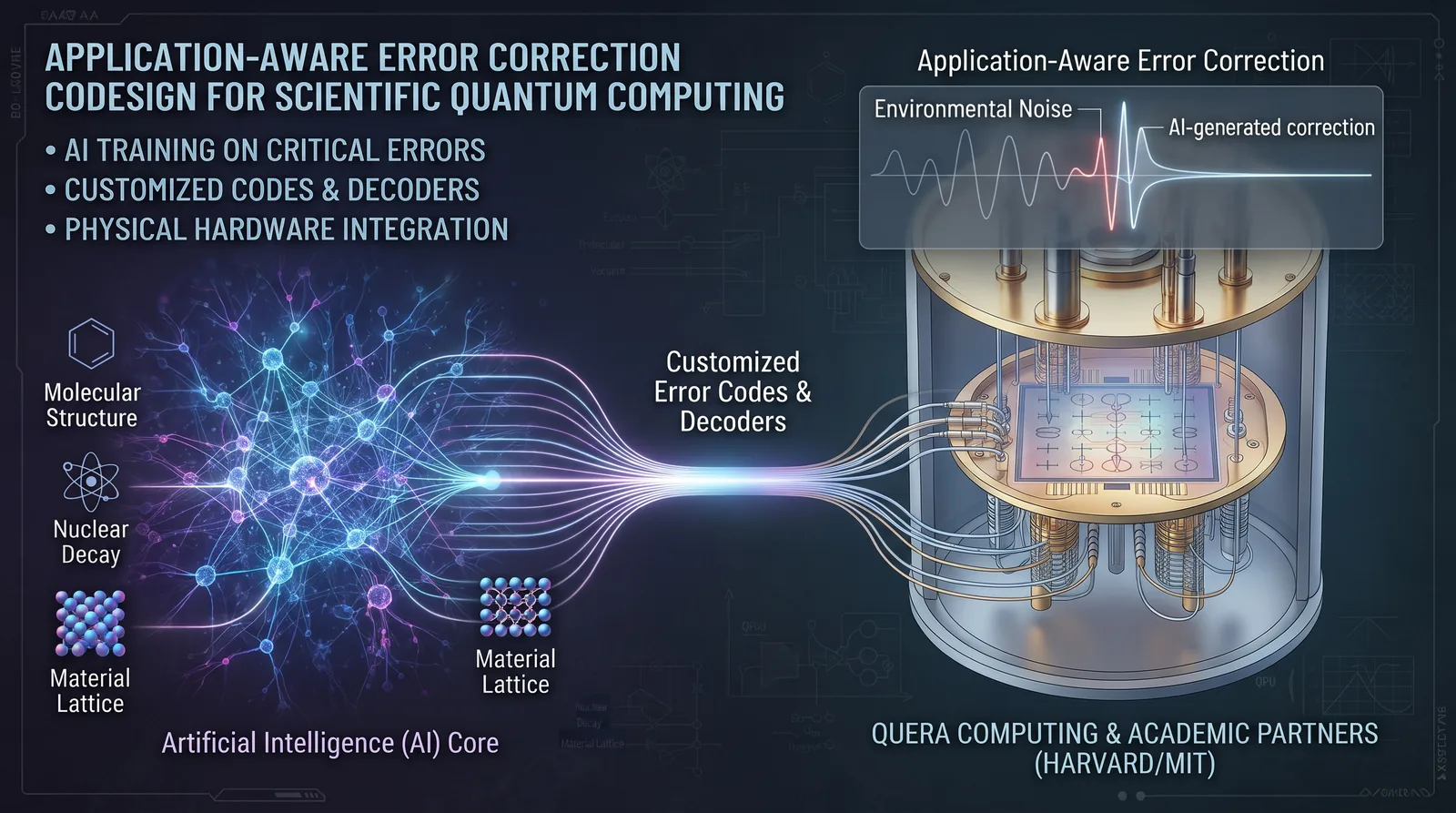
How artificial intelligence addresses qubit instability The Application-Aware Error Correction Codesign for Scientific Quantum Computing project builds on earlier quantum error-correction research. In that earlier work, increasing the number of physical qubits was associated with reduced overall error rates, providing a foundation for more ambitious fault-tolerant approaches. [source]
The new project trains machine-learning models to recognize error patterns relevant to scientific applications, including nuclear science, chemistry, materials science, and quantum simulation. The goal is not for artificial intelligence to replace the quantum computer, but to help formulate customized error-correction codes and decoders suited to particular computational tasks. [source]
This application-aware approach differs from a generic error-correction design. Instead of treating all qubit errors in the same way, the project aims to tailor the correction strategy to the types of errors and computational structures most relevant to a given scientific problem. [source]
The Genesis Mission context The initiative is part of the Genesis Mission program, which seeks to combine supercomputing resources, experimental facilities, and artificial-intelligence platforms to accelerate scientific innovation. The project is funded as one of 12 Phase II awards under that program. [source]
Mikhail Lukin is the principal investigator and co-director of the Harvard Quantum Initiative. The effort is supported by a significant federal grant from the U.S. Department of Energy. [source]
The program is administered by the U.S. Department of Energy’s Advanced Scientific Computing Research division. The current award expands on the group’s earlier theoretical and hardware-development work while emphasizing cooperation across universities, federal laboratories, and private companies. [source]
Testing across academic and private hardware The collaboration includes researchers from academic institutions, federal laboratories, and private enterprises. The newly designed codes and decoders are scheduled to be tested on physical quantum hardware at Harvard, MIT, and QuEra Computing. [source]
This is an important distinction: the project is not merely a software simulation. It is intended to move AI-assisted error-correction designs onto real quantum hardware, where noise, connectivity constraints, calibration errors, and hardware-specific failure modes can affect performance. [source]
However, the available information describes planned testing rather than completed, peer-reviewed validation across all participating platforms. The initiative should therefore be treated as a prototype or demonstration-stage effort, not as a proven fault-tolerant quantum-computing system. [source]
What application-aware error correction means Traditional static error-correction codes generally apply a fixed set of rules to detect and correct errors, regardless of the particular scientific calculation being performed. The proposed approach instead uses artificial intelligence to identify error patterns and design codes and decoders that may be better suited to a specific application. [source]
For example, a chemistry simulation and a nuclear-science calculation may place different demands on a quantum processor. An application-aware decoder could, in principle, exploit structure in the errors or the computation to improve correction efficiency, but that benefit must be demonstrated on hardware rather than assumed. [source]
A recent preprint reportedly described a neural-network error decoder with substantially lower error rates and faster execution speeds. That result is promising, but it does not by itself establish that the full application-aware system will perform reliably across the participating hardware platforms. [source]
What remains unverified on hardware The available information does not specify the technical benchmarks that the hardware must meet to validate fault-tolerant quantum error correction. It also does not provide a detailed timeline for completing milestones across the participating national laboratories and universities. [source]
Important unresolved questions include logical-error rates, code distance, decoder latency, qubit connectivity, calibration stability, overhead in physical qubits, and performance across repeated error-correction cycles. Without these benchmarks, it is not possible to determine whether the approach will scale to scientifically useful quantum computations. [source]
The project’s success will also depend on whether AI-generated codes and decoders can generalize beyond the specific devices and error conditions on which they were trained. A decoder that performs well on one quantum processor may not transfer directly to another architecture without retraining or redesign. [source]
What the prototype does not prove It may seem that artificial intelligence alone performs the quantum calculations. In fact: artificial intelligence is intended to recognize errors, formulate custom codes, and build decoders, while the actual quantum computation and hardware testing occur on physical quantum devices. [source]
It may seem that the project has already demonstrated fault-tolerant quantum computing. In fact: the reported work is at a prototype stage, with AI-generated codes and decoders scheduled for testing on physical hardware at Harvard, MIT, and QuEra. [source]
It may seem that the approach eliminates qubit noise. In fact: the goal is to detect, characterize, and correct errors more effectively; it does not claim that quantum hardware has become noise-free. [source]
It may seem that the reported decoder improvements establish broad practical advantage. In fact: the preprint result is preliminary and must be validated across multiple hardware platforms and scientific workloads before broader claims are justified. [source]
Verdict: The initiative aims to integrate artificial intelligence with physical quantum hardware to design application-specific error-correction codes and decoders for scientific quantum computing. It represents a promising prototype-stage effort, but its real-world utility depends on successful validation on hardware across Harvard, MIT, QuEra, and other participating institutions; the available information does not establish completed fault-tolerant performance, scalability, or deployment timelines.
Based on reporting from Harvard Gazette. This is an independent explainer, written in our own words with AI assistance; Harvard Gazette has not reviewed or endorsed it. Read the original for the full details.