MathHelm coordinates global discussions on automated math manuscripts
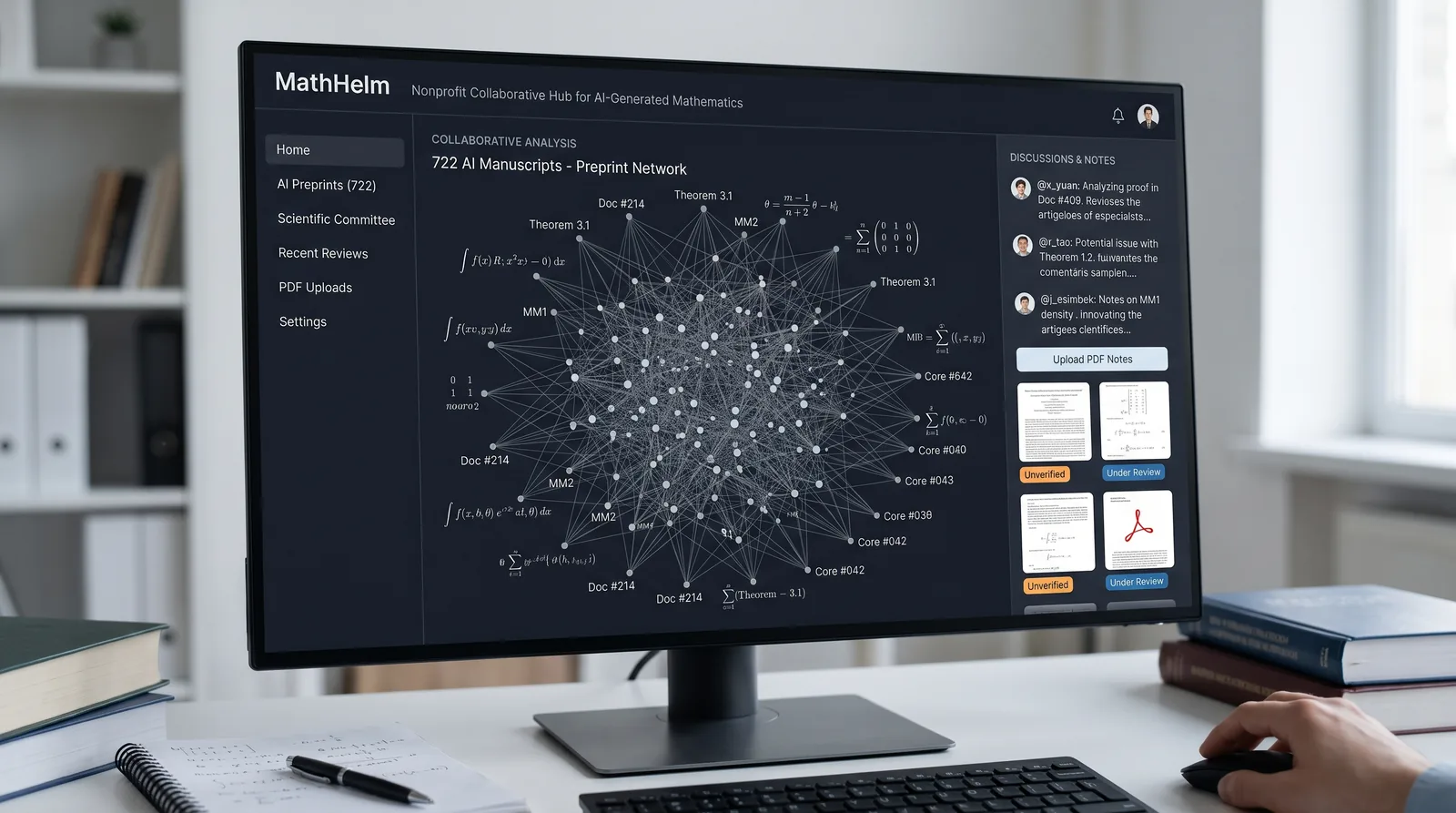
A scientific committee launched a collaborative platform called MathHelm to centralize discussions around 722 AI-authored math documents released in 2026. The nonprofit platform aims to help researchers navigate machine-made preprints that lack traditional human validation.
Reviewed by Matheus Grangeiro
- Sample size
- 722
Key numbers
722manuscripts
Mathematical manuscripts generated by an internal AI model released by OpenAI
2026year
Year when OpenAI released the AI-generated mathematical manuscripts
Evidence level: Community-platform announcement; no empirical evaluation reported
Why it matters: On 6 October 2026, OpenAI released 722 mathematical manuscripts generated by an internal AI model, claiming significant results across multiple research areas. Most were not verified by humans, and many results lacked accompanying Lean verification. The volume and unfamiliar presentation created a need for a shared space where mathematicians could discuss, question and contextualize this output.
How MathHelm coordinates global mathematical discussions MathHelm is a nonprofit, community-run forum created by an international scientific committee to centralize discussion of AI-generated mathematical papers. It is open to researchers worldwide, with discussions primarily in English.
Participants are invited to register under their real names and may upload personal PDF notes. Comments can address correctness, readability, originality, main results or key ideas; the platform encourages objective, specific contributions and relevant references.
The forum was founded by the MathHelm scientific committee and operates on a nonprofit basis to serve the mathematical community. It focuses on mathematical content and takes no predetermined position for or against AI.
Managing the flood of AI-generated mathematics OpenAI released the 722 manuscripts on 6 October 2026. The MathHelm announcement states that most were not verified by humans and that many results did not have accompanying Lean verification.
The post describes the collection as intimidating: the papers often differed from familiar scholarly conventions, and individual mathematicians could not quickly assess most arguments on their own. Useful discussions were already occurring online, but were scattered and easy to miss.
MathHelm is intended to bring those discussions together. It is not a peer-review service, a validation pipeline or a systematic assessment programme; it provides a shared venue for comments, questions and partial observations.
Evaluating the response to automated math preprints The MathHelm scientific committee is chaired by Xinyi Yuan of Peking University. Its members include Yi Ni of Caltech, Xiaoming Sun of the Institute of Computing Technology, Chinese Academy of Sciences, Liang Xiao of Peking University, Yuan Yuan of Westlake University, Ruixiang Zhang of the University of California, Berkeley, and Fan Zheng of ICMAT–CSIC in Spain.
The platform’s initial focus includes the 722 OpenAI manuscripts, but it is also open to discussion of other AI-generated papers and related mathematical questions.
MathHelm is currently presented as operational: researchers can register under real names, discuss papers and upload personal notes. The announcement does not report user numbers, moderation procedures, content-quality controls, accessibility features or measures of discussion effectiveness.
What MathHelm does not guarantee It may seem that MathHelm was created to endorse or validate the accuracy of AI-generated mathematical research. In fact: the platform takes no predetermined position for or against AI and provides a venue for discussion rather than a validation service.
It may seem that mathematicians are required to review the OpenAI manuscripts. In fact: the announcement states that mathematicians have no obligation to check AI-generated papers.
It may seem that the policy prohibiting AI training on forum content is enforceable. In fact: the policy prohibits such use, but the post’s comments question whether it can be legally or technically enforced.
It may seem that MathHelm systematically organizes and assesses automated mathematical output. In fact: it centralizes community discussion; individual researchers still decide what to read, question or verify.
It may seem that all 722 manuscripts deviate from academic standards. In fact: the announcement says their presentations often differ from familiar scholarly conventions; it does not claim that every manuscript is non-standard.
The announcement does not report user adoption, moderation capacity, verification outcomes, dispute-resolution procedures or evidence that centralized discussion improves assessment of AI-generated mathematics.
Verdict: The MathHelm scientific committee launched a nonprofit forum to centralize discussion of AI-generated mathematical papers, beginning with the 722 unverified manuscripts released by OpenAI on 6 October 2026. The platform invites real-name participation and PDF uploads, but it does not validate papers, require review, guarantee enforcement of its AI-training policy or demonstrate that centralized discussion improves mathematical assessment.
Based on reporting from Terence Tao (UCLA). This is an independent explainer, written in our own words with AI assistance; Terence Tao (UCLA) has not reviewed or endorsed it. Read the original for the full details.