Mapping invisible cosmic structures through gravitational lenses
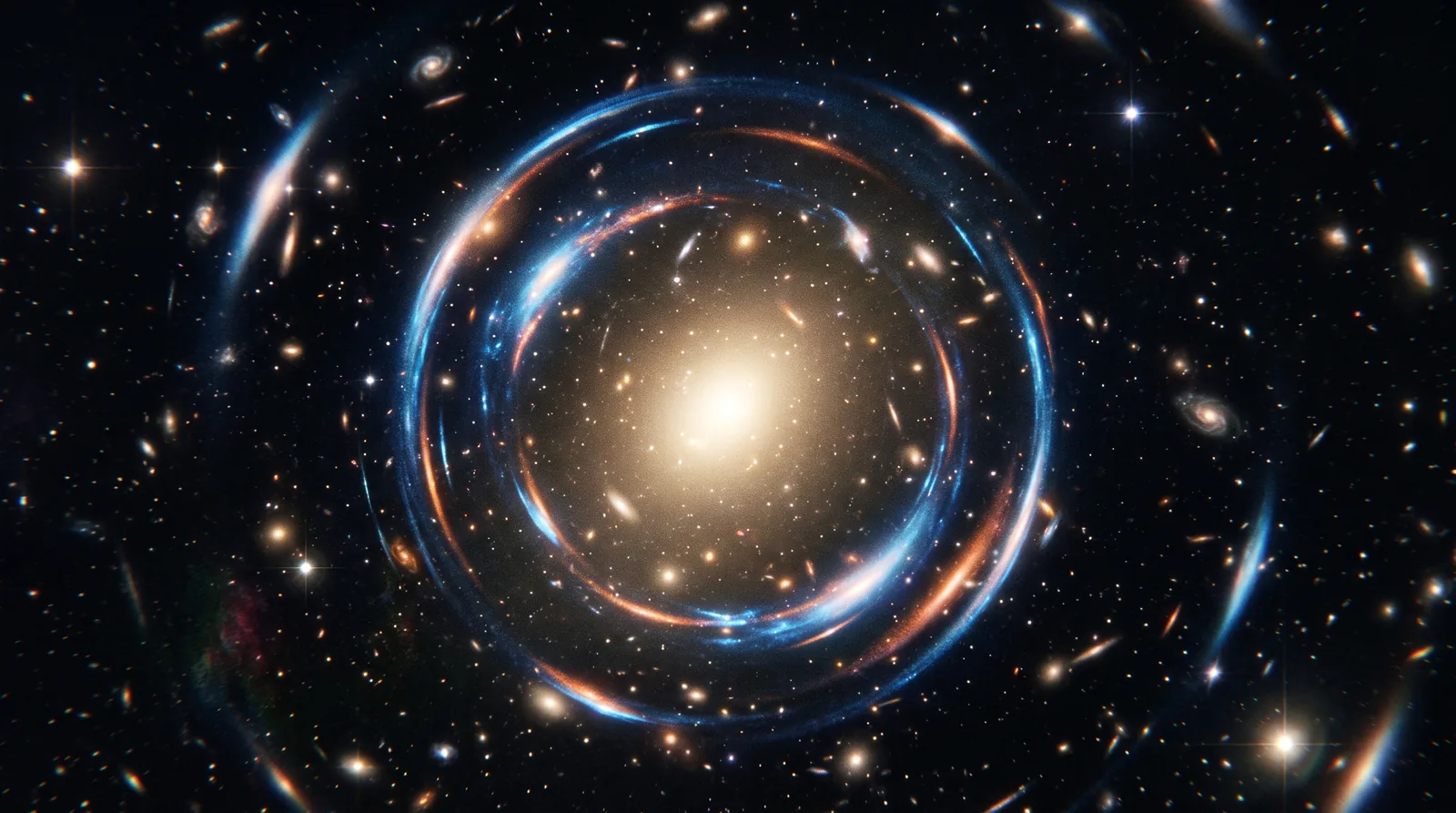
Astronomers are using collections of gravitationally lensed galaxies captured by Hubble to test dark matter theories and prepare analytical pipelines for upcoming data from the Roman telescope. This dual-telescope strategy enables researchers to spot microscopic irregularities in lensed arcs that signal hidden matter clumps.
Reviewed by Matheus Grangeiro
Key numbers
1.3trillion solar masses
Estimated dark matter halo mass of the Milky Way galaxy
Evidence level: Observational astronomy; Hubble imaging and lens modelling
Why it matters: Dark matter is invisible, but its gravity affects how light travels through the universe. Strong gravitational lenses offer a way to measure the distribution of mass—including dark matter—around foreground galaxies and to test predictions about small dark-matter clumps.
How gravitational lensing magnifies distant galaxies Albert Einstein first predicted gravitational lensing, which occurs when the gravity of a massive foreground object bends, warps and magnifies light from a more distant background object. NASA describes the effect as a natural cosmic lens that can reveal objects much farther away than a telescope could otherwise observe.
When a distant background galaxy aligns closely behind a massive foreground galaxy, its light can appear as distorted, magnified arcs around the foreground galaxy. Depending on the alignment and mass distribution, the background galaxy may also appear as an arc–counterarc pair, an Einstein ring or a quadruply lensed configuration.
Astronomers measure the distortion of lensed background galaxies to infer the quantity and distribution of mass in the foreground lens, including its invisible dark matter. These measurements do not directly image dark matter; they infer its gravitational effects.
Bridging Hubble imaging and Roman’s wide-field survey The strong lenses highlighted by NASA were first detected by the Dark Energy Spectroscopic Instrument (DESI) at Kitt Peak. Hubble subsequently observed them, and the Nancy Grace Roman Space Telescope—launched in August 2026—will take further observations.
Hubble observes primarily in visible and ultraviolet light, with some infrared coverage, and provides high-resolution views of individual objects. Roman observes primarily in infrared light, with some visible coverage, across a much larger field of view.
This complementarity matters because Roman is expected to find more lenses across wider areas of sky, while Hubble can provide detailed follow-up observations of especially interesting targets. NASA states that Hubble’s sharper view can reveal small imperfections in lensed arcs that may indicate small dark-matter clumps.
Testing predictions of cold dark matter The Milky Way’s dark-matter halo is estimated to contain approximately 1.3 trillion solar masses. Cold dark matter theory predicts many smaller clumps, ranging from one million to one billion solar masses.
By modelling Hubble’s high-resolution lens images, researchers hope to detect small distortions in gravitationally lensed arcs that could reveal these low-mass clumps. Finding—or failing to find—such clumps could help confirm or dispel predictions of cold dark matter theory.
This is a test of a theoretical prediction, not a direct detection of dark-matter particles. A positive result would support the cold-dark-matter framework; it would not by itself prove that dark matter consists of a particular particle species.
What foreground and background variations reveal Most of the foreground lensing galaxies shown by NASA are elliptical galaxies, which tend to be older, denser and more compact. However, not all foreground lenses are elliptical: some appear elongated or have spiral arms, and one has a visible dust lane.
These differences can help researchers investigate alternative evolutionary pathways for galaxies. A dust lane is rare in a lensing galaxy, and Hubble’s sharp visible-light imaging is particularly useful for revealing such detail.
The colours of lensed background galaxies also carry information: bluish arcs generally indicate younger stars, while reddish arcs indicate older stellar populations. Hubble and Roman will use these differences to study how galaxies evolved earlier in the universe.
What the Hubble–Roman collaboration does not show It may seem that Hubble and Roman serve the same observational purpose. In fact: Hubble provides high-resolution visible and ultraviolet imaging of individual targets, while Roman provides a much wider field of view, primarily in infrared.
It may seem that detecting small dark-matter clumps would validate cold dark matter theory outright. In fact: it could support or challenge specific predictions of the theory; the NASA article frames the goal as confirming or dispelling them.
It may seem that all strong lenses form Einstein rings or concentric arcs. In fact: the observed configurations include arc–counterarc pairs, Einstein rings and quadruply lensed galaxies, depending on alignment and mass distribution.
It may seem that elliptical galaxies are the only possible foreground lenses. In fact: NASA notes that not all foreground galaxies in the sample are elliptical; some have spiral arms, elongated shapes or dust lanes.
It may seem that the “super-intelligence tool” is already deployed or fully specified. In fact: NASA says researchers intend to build it to search for similar arcs in future Roman images; the article does not describe its architecture, training data, accuracy or deployment timeline.
Verdict: Hubble’s gravitational-lens observations provide high-resolution examples that can refine lens models, probe dark-matter distribution and prepare researchers to analyse Roman’s broader sample. The approach may test predictions of cold dark matter theory, but it does not directly detect dark matter, does not yet establish whether small clumps will be found, and does not specify the AI tool’s design or observation schedule.
Source: NASA. The original is licensed Domínio público (EUA), exceto imagens e conteúdo de terceiros. This text is an AI-assisted adaptation (summarized, simplified and translated) and may differ from the original.