Mapping a billion cosmic bodies with the Euclid space telescope
The European Space Agency and the Euclid Consortium released their initial major data collection, gathering illumination from over one billion astronomical bodies across 13 months of observations. This foundation allows researchers to trace cosmic history across 10 billion years and study the large-scale structure of the universe.
Reviewed by Matheus Grangeiro
Key numbers
9500full Moons
area of sky covered by the release
13months
duration of observations in DR1 Foundation
2023year
space telescope launch timing
10000images
number of science images analyzed
900million
number of galaxies
15000candidates
strong gravitational lensing candidates
60million
quasar candidates
160million
sources with spectra
Evidence level: Observation or measurement
Why it matters: Mapping the large-scale structure of the universe requires observations that are both wide and precise. Ground-based telescopes must look through Earth’s turbulent atmosphere, which blurs fine details and complicates the measurement of faint, distant galaxies. Euclid observes from space, allowing it to conduct broad surveys in visible and near-infrared light with the stability needed to trace galaxies, galaxy clusters, quasars, and gravitational lenses. These observations provide the raw material for studying dark matter, dark energy, and the cosmic web.
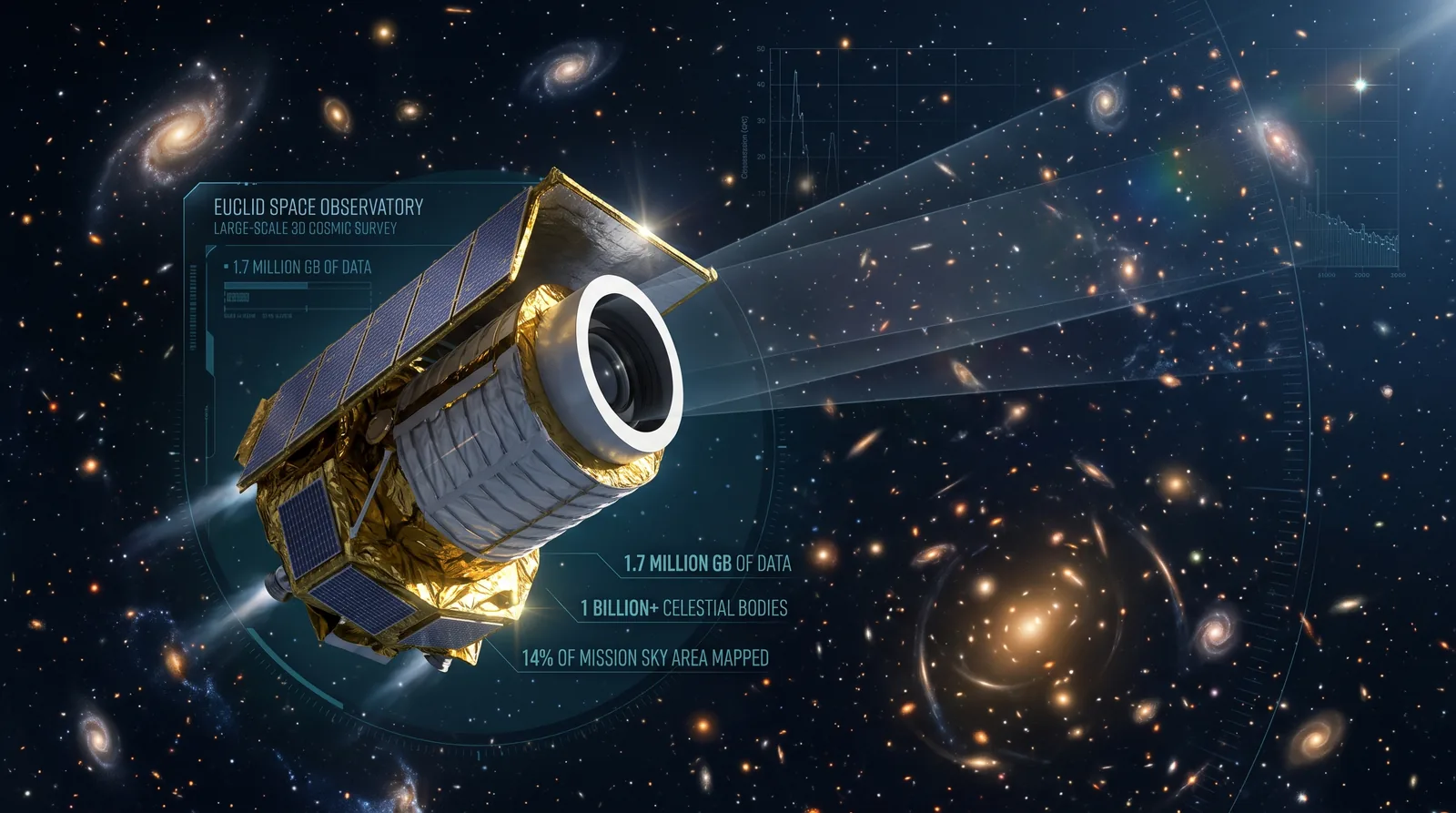
How Euclid maps celestial bodies The Euclid Consortium and the European Space Agency released the DR1 Foundation dataset, the mission’s first major data release since its launch in mid-2023. It compiles observations from 13 consecutive months and captures light from more than one billion astronomical objects across an area equivalent to 9,500 full Moons.
Euclid uses two main instruments: VIS, a 600-megapixel visible-light camera, and NISP, the Near-Infrared Spectrometer and Photometer. The release includes large sky mosaics, optical images, near-infrared observations, and spectra from more than 160 million sources.
Operating above Earth’s atmosphere allows Euclid to avoid the image blurring and light dimming caused by atmospheric turbulence. This enables deep and wide surveys that ground-based telescopes cannot achieve with the same combination of sky coverage, image quality, and sensitivity to rare distant objects.
Scale of the initial release The DR1 Foundation release contains about 1.7 million gigabytes of data derived from roughly 10,000 science images. It covers 1,900 square degrees of sky, equivalent to about 14% of the sky area planned for Euclid’s six-year mission.
Dataset feature DR1 Foundation result Observation period 13 months. Science images analyzed About 10,000. Total data volume About 1.7 million GB. Galaxies identified More than 900 million. Strong gravitational-lens candidates Around 15,000. Quasar candidates More than 60 million. Spectra released More than 160 million sources. Sky coverage 1,900 square degrees, about 14% of the planned six-year survey. The release includes more than 900 million galaxies, around 15,000 strong gravitational-lens candidates, and more than 60 million quasar candidates. It is therefore a major early milestone, but it is not the completed Euclid survey.
Gravitational lensing and cosmic structure Strong gravitational lensing occurs when the gravity of a massive foreground object bends and magnifies light from a more distant background galaxy. Euclid identified approximately 15,000 strong-lens candidates, forming the largest catalogue of strong lenses ever assembled—larger than all previous catalogues combined.
These lenses are scientifically valuable because they can help researchers infer the distribution of mass in foreground galaxies, including dark matter. Multiple images of the same background object, whose brightness may vary over time, can also help scientists probe the expansion of the universe.
Galaxy clusters are another major target. They reveal how matter clumps together and how cosmic structure grows over time. Euclid’s wide-field observations make it possible to study large samples of ancient galaxy clusters that were previously difficult to access.
From images to a 3D map Euclid’s ultimate goal is not only to photograph the sky but to construct a three-dimensional map of the universe. Spectroscopy splits galaxy light into its component wavelengths, allowing researchers to estimate distances and place galaxies within the cosmic web.
The current release provides the foundation for that work, but the full three-dimensional mapping effort is still underway. The complete DR1 release, expected in mid-2027, will add weak-lensing observations and measurements of how galaxies and galaxy clusters fit into the cosmic web.
Weak lensing differs from strong lensing: rather than producing dramatic arcs or multiple images, it produces subtle distortions in the shapes of many background galaxies. Detecting those distortions requires exceptionally precise image processing and photometric calibration.
International collaboration and data processing German institutions played a central role in Euclid’s instruments and data infrastructure. The Max Planck Institute for Astronomy in Heidelberg and the Max Planck Institute for Extraterrestrial Physics near Munich contributed critical optical components, while the German Science Data Centre processes observations into scientifically usable products.
More than 300 research institutions in Germany and abroad are involved in analyzing the data, and more than 2,500 researchers use the release. The German Space Agency at DLR provided 60 million euros from Germany’s National Space Programme to support participating German research institutes.
ESA selected Thales Alenia Space as prime contractor for the satellite and service module, while Airbus Defence and Space developed the payload module, including the telescope. NASA supplied detectors for the NISP instrument.
What the 14% release does not show The current dataset covers only about 14% of the total sky area Euclid is scheduled to survey during its six-year mission. It is therefore an early foundation release, not the final or complete map of the universe.
The release also does not include the full weak-lensing analysis or the complete cosmological interpretation of galaxy and cluster distributions. Those components are scheduled for the full DR1 release in mid-2027.
Although Euclid has captured light from more than one billion objects, the source specifies that the release includes more than 900 million galaxies. These categories are not identical: “objects” includes other astronomical sources, while “galaxies” refers specifically to identified galaxies.
Common misreadings It may seem that the entire six-year mission dataset is now fully available. In fact: the current release covers only about 14% of the planned sky area, while the full DR1 release is expected in mid-2027.
It may seem that Euclid has already completed its three-dimensional map of the universe. In fact: the DR1 Foundation release lays the groundwork for that map; full weak-lensing analysis and cosmic-web placement are still to come.
It may seem that the release contains more than one billion galaxies. In fact: it captures light from more than one billion objects, including more than 900 million galaxies.
It may seem that all gravitational lenses in the dataset have been confirmed. In fact: the release identifies around 15,000 strong gravitational-lens candidates, which still require follow-up confirmation and analysis.
Verdict: Initial observations from the Euclid space telescope successfully captured light from more than one billion astronomical objects across 13 months of observations, producing a 1.7-million-GB dataset covering about 14% of the planned six-year survey area. The release provides an unprecedented early foundation for mapping dark matter, dark energy, galaxy clusters, and gravitational lenses, but the full three-dimensional cosmic map, weak-lensing analysis, and complete survey remain scheduled for later releases, with the full DR1 expected in mid-2027.
Based on reporting from Max Planck Society. This is an independent explainer, written in our own words with AI assistance; Max Planck Society has not reviewed or endorsed it. Read the original for the full details.