Clearing haze with state-space modeling
Researchers introduced a method that pairs linear-scaling state-space modeling with local detail reconstruction to remove haze from images. This approach achieves strong benchmark metrics while running substantially faster than heavy transformer alternatives.
Reviewed by Matheus Grangeiro
- Peer reviewed
- Yes
Key numbers
42.48dB
RESIDE SOTS benchmark indoor peak signal-to-noise ratio
0.9968
RESIDE SOTS benchmark indoor structural similarity
36.18dB
RESIDE SOTS benchmark outdoor peak signal-to-noise ratio
0.9931
RESIDE SOTS benchmark outdoor structural similarity
512 x 512pixels
Resolution for processing speed test
80.62ms
Execution time on an RTX 4090
Evidence level: Simulation or model
Why it matters: Removing haze from a single image requires balancing two competing needs: the model must understand broad, image-wide haze patterns while preserving fine edges, textures, and object boundaries. Convolutional networks often recover local detail well but may lose global consistency, while Transformer-based global models can be computationally expensive. Geometry-aware methods can also fail if unreliable depth information is introduced too aggressively. SSMDehazeNet combines a state-space branch for global haze propagation with a local reconstruction branch and a progressive depth-modulation mechanism, aiming to improve both quality and computational efficiency.
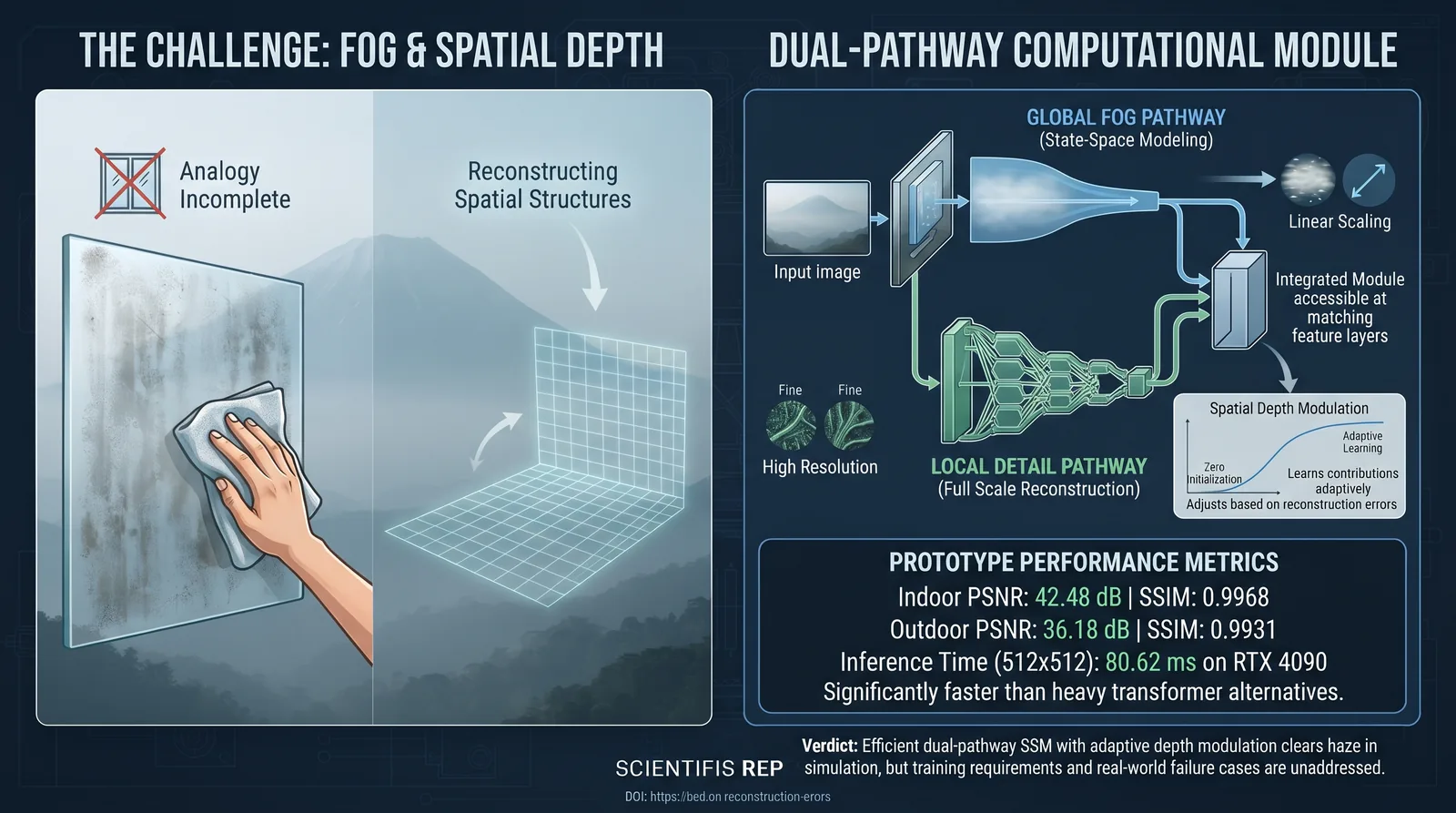
How the dual pathways process haze The model uses two parallel computational branches. One branch applies state-space modeling to propagate scene-wide haze statistics with linear computational complexity, while the other reconstructs fine structural details at full resolution.
Both branches are coupled within a Parallel Hybrid State-Space Module. This design keeps global and local information available at the same feature layer, rather than forcing the network to choose between broad haze removal and detailed reconstruction.
The global branch is intended to handle haze that varies across the image, while the local branch preserves edges and fine structures. This division addresses a common weakness of purely convolutional architectures, which can restore local detail but struggle to maintain coherence across an entire scene.
How progressive depth modulation works The model incorporates geometry through a zero-initialized Spatial Depth Modulator. At the beginning of training, this design gives depth-related information negligible influence, reducing the risk that imperfect depth estimates destabilize learning.
As training proceeds, the network learns how much weight to assign to the depth cue. The depth-consistency objective is also modulated by the current reconstruction residual, meaning that the influence of geometry adapts to the model’s ongoing reconstruction performance.
This approach does not mean the network relies entirely on external depth data. Instead, it introduces depth-related information progressively and lets the model learn its contribution from data, reducing the chance that erroneous depth estimates dominate early training.
Performance on benchmark datasets On the RESIDE SOTS benchmark, SSMDehazeNet achieved a peak signal-to-noise ratio of 42.48 dB and a structural similarity index of 0.9968 for indoor images. For outdoor images, it achieved 36.18 dB and 0.9931, respectively.
Benchmark condition Peak signal-to-noise ratio Structural similarity RESIDE SOTS indoor 42.48 dB. 0.9968. RESIDE SOTS outdoor 36.18 dB. 0.9931. These results indicate strong restoration quality on the benchmark datasets. However, benchmark performance does not guarantee that the model will perform equally well on real-world images with unusual lighting, motion blur, sensor noise, extreme haze, or complex outdoor scenes.
The authors also report favorable no-reference image-quality results, but the abstract does not provide the specific no-reference metric values. This means the available information supports the claim qualitatively but does not quantify that part of the evaluation.
Computational efficiency At a resolution of 512 by 512 pixels, SSMDehazeNet processed an image in 80.62 milliseconds on an NVIDIA RTX 4090 graphics card. This corresponds to approximately 12.4 frames per second under those test conditions.
The authors state that this runtime is substantially faster than heavy Transformer-based dehazing methods. The speed advantage arises from the state-space branch’s linear computational scaling, which avoids the high computational cost often associated with global Transformer-style modeling.
The reported timing is an inference measurement on specific hardware, not a universal runtime guarantee. Performance will vary with image resolution, batch size, hardware configuration, software environment, and implementation details.
Generalization and robustness testing The study includes zero-shot evaluations on the external O-HAZE and NH-HAZE datasets. These tests assess how the model performs on data it was not trained on, providing a measure of generalization beyond the RESIDE SOTS benchmark.
The evaluation also includes a branch-level analysis and a controlled geometry-corruption study. The geometry-corruption experiment helps characterize the model’s reliance on the learned geometry cue and tests what happens when depth-related information is degraded.
These additional evaluations strengthen the study’s evidence base, but they do not eliminate the need for real-world validation. The available abstract does not report failure cases, field deployment results, or performance under varied camera and environmental conditions.
What remains unknown The source does not provide training time, training hardware requirements, energy consumption, or operational costs. It also does not report failure cases or real-world deployment performance beyond the benchmark and zero-shot evaluations mentioned in the abstract.
The study does not specify how the model would perform on much higher-resolution images, video streams, mobile hardware, or embedded devices. The reported 80.62 ms runtime applies to 512 by 512 pixel images on an RTX 4090, not to all deployment scenarios.
The work was supported by the Doctoral Student Training Fund of Changchun University of Science and Technology. The authors declare no competing interests.
Common misreadings It may seem that the network relies entirely on external depth data to guide haze removal. In fact: the Spatial Depth Modulator begins with zero initialization, allowing its contribution to be learned adaptively while the depth-consistency objective is adjusted according to reconstruction error.
It may seem that the benchmark results prove the model is ready for real-world deployment. In fact: the results are from RESIDE SOTS and zero-shot evaluations on O-HAZE and NH-HAZE; the abstract does not report field deployment, failure cases, or operational costs.
It may seem that the 80.62 ms runtime applies to all images and hardware. In fact: it applies to 512 by 512 pixel images processed on an RTX 4090; performance will vary with resolution, batch size, and hardware.
It may seem that the model replaces physical depth sensing. In fact: it uses depth-related geometry as a learned, progressively introduced cue within a dehazing network, rather than relying on it as the sole source of spatial information.
Verdict: Simulations on benchmark datasets show that SSMDehazeNet’s hybrid state-space and local-reconstruction architecture, combined with progressive depth modulation, achieves 42.48 dB and 0.9968 structural similarity on indoor RESIDE SOTS images and 36.18 dB and 0.9931 on outdoor images. It processes 512 by 512 pixel images in 80.62 ms on an RTX 4090, making it substantially faster than heavy Transformer-based alternatives. However, the study leaves training time, hardware requirements beyond inference, real-world failure cases, and operational costs unaddressed.
Based on reporting from Scientific Reports. This is an independent explainer, written in our own words with AI assistance; Scientific Reports has not reviewed or endorsed it. Read the original for the full details.