Magnetic geometry dictates speed and life cycle of solar dynamic fibrils
Researchers analyzed 176 dynamic fibrils around a solar sunspot to understand how wave energy moves through the sun's atmosphere. The findings clarify the physical mechanisms driving solar atmospheric heating and thermal regulation.
Reviewed by Matheus Grangeiro
- Peer reviewed
- Yes
- Sample size
- 176
Key numbers
13182active region
NOAA active region designation
176fibrils
Total dynamic fibrils identified
132fibrils
Fibrils with single-parabolic motion
44fibrils
Fibrils with multi-parabolic motion
120 ± 43m s-2
Mean deceleration of dynamic fibrils
15.9 ± 4.5km s-1
Maximum velocity of dynamic fibrils
1.13 ± 0.48Mm
Maximum length of dynamic fibrils
270 ± 63s
Duration of dynamic fibrils
Press versus study
Equivalent
What the press says
The press text states that the study was published on Nov. 10.
What the study shows
The paper abstract does not mention the publication date.
Evidence level: Observation or measurement
Why it matters: Understanding how energy is transported and dissipated in the Sun’s atmosphere remains a central challenge in solar physics. Dynamic fibrils are small-scale chromospheric structures whose motions may help explain how magnetic energy and slow magnetoacoustic waves move upward from the solar surface. If the observed relationships hold more broadly, they could provide useful observational constraints for models of heating and energy transport across the chromosphere, transition region, and corona.
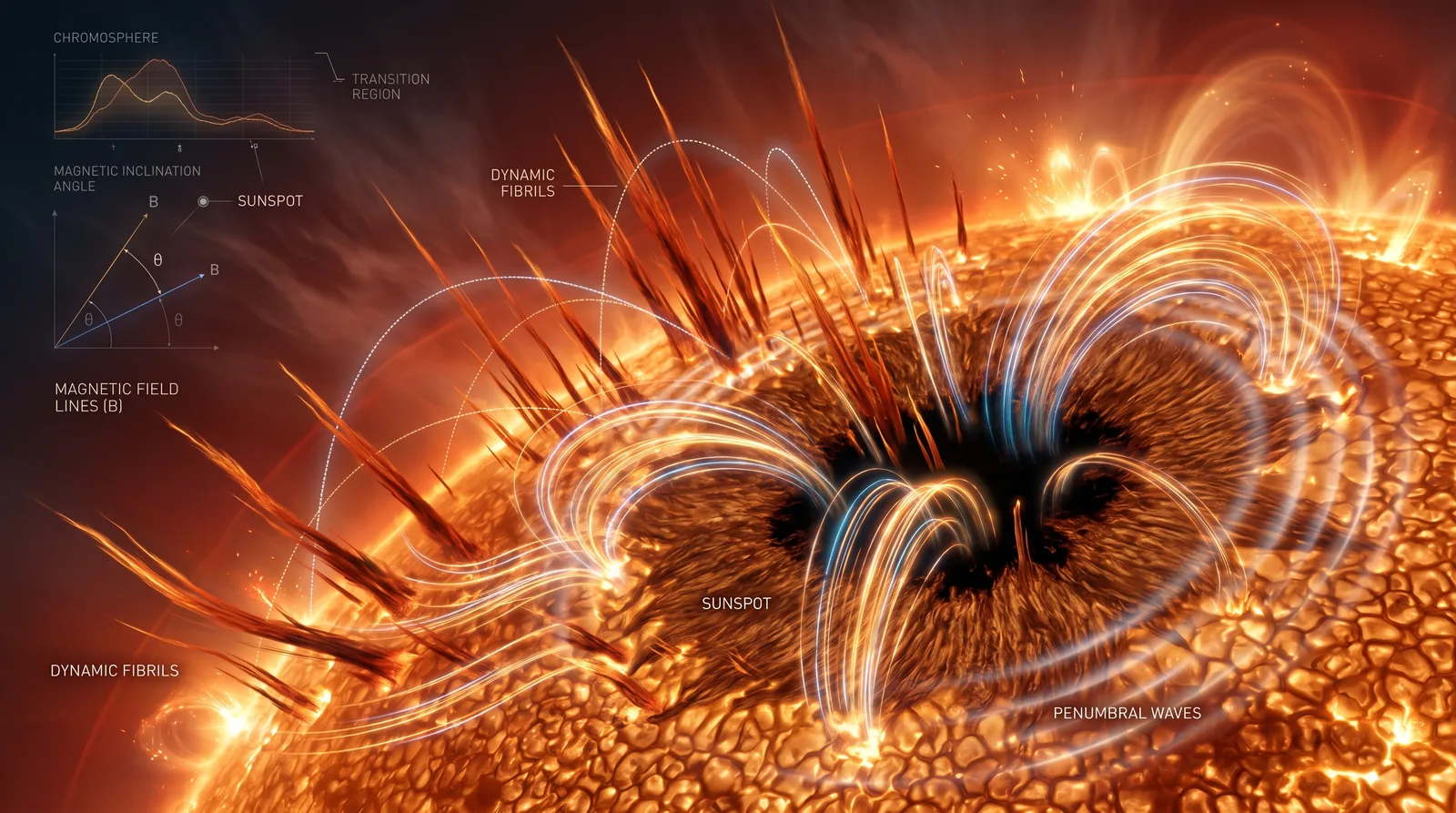
How magnetic fields shape dynamic fibrils Dynamic fibrils are thin, elongated features in the solar chromosphere whose motions are closely associated with magnetohydrodynamic wave processes. Studying how they rise, decelerate, and disappear can help researchers probe the mechanisms that move energy through the Sun’s lower atmosphere.
Researchers at the Yunnan Observatories examined NOAA active region 13182 using high-resolution H-alpha observations from the New Vacuum Solar Telescope on January 10, 2023. They combined these measurements with extreme-ultraviolet images and vector magnetic-field data from NASA’s Solar Dynamics Observatory.
The team identified 176 dynamic fibrils near the sunspot. Of these, 132 showed single-parabolic trajectories, while 44 showed multi-parabolic motion. The distinction matters because multi-parabolic events may reflect repeated or wave-driven motion rather than a single ballistic rise and fall.
Fibrils located in regions with more vertical magnetic fields showed larger deceleration and shorter periods. By contrast, fibrils in regions with more horizontal magnetic configurations showed the opposite behavior. The researchers propose that magnetic-field inclination affects the acoustic cutoff frequency, which in turn regulates the propagation of slow magnetoacoustic waves.
Kinematic measurements and wave links The statistical analysis found moderate-to-strong relationships among several kinematic parameters. Most notably, deceleration showed a significant positive correlation with maximum velocity, with a correlation coefficient of 0.71. This pattern is consistent with shock-driven models, in which stronger upward motion is followed by stronger deceleration.
Across the 176 identified events, the mean deceleration was 120 ± 43 m s − 2 −2 , the mean maximum velocity was 15.9 ± 4.5 km s − 1 −1 , the mean maximum length was 1.13 ± 0.48 Mm, and the mean duration was 270 ± 63 seconds. These values describe the observed sample rather than establishing universal properties for every dynamic fibril on the Sun.
The study also found a spatial and temporal relationship between one multi-parabolic fibril event and running penumbral waves. The dominant oscillation period of that event was 287 seconds, close to the 263-second dominant period of the associated penumbral waves. Together with the timing and spatial correspondence, this supports a physical connection between dynamic fibrils and slow magnetoacoustic waves.
Multi-wavelength observations revealed signatures of dynamic fibrils extending from the chromosphere through the transition region and into the corona. This layered evidence suggests that these structures may contribute to energy transport and atmospheric heating, although the study does not directly quantify how much heating they produce.
What the observations support The evidence supports three specific conclusions. First, magnetic-field inclination is associated with differences in fibril kinematics: more vertical fields correspond to greater deceleration and shorter periods, while more horizontal fields correspond to the opposite pattern.
Second, the observed relationship between deceleration and maximum velocity is consistent with shock-driven models. This does not prove that every fibril is shock-driven, but it provides observational support for that proposed mechanism in this active region.
Third, the close match between the 287-second fibril oscillation and the 263-second running penumbral wave period, combined with their spatial and temporal association, provides evidence linking at least one multi-parabolic fibril event to slow magnetoacoustic waves. This is an observational association, not a demonstration that all dynamic fibrils are driven by the same wave mechanism.
What remains unresolved The published source does not state how many active regions or how long a period was screened before the researchers selected NOAA active region 13182. Without that broader selection context, it is difficult to judge how representative this particular sunspot environment is of solar conditions more generally.
The findings are also based on observations from one active region on one date. Although the sample contains 176 fibrils, the conclusions should not be generalized to all sunspots, all phases of the solar cycle, or all chromospheric conditions without additional observations.
The study provides evidence that dynamic fibrils may participate in energy transport and heating, but it does not measure the actual amount of energy deposited into the upper solar atmosphere. Future work would need to connect the observed motions and wave periods to quantitative estimates of energy flux, dissipation, and heating.
Common misreadings It may seem that all dynamic fibrils move at uniform speeds across the Sun. In fact: their kinematics differ substantially depending on whether they occur in more vertical or more horizontal magnetic-field configurations.
It may seem that the study proves that dynamic fibrils cause coronal heating. In fact: it finds multiwavelength signatures consistent with energy transport and suggests a potential contribution to heating, but does not directly quantify the heating produced.
It may seem that the observed wave connection applies to every fibril. In fact: the explicit spatial and temporal wave association was reported for one multi-parabolic event, while the broader sample supports statistical relationships among kinematic properties.
It may seem that the active region was chosen through a fully described survey of the Sun. In fact: the source does not report the total number of active regions or the time span screened before selecting NOAA active region 13182.
Verdict: High-resolution observations of 176 dynamic fibrils around NOAA active region 13182 show that magnetic-field inclination is associated with fibril kinematics and may regulate slow magnetoacoustic wave propagation. The data support a link between at least one multi-parabolic fibril and running penumbral waves, and suggest a possible role for fibrils in energy transport and heating through the solar atmosphere. However, the findings come from a single observed active region, and the broader screening scope used to select it remains unspecified. Study: doi.org/10.3847/1538-4357/aeaf54