Hybrid quantum-classical brain tumor scan categorization tested in simulation
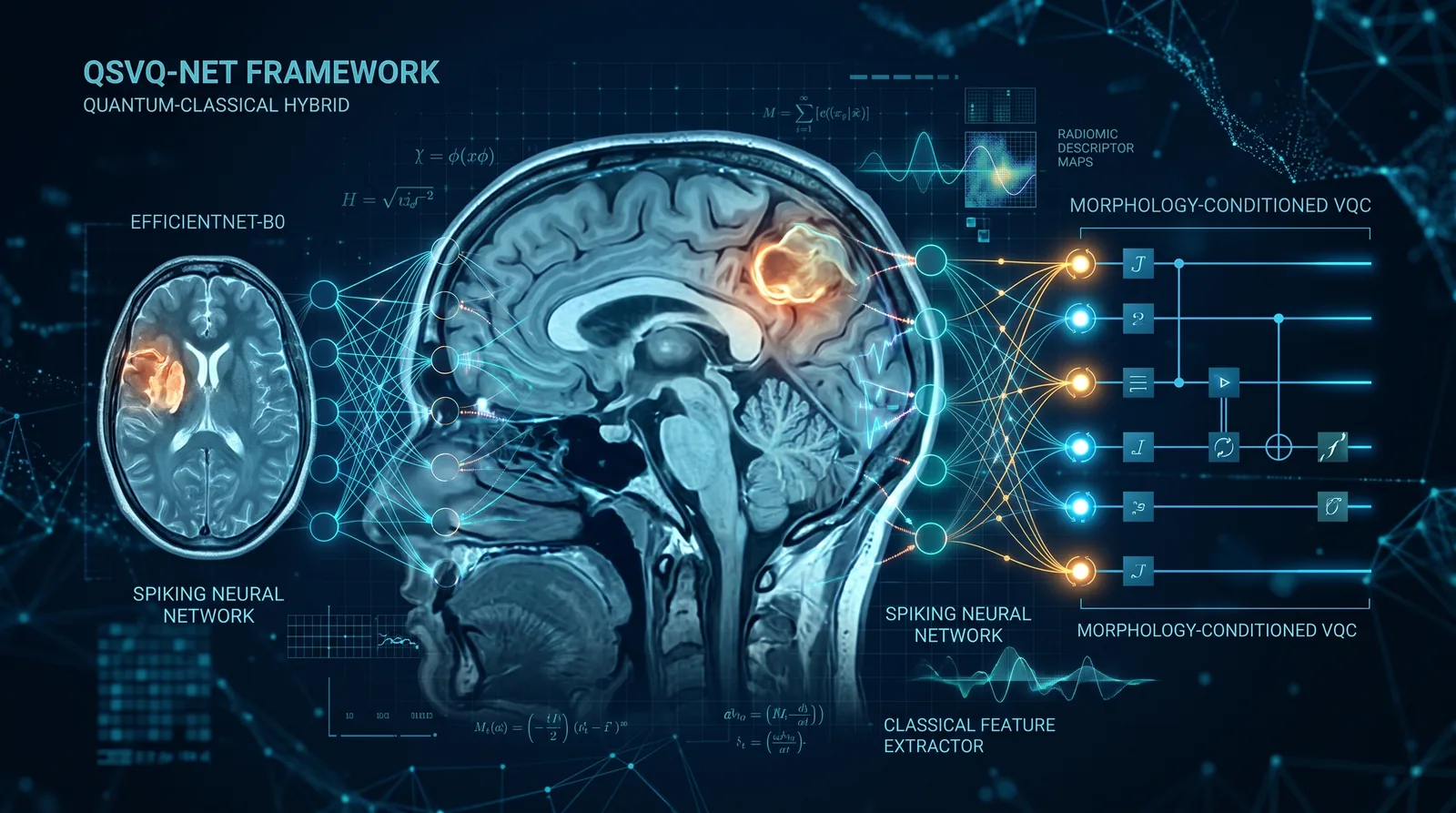
Researchers introduced QSVQ-Net, a hybrid quantum-classical architecture designed to categorize brain tumors from magnetic resonance imaging scans. While internal validation showed high accuracy and low calibration error, independent testing without masks revealed a sharp performance drop relative to traditional models.
Reviewed by Matheus Grangeiro
- Peer reviewed
- Yes
Key numbers
98.8%
accuracy achieved on the BRISC-2025 test partition
0.006null
expected calibration error on the BRISC-2025 test partition
99.48%
accuracy reached under five-fold cross-validation
98.91%
lower bound of the 95 percent confidence interval
100.0%
upper bound of the 95 percent confidence interval
99.57%
accuracy of the EfficientNet-B0 baseline model
0.59p-value
paired t-test comparing QSVQ-Net and EfficientNet-B0
72.6%
accuracy on an independent mask-free dataset
Evidence level: Simulation or model
Why it matters: Accurate brain tumor classification from MRI scans is central to treatment planning, but high-performing deep learning models are often poorly calibrated and rarely evaluated beyond a single dataset. A model may achieve near-perfect accuracy on a controlled benchmark yet fail when applied to images from different hospitals, scanners, acquisition protocols, or clinical workflows. QSVQ-Net is a hybrid quantum-classical framework designed to classify brain tumors from MRI while incorporating morphological information into a variational quantum circuit. Its results show strong internal benchmark performance, but no demonstrated quantum accuracy advantage and a substantial drop in performance on independent mask-free data.
How the hybrid framework processes scans QSVQ-Net combines an EfficientNet-B0 image backbone, a complex-valued spiking neural network, and a morphology-conditioned variational quantum circuit. The EfficientNet-B0 component extracts visual features from MRI scans, while the spiking network processes those representations through a pulse-based computational architecture.
The quantum component uses eighteen morphological and radiomic descriptors to parameterize qubit rotations through a learnable mapping. These descriptors summarize structural and statistical properties of the tumor, such as shape, boundary, texture, and other image-derived measurements. In effect, the model converts imaging features into parameters that shape the quantum state used during classification.
This design is intended to make the classifier sensitive to tumor morphology rather than relying exclusively on raw pixel patterns. However, that same dependence creates a practical vulnerability: if morphology-derived inputs are unavailable, inconsistent, or less reliable in a new dataset, the quantum branch may receive weaker or less informative conditioning signals.
Performance against classical baselines On the BRISC-2025 test partition, QSVQ-Net reached 98.8% accuracy with an expected calibration error of 0.006. Under five-fold cross-validation, it achieved 99.48% accuracy, with a 95% confidence interval of 98.91% to 100.0%.
The study compared QSVQ-Net directly with an EfficientNet-B0 classical baseline. EfficientNet-B0 achieved 99.57% accuracy under cross-validation, while the paired t-test comparing the two models returned p = 0.59. This means the study found no statistically significant difference in performance between QSVQ-Net and the classical baseline.
The evaluation also included confidence intervals, calibration assessment, matched multi-seed ablations, intrinsic circuit characterization, auxiliary localization for mask-free inference, and external validation against classical models. These are appropriate components of a more rigorous machine-learning evaluation, although they do not substitute for prospective clinical validation.
Where the model falters without masks The most important limitation emerged in external testing on an independent dataset without masks. QSVQ-Net’s accuracy fell to 72.6%, while classical baselines retained 90% to 93% accuracy under the same mask-free condition.
This represents a decline of roughly 26 percentage points from the model’s 98.8% internal test result. The authors trace the failure to the morphology branch, which is consistent with the architecture’s reliance on eighteen morphological and radiomic descriptors to condition the quantum circuit.
The result indicates that QSVQ-Net’s high internal performance does not yet demonstrate robust generalization to real-world settings where pre-segmented tumor masks or reliable morphology-derived features may not be available. It also suggests that the model’s apparent advantage in controlled benchmark conditions may depend on inputs that are not consistently available in routine clinical imaging.
Quantum advantage and generalization limits The study does not claim a quantum accuracy advantage. The authors state that the quantum branch performed within the confidence-interval overlap of a parameter-matched classical control, meaning that its results were statistically indistinguishable from the matched classical comparison under the evaluated conditions.
This is an important distinction. The presence of a quantum circuit does not by itself establish practical quantum advantage. To support such a claim, researchers would need to show measurable benefits over appropriate classical alternatives—such as higher accuracy, better calibration, greater robustness, lower computational cost, or improved efficiency. The available evidence does not establish any of those advantages for QSVQ-Net.
The study used publicly available, de-identified imaging datasets and did not involve new human or animal experimentation. It therefore does not provide prospective clinical validation, multi-center testing, or evidence of performance on unmasked real-world scans acquired under varied clinical conditions.
Unresolved computational overheads The available article information does not specify absolute hardware execution time, quantum processing overhead, training compute requirements, energy consumption, or deployment cost. These operational measures are essential for determining whether a complex hybrid pipeline could be practical in routine clinical environments.
Clinical deployment would also require validation across multiple institutions, scanner types, patient populations, and imaging protocols. The study’s external mask-free result is a warning sign rather than evidence of readiness for clinical use, because it shows that performance can deteriorate sharply when the model encounters data conditions different from those used during development.
Common misreadings It may seem that the quantum-classical hybrid model achieves superior diagnostic accuracy over classical neural networks. In fact: a paired t-test found no statistically significant difference between QSVQ-Net and EfficientNet-B0, and the authors explicitly make no claim of quantum accuracy superiority.
It may seem that 98.8% accuracy proves the system is ready for clinical deployment. In fact: that result was obtained on the BRISC-2025 internal test partition, while accuracy fell to 72.6% on an independent mask-free dataset.
It may seem that including a quantum circuit guarantees a practical advantage. In fact: the quantum branch performed within the confidence-interval overlap of a matched classical control, and no accuracy, efficiency, or robustness advantage was demonstrated.
It may seem that the study validates the model in real clinical settings. In fact: the research relied on publicly available, de-identified datasets and did not conduct new human or animal trials or prospective clinical validation.
Verdict: Simulations and benchmark evaluations show that QSVQ-Net achieves 98.8% accuracy and an expected calibration error of 0.006 on BRISC-2025, along with 99.48% accuracy under five-fold cross-validation. However, it is statistically indistinguishable from EfficientNet-B0, shows no demonstrated quantum accuracy advantage, and drops to 72.6% accuracy on independent mask-free data while classical baselines retain 90% to 93%. The morphology branch, limited generalization, and unresolved computational and hardware costs remain the principal barriers to clinical translation.