Generating Food from Sunlight and Air Without Farmland
A multi-institutional consortium is developing a system to produce food from light, water, and air without livestock or agricultural land. This approach addresses projected global food demands, which are expected to grow by roughly sixty percent by mid-century.
Reviewed by Matheus Grangeiro
Key numbers
60percent
expected increase in global food demand by 2050
2050year
target year for population and food demand projections
9.7billion
projected world population by 2050
8billion
projected population in the Global South
2percent
expected increase in additional agricultural land available
Evidence level: Prototype or demonstration
Why it matters: Global food demand is projected to rise substantially by mid-century, while the amount of agricultural land available for expansion is limited. Conventional livestock and crop production require land, water, feed, fertilizer, and energy, and their environmental impacts can be substantial. A system that uses sunlight, water, carbon dioxide, nitrogen, and microbial metabolism to produce food-related biomass could, if it becomes efficient and scalable, reduce dependence on agricultural land and animal agriculture. However, the current work is at an early prototype stage and does not yet demonstrate commercially competitive food production. [source]
How autotrophic organisms make nutrients Autotrophic organisms can build organic molecules from inorganic inputs by using an external energy source. In this concept, microorganisms use hydrogen as an energy carrier and electron donor, while carbon dioxide and nitrogen-containing inputs provide the carbon and nitrogen needed to synthesize cellular material. [source]
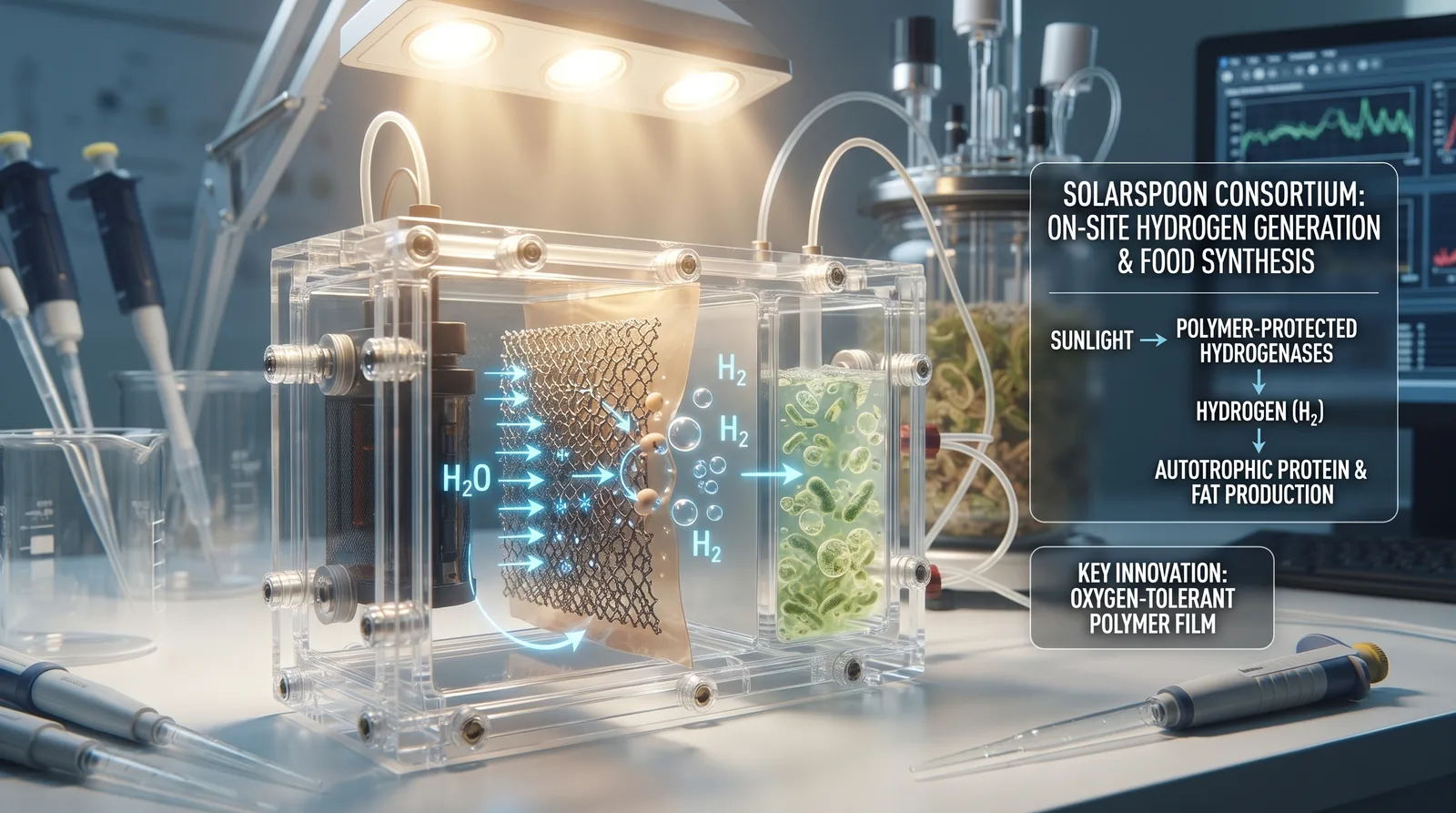
Hydrogenases are enzymes that can catalyze reactions involving hydrogen. In the proposed system, they help convert electrons and water into hydrogen gas, which can then support microbial metabolism and the production of biomass or protein. [source]
Traditional microbial cultivation often uses bioreactors supplied with water, nitrogen, and carbon dioxide. The SOLARSPOON concept seeks to couple these biological processes more directly to sunlight-driven hydrogen production, reducing reliance on externally supplied hydrogen. [source]
Protecting hydrogenases from oxygen A central technical barrier is that many hydrogenases are sensitive to oxygen. When oxygen is present, these enzymes can lose activity quickly, interrupting the electron flow needed for hydrogen production and downstream microbial metabolism. [source]
Researchers in Nicolas Plumeré’s laboratory developed a specialized polymer film intended to shield hydrogenases from oxygen. The film creates a local microenvironment that helps maintain catalyst activity during electron-to-hydrogen conversion. [source]
This is a meaningful materials-science advance because catalyst stability is essential for any practical bioelectrochemical system. A hydrogenase that rapidly deactivates in air would be difficult to use in an open or oxygen-exposed production environment. [source]
The SOLARSPOON consortium The University of Cambridge leads the multi-institutional SOLARSPOON consortium. Its collaborators include the Technical University of Denmark, Imperial College London, Solar Foods, and the Technical University of Munich. [source]
Nicolas Plumeré, Professor of Electrobiotechnology at TUM, contributes expertise in hydrogenase protection and electrobiotechnology. Magnus Fröhling, Professor of Circular Economy and Sustainability Assessment at TUM, contributes analysis of energy efficiency, scalability, and environmental sustainability. [source]
The consortium’s work connects several disciplines: electrochemistry, microbiology, materials engineering, process design, and sustainability assessment. This breadth is appropriate because turning a laboratory catalyst-protection result into a food-production system requires much more than demonstrating that an enzyme remains active. [source]
From on-site hydrogen to food synthesis The proposed platform aims to generate hydrogen on-site directly from sunlight rather than relying on external hydrogen networks or infrastructure. In principle, this could simplify the supply chain by coupling renewable electricity, water splitting, hydrogen production, and microbial growth in a single system. [source]
Future adaptations aim to synthesize fats as well as proteins from components of ambient air. This would broaden the potential nutritional output beyond protein alone, but it remains a future goal rather than a demonstrated capability of the current prototype. [source]
The researchers must integrate the protective polymer film into the broader technology to achieve stable and efficient protein production. They also plan to investigate processing fats from ambient-air components alongside proteins. [source]
What remains unquantified The available source does not provide exact energy-conversion efficiencies for the full system. It also does not report production costs per kilogram of protein or compare those costs with conventional farming, microbial fermentation, or other alternative protein technologies. [source]
The study does not establish a timeline for scaling the prototype to a commercial pilot plant. It also does not quantify land, water, electricity, nutrient, or carbon-dioxide requirements per unit of food produced. [source]
Because these values are missing, it is not possible to verify whether the system would be economically competitive, environmentally beneficial at scale, or capable of producing food at a meaningful volume. The current evidence supports a prototype-stage demonstration of hydrogenase protection, not a validated food-production platform. [source]
What the prototype does not prove It may seem that sunlight and microbes can already produce food without agriculture. In fact: the reported work demonstrates a specialized polymer film designed to protect hydrogenases from oxygen; it does not demonstrate a complete, scalable food-production system. [source]
It may seem that the system eliminates the need for all agricultural land. In fact: the concept aims to reduce reliance on land and livestock, but its actual land, energy, water, and nutrient requirements at commercial scale remain unquantified. [source]
It may seem that the system is economically competitive with conventional protein production. In fact: the source does not provide cost per kilogram of protein, energy-conversion efficiency, or commercial scaling timelines. [source]
It may seem that the technology can already produce both proteins and fats. In fact: protein production is the nearer-term goal, while fat synthesis from ambient-air components remains a planned future adaptation. [source]
Verdict: The research demonstrates a specialized polymer film designed to shield hydrogenases from oxygen in a prototype setting. This could support future sunlight-driven microbial food-production systems, but the work does not yet establish complete protein production, fat synthesis, commercial energy efficiency, production cost, or a pathway to industrial scale.
Based on reporting from TU Munich. This is an independent explainer, written in our own words with AI assistance; TU Munich has not reviewed or endorsed it. Read the original for the full details.