Copper-aluminum oxide membrane breath sensor for liver disease detection
Researchers developed a new breath-monitoring device that isolates tiny amounts of dimethyl sulfide to screen for liver disorders without invasive tests. This matters because it could enable pain-free, early detection of conditions like cirrhosis if clinical reliability is proven.
Reviewed by Matheus Grangeiro
- Peer reviewed
- Yes
Key numbers
30parts per billion
Threshold associated with liver conditions
3.3ratio
Initial gas response ratio
50.4ratio
Improved gas response ratio with filtering layer
10parts per billion
Minimum detection limit under high humidity
90%
Relative humidity level during testing
Evidence level: Prototype or demonstration
Why it matters: Liver disorders like cirrhosis and hypermethioninemia are difficult to screen for non-invasively, and precise quantification of breath biomarkers has historically proved difficult due to interfering compounds like hydrogen sulfide and moisture.
How the copper-aluminum oxide membrane isolates dimethyl sulfide in breath
Investigators created a new device designed to identify trace levels of dimethyl sulfide in human breath. Healthy individuals exhale dimethyl sulfide in minimal amounts, while concentrations exceeding thirty parts per billion correlate with hepatic dysfunctions like cirrhosis and hypermethioninemia.
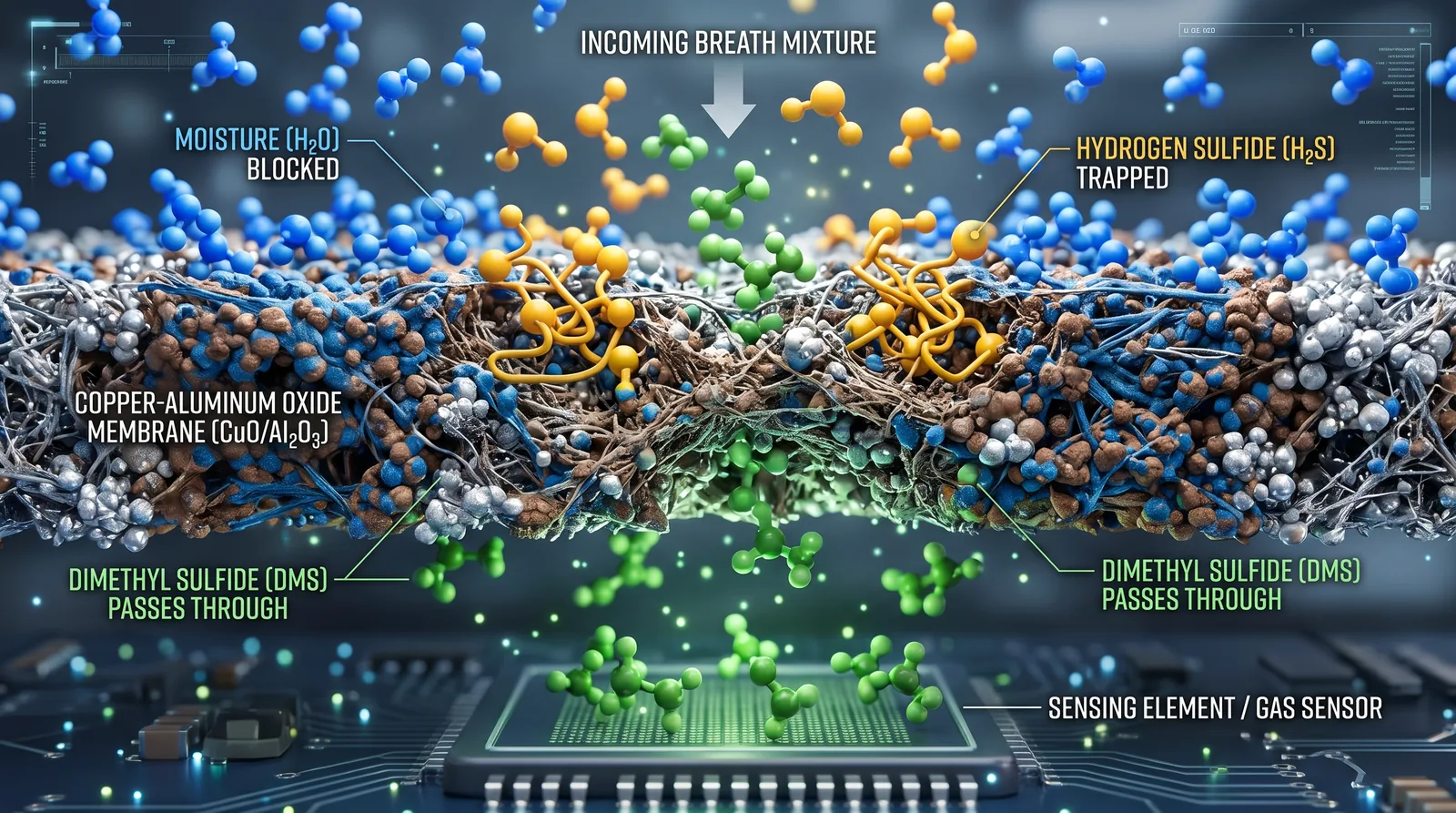
To resolve obstacles where hydrogen sulfide and exhaled moisture disrupt accurate readings, the team integrated a membrane composed of copper oxide and aluminum oxide. The specialized membrane traps hydrogen sulfide before contact with the active sensing element while permitting the targeted gas to traverse freely, and the coating additionally minimizes disruptions caused by ambient moisture.
Scientists from the Hefei Institutes of Physical Science led the investigation alongside other groups to advance non-invasive detection methods for hepatic disorders, publishing their findings in the journal ACS Nano. The monitoring tool functions reliably despite the presence of competing compounds and elevated moisture, successfully registering subtle fluctuations of the biomarker in complicated gaseous mixtures.
Analytical breakdown of selectivity improvements and testing limits
Incorporating the membrane substantially enhanced the apparatus selectivity between the two gases, causing the selectivity metric comparing the gases to rise substantially. Specifically, the initial gas response ratio of 3.3 climbed to 50.4 once the filtering layer was added. This jump demonstrates how effectively the chemical barrier blocks unwanted elements while letting the chemical of interest reach the sensor underneath.
The equipment identified the target compound at a minimum detection limit of 10 parts per billion under a relative humidity level of 90 percent during evaluations utilizing artificial breath mixtures that replicated patient conditions. These specific values quantify the instrument performance under high moisture conditions mimicking patient breath, addressing the historical obstacle of hydrogen sulfide disruption that plagues traditional sensors.
Study authors believe the outcomes underscore the device feasibility for pain-free hepatic screening. However, the work tested artificial breath mixtures rather than human clinical trials, leaving an open gap between current laboratory prototypes and real-world medical deployment.
What remains unknown about manufacturing costs and clinical translation
The source material does not report the fabrication cost of the sensor. Without production economics, understanding whether the device can compete commercially remains impossible.
The timeline for clinical trials involving real patients has not been established. Human testing data is required before any medical claims can be validated in a clinical setting.
The long-term stability and lifespan of the filtering layer remain unmeasured. Without durability metrics over extended periods, its endurance in daily use is still unknown.
Evidence level: Prototype or demonstration; laboratory testing with simulated breath samples
Why it matters: Breath analysis could offer a non-invasive route to screen for liver disease, but detecting trace biomarkers is difficult because breath contains interfering gases and high humidity. Dimethyl sulfide (DMS) is normally present at low concentrations, but levels above 30 parts per billion (ppb) have been associated with liver conditions including cirrhosis and hypermethioninemia.
How the CuO/Al₂O₃ layer isolates dimethyl sulfide in breath Researchers from the Hefei Institutes of Physical Science of the Chinese Academy of Sciences, working with the Key Laboratory of Odor Pollution Control and Shenzhen Technology University, developed a gas sensor for detecting trace DMS in breath. The study, “Exclusive Detection of Dimethyl Sulfide by a Pd–WO₃ Sensor with the CuO/Al₂O₃ Filtering Overlayer,” was published in ACS Nano.
The sensor uses a Pd–WO₃ sensing material beneath a thin filtering overlayer made of copper oxide (CuO) and aluminium oxide (Al₂O₃). The overlayer captures hydrogen sulfide (H₂S), a common interfering gas in breath, before it reaches the sensing material.
The CuO/Al₂O₃ layer also helps reduce interference from moisture. It allows DMS to pass through to the underlying sensor, improving selective detection in humid breath-like conditions.
Analytical breakdown of selectivity improvements and testing limits With the filtering layer in place, the sensor’s DMS-to-H₂S response ratio increased from 3.3 to 50.4. This indicates a substantial improvement in the sensor’s ability to distinguish DMS from H₂S.
The sensor detected DMS at concentrations as low as 10 ppb under 90% relative humidity. These conditions were designed to approximate the high humidity of exhaled breath.
The researchers tested breath samples designed to simulate those of patients with liver disease. In these complex gas mixtures, the sensor could detect small changes in DMS concentration.
These results demonstrate analytical performance under controlled laboratory conditions. They do not establish diagnostic accuracy, clinical sensitivity, specificity or real-world performance in patients.
What remains unknown about manufacturing costs and clinical translation The available release does not report the fabrication cost of the sensor, its manufacturing scalability, regulatory pathway or clinical-trial timeline. These factors will determine whether the technology can move from a laboratory prototype to routine medical screening.
The release also does not report long-term stability, sensor lifetime, calibration drift, performance after repeated exposure to breath, or performance across diverse patient populations. These questions remain important for clinical translation.
The researchers describe the result as a potential route to non-invasive liver-disease screening. This is a prospective claim, not evidence that the device can diagnose liver disease in people.
What the simulated breath mixtures do not show It may seem that the sensor has already been proven effective for diagnosing liver disease in patients. In fact: the study used breath samples designed to simulate those of patients with liver disease; no human clinical trial is reported.
It may seem that the CuO/Al₂O₃ layer removes all interfering compounds. In fact: the reported result concerns selective capture of H₂S and reduced moisture interference; it does not establish performance against every possible breath constituent.
It may seem that a 10-ppb detection limit proves clinical usefulness. In fact: it demonstrates analytical sensitivity under 90% relative humidity in simulated samples; diagnostic performance requires validation in real patients.
It may seem that the sensor can distinguish liver disease from other conditions. In fact: DMS can be associated with liver dysfunction, but the available release does not report tests for differential diagnosis or disease staging.
The release does not report fabrication cost, long-term stability, calibration drift, patient testing or a clinical-trial timeline.
Verdict: The study demonstrates that a CuO/Al₂O₃ filtering overlayer can selectively reduce hydrogen-sulfide interference and improve DMS detection in simulated breath samples under 90% relative humidity. The sensor detected DMS down to 10 ppb and improved the DMS-to-H₂S response ratio from 3.3 to 50.4; however, human clinical validation, long-term stability, cost and diagnostic performance remain unestablished.
Based on reporting from Chinese Academy of Sciences. This is an independent explainer, written in our own words with AI assistance; Chinese Academy of Sciences has not reviewed or endorsed it. Read the original for the full details.