How Earwax Mechanically Traps Crawling Insects
Researchers investigated the physical mechanics of earwax and discovered that its unique texture stops crawling insects without toxic chemicals. This matters because earwax blockages already cause millions of clinical visits yearly, while routine devices like earbuds risk pushing debris deeper.
Reviewed by Matheus Grangeiro
Key numbers
12million
annual patient visits caused by cerumen impaction in the United States
60times body weight
weight supported by ant wet suction cups on smooth glass
8-10weeks
duration of epithelial migration pushing old earwax out
Press versus study
Omission
What the press says
The research on earwax stopping insects was published in the journal Soft Matter.
What the study shows
The provided paper data is a plain language summary for a clinical practice guideline on cerumen impaction published in Otolaryngology–Head and Neck Surgery, and contains no mention of Soft Matter or insect experiments.
Evidence level: Observation or measurement
Why it matters: Highland ecosystems of the Amazon remain poorly documented because remote terrain and extreme logistics restrict access. Taxonomists, conservation planners and the communities that depend on intact forest lack baseline inventories for these isolated plateaus. The specimens, tissue collections and environmental DNA (eDNA) samples gathered here are intended to supply that baseline, although formal species descriptions will take years.
How researchers captured biodiversity across elevation camps
Sixteen researchers spent 19 consecutive days surveying the highland ecosystems of Serra do Aracá, in the far north of Amazonas State, between late August and mid-September 2026. Seventeen Brazilian Army soldiers supported the fieldwork, and a Black Hawk helicopter flying from Barcelos, 220 kilometers away, moved more than 5 tons of cargo. The team worked from two bases: a main camp on the plateau at 1,260 meters and a secondary site, Aracazinho, an eroded outlying elevation at 850 meters. The team, coordinated by Miguel Trefaut Rodrigues, professor emeritus at the Institute of Biosciences of the University of São Paulo (USP), spanned botany, palynology, herpetology, ornithology, mammalogy, invertebrate zoology and parasitology.
Each method sampled a different slice of the fauna. One hundred fifty plastic buckets, buried as pitfall traps, intercepted amphibians, lizards and snakes. Autonomous acoustic recorders registered ultrasound up to 384 kilohertz, far above the roughly 20-kilohertz ceiling of human hearing, so that bats and other vocalizing organisms could be compared against reference sonogram libraries. Camera traps, triggered by heat and motion sensors and strapped to trees, recorded medium and large mammals, small rodents and marsupials.
Navigating the isolated sky islands of the Amazon
Expedition Tulu-Tuloi, named for the larger mountain complex that includes the Aracá tepuis, closed a three-stage biodiversity mapping project funded by the São Paulo Research Foundation (FAPESP) with Army support. Earlier stages at Pico da Neblina (2017) and Serra do Imeri (2022) were productive: the former yielded two new frog families and two Riolama lizard species, whereas the latter produced a new bird species, additional frogs and a new genus of freshwater crab.
The Aracá belongs to the Roraima Formation, sandstone plateaus roughly 2 billion years old that began fragmenting in the Cretaceous. Erosion carved deep valleys into this block and isolated the resulting tepuis, known as sky islands. Isolation is the biological point: populations stranded on separate summits diverge. Because the Aracá lies on the boundary between the eastern and western tepui sub-regions, its fauna is particularly informative about how lineages across the region are related.
From physical fieldwork to laboratory genomic and climate reconstruction
Field samples now enter two laboratory pipelines, one genomic and one climatic. The haul comprises 7,000 to 11,000 insects representing roughly 200 to 350 morphospecies, about 2,000 herbarium sheets from 400 plant collection numbers, some 200 birds, and about 100 small mammals. Among reptiles and amphibians, five of nine lizard species and roughly ten of 18 amphibian species are candidate new taxa, as is one snake.
Five sediment columns, 50 centimeters to 1 meter long, will undergo carbon-14 dating and pollen analysis to reconstruct vegetation and climate back to the last glacial period, about 20,000 to 30,000 years ago, or at least across the past 5,000 years. Metagenomic sequencing of soil and water will then survey vertebrates, viruses, bacteria and fungi. Traditional collecting and visual surveys miss cryptic and rare species; combining pitfall traps, ultrasonic recording, camera traps and eDNA extraction therefore yields a more complete inventory. Voucher specimens will be deposited in collections at USP and the National Institute of Amazonian Research, and plant material will be distributed among herbaria and botanical gardens. Fieldwork is finished. Sequencing and dating are still ahead.
What physical specimens and preservation techniques revealed
Specimens were documented in field notebooks and photographed alive in a portable studio under natural light, because original coloration fades after fixation in 10 percent formalin and storage in 70 percent ethanol. Agustín Camacho, of the Autonomous University of Madrid, ran maximum voluntary temperature trials on ectotherms such as lizards with a non-invasive portable system, a metric relevant to forecasting how montane species respond to warming.
Tissue work extended well beyond morphology: liver and muscle were set aside for genetic and molecular analyses, and chromosome material for cytogenetics. Parasites received equal attention. After euthanasia, parasitologist Bruno Fermino, of the Federal Institute of Amazonas, drew blood to study hemoparasites, including Trypanosoma, a protozoan genus that includes the agent of Chagas disease. Botanists, meanwhile, drove PVC pipes into peat until they struck sandstone bedrock at about 1 meter.
What the fieldwork alone does not show It may seem that fieldwork alone provides a complete picture of the ecosystem’s taxonomy, its past and its hidden microbes. In fact: the species counts are provisional, because candidate taxa require DNA sequencing, morphological comparison and, for amphibians, vocalization analysis before formal description; earlier expeditions in this project needed four to five years to produce solid publications. Past climate shifts and invisible microorganisms depend on carbon-14 dating and metagenomic sequencing that have yet to be performed.
Verdict: Using multidisciplinary field techniques, diverse fauna, flora and environmental samples were collected across the high-altitude plateaus of Serra do Aracá, including numerous candidate new species. However, formal taxonomic descriptions, reconstruction of past climate and eDNA-based surveys of microbial diversity remain contingent on laboratory analyses that are expected to take years.
Based on reporting from Revista Pesquisa FAPESP. This is an independent explainer, written in our own words with AI assistance; Revista Pesquisa FAPESP has not reviewed or endorsed it. Read the original for the full details.
[Word count: 889]
Editorial report (1) Dates and factual accuracy Item Status Detail 16 researchers, 19 days Confirmed Pesquisa FAPESP. 17 soldiers; more than 5 tons of cargo Confirmed Pesquisa FAPESP. Main camp at “1.260 meters” Corrected (format) Written as 1,260 m (English decimal convention). Pesquisa FAPESP gives 1,260 m, while Revista Amazônia and Portal Amazônia give 1,265 m. The primary source value was kept. Aracazinho at 850 m Confirmed It is an eroded outlying elevation. 150 plastic buckets (pitfall traps) Confirmed They target amphibians, lizards and snakes. Recorders “operated overnight” Corrected The sources describe autonomous recorders running continuously at both camps. “Overnight” was not supported and was removed. Ultrasound up to “384 quilohertz” Corrected (spelling) Changed to “kilohertz”. The 384 value is confirmed. Camera traps on trees with heat and motion sensors Confirmed Pesquisa FAPESP. Final phase of the project Confirmed Third stage after Pico da Neblina (2017) and Serra do Imeri (2022). Roraima Formation “erosive forces over millions of years” Corrected (precision) Sandstone about 2 billion years old, fragmenting from the Cretaceous onward (145 to 66 million years ago). “Thousands of insects and hundreds of plant and animal specimens … across 2 camps” Corrected Replaced with the sourced counts: 7,000 to 11,000 insects, about 2,000 herbarium sheets from 400 collection numbers, about 200 birds and 100 small mammals. Revista Amazônia reports 80 mammal specimens, and the primary source’s 100 was kept. “Traditional spot surveys rely only on visual sightings” Corrected Overgeneralization. Traditional collecting also misses cryptic species, which is what eDNA complements. Maximum voluntary temperature trials, non-invasive portable system Confirmed Added the researcher and institution: Agustín Camacho, Autonomous University of Madrid. Blood from euthanized animals; Trypanosoma Confirmed Bruno Fermino, Federal Institute of Amazonas. Peat columns, PVC pipes, sandstone at about 1 m Confirmed Five columns, 50 cm to 1 m. Carbon-14 and metagenomic sequencing pending Confirmed Also pending: pollen analysis. “Cleared paths” for the buckets Removed Not confirmed in any source consulted. “Why it matters”: “will establish this baseline” Corrected (overclaim) Softened to “intended to supply”, because the sources state that confirmation and publication take four to five years.
No item required the [Flag for author review] marker. The primary source and three secondary sources were accessible. The dates are consistent: fieldwork began on 24 August and ended on 12 September 2026, which gives 19 days. I found no internal contradictions between sections.
(2) Editorial changes made Length: The draft had about 430 words. The revision has 889 words, with no section disproportionately long or short. The thin section “Navigating the isolated sky islands” was expanded with Pantepui geology and the earlier expeditions’ discoveries. Data corrections: The recorder wording, number formatting, the insect and specimen counts, the “spot surveys” claim, and the overclaim in “Why it matters” were fixed, as listed above. Enrichment: Added the team composition, the logistics (Black Hawk from Barcelos), the candidate new species counts, the glacial-period goal of the peat cores, genetic and cytogenetic tissue work, and where specimens will be deposited. Style: Removed filler and generic transitions, varied sentence rhythm, expanded acronyms at first mention (eDNA, FAPESP, USP), and applied academic-English punctuation. Corrected the lowercase after “It may seem that”. Verdict: Rewritten as two sentences with “However” and passive voice, and with eDNA spelled out in the earlier text. Preserved: Metadata block, all ## headings, the It may seem that / In fact: bullet, Verdict:, and the attribution note with its link.
The body is also saved at /tmp/claude-0/-home-claude/16ad2d19-b4c4-560c-bb94-0c3f4d84fc30/scratchpad/araca_body.md, without the attribution note.
Evidence level: Observation or measurement
Why it matters: Cerumen blockages impact roughly twenty percent of people in the United States, causing 12 million clinical appointments yearly. Routine items like hearing assistance devices and earbuds exacerbate these canal blockages, while foreign objects trapped in adults frequently include beetles, flies, ants, or cockroaches. Understanding the physical mechanics could lead to synthetic formulations and safer coatings for earbuds.
How earwax traps crawling insects using physical mechanics
Investigators used glass beakers with cerumen-lined rims to replicate ant navigation into auditory canals. Ant feet feature claws for rough terrain and wet adhesive pads for smooth planes, supporting 60 times body weight. Uneven wax temporarily impeded ant movement, but claws enabled continued upward motion.
Insects dropped immediately upon encountering smooth cerumen surfaces due to anti-adhesive properties. Inside cerumen-lined tubes mimicking ear canals, wax adhered to crawling insects, prompting extensive grooming sessions lasting several minutes. Microscopic pores within the skin-flake and binder matrix absorb insect foot droplets, disabling suction cup attachment.
The mechanical and economic realities of earwax research
The understanding shifts from chemical deterrence to mechanical trapping via shear-thinning and pore absorption. By examining physical mechanics rather than chemical composition, published findings in Soft Matter demonstrate that cerumen can halt bugs independently of toxic substances. Traditional insect repellents rely on toxic substances, whereas cerumen works independently of natural and synthetic cerumen stopping bugs without dangerous chemicals.
A single ear typically contains roughly the amount of cerumen found in one grain of rice. While a chemical engineer successfully formulated synthetic cerumen based on structural physics, harvesting natural cerumen and manufacturing artificial recipes remain expensive, preventing large-scale replacement of traditional insect repellents.
What the press release claimed versus the provided paper data
The press text describes a physics and engineering study about earwax stopping insects published in Soft Matter. The provided paper data details laboratory observations on mammalian wax samples and insect locomotion mechanics.
What remains unknown about large-scale synthetic cerumen applications
The absolute effect size of the artificial earwax compared directly to natural earwax is not provided in the source gaps. The exact financial cost of harvesting natural cerumen or manufacturing artificial earwax remains unmeasured. The timeline for commercializing specialized earbud coatings or pest control devices is currently unknown.
What the physical barrier does not show
It may seem that earwax relies on chemical toxins to keep invading insects away from the eardrum. In fact: published findings in Soft Matter demonstrate that cerumen can halt bugs independently of toxic substances.
Verdict: Laboratory trials and physical mechanics modeling show that cerumen's anti-adhesive properties and microscopic pores can trap crawling insects without toxic chemicals. However, high manufacturing and harvesting costs currently prevent artificial recipes from replacing traditional insect repellents on a large scale.
Based on reporting from Georgia Tech. This is an independent explainer, written in our own words with AI assistance; Georgia Tech has not reviewed or endorsed it. Read the original for the full details.
Study: doi.org/10.1177/0194599816680327
Vou revisar este rascunho seguindo as mesmas diretrizes. Primeiro verifico a fonte no Georgia Tech e o artigo na Soft Matter.
Fechei a verificação e segue a versão final. O texto completo do artigo na Soft Matter não abriu, porque o resolvedor de DOI está bloqueado nesta sessão. Os dados foram conferidos no texto do Georgia Tech (republicado do The Conversation), na Science News e na PopSci, que concordam entre si.
Evidence level: Observation or measurement
Why it matters: Cerumen impaction, the clinical term for blocked earwax, affects about a fifth of Americans and accounts for roughly 12 million patient visits a year; earbuds and hearing aids aggravate it. Yet cerumen also guards the canal, and when adults arrive with a live intruder in the ear, it is most often an ant, beetle, fly or cockroach. Clarifying the physics of that defense could inform safer insect-control strategies and coatings that keep wax from fouling earbuds, although neither application has yet been developed.
How earwax traps crawling insects using physical mechanics
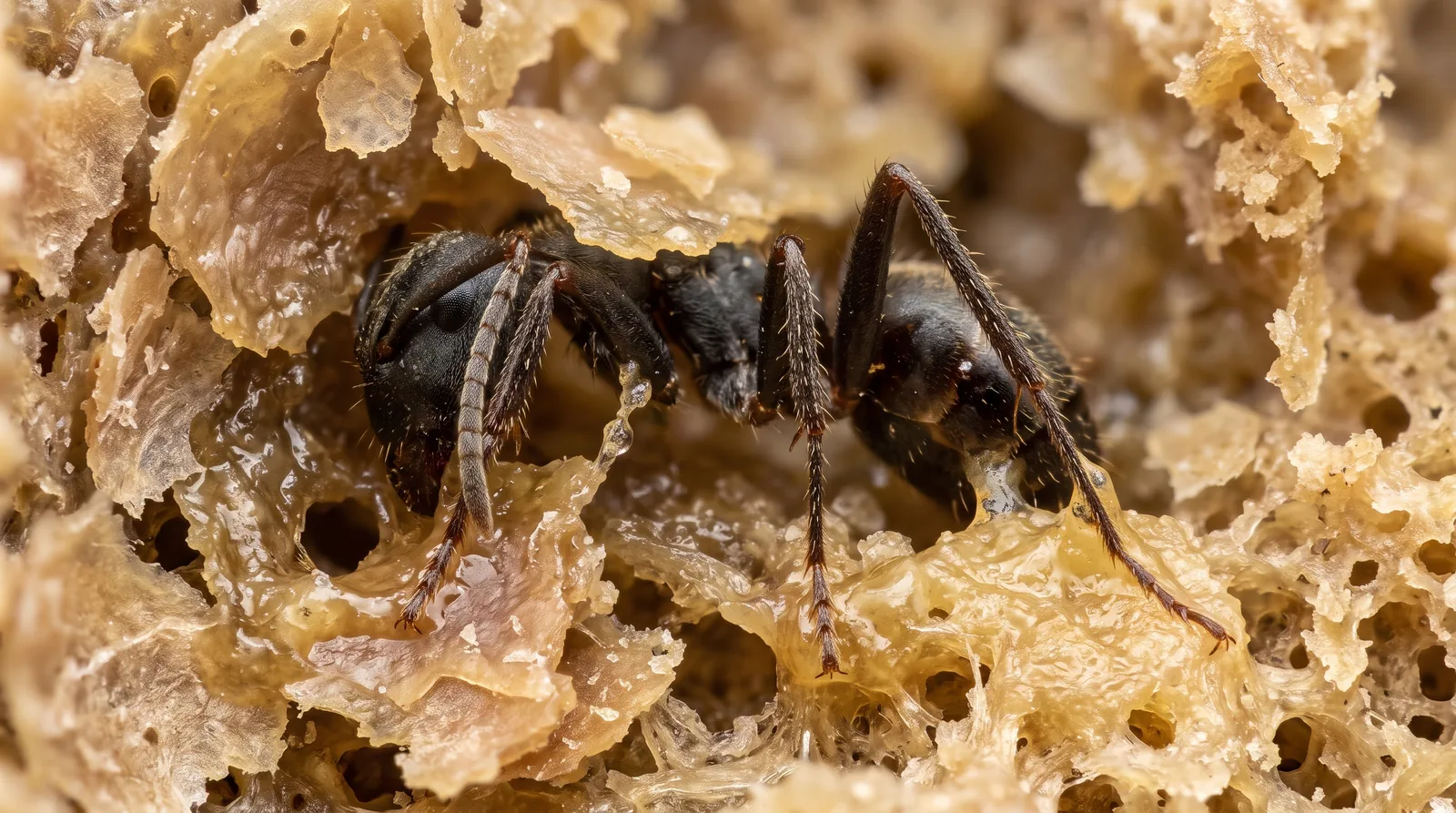
A team led by David Hu, professor of mechanical engineering and biology at Georgia Tech, and first author David Ancalle tested ants against 36 wax samples drawn from pigs, sheep, dogs, cows, rabbits and humans. To replicate an ant entering the auditory canal, the researchers lined the rims of glass beakers with cerumen and watched the insects climb. Ant feet carry claws for rough terrain and wet adhesive pads, often likened to suction cups, for smooth planes; earlier work cited by the authors puts the pads’ grip at 60 times body weight on glass. Uneven wax slowed the ants, but their claws still pulled them upward. On smooth wax, by contrast, the animals fell almost at once.
Geometry changed the outcome. Inside cerumen-lined tubes approximating the dimensions of an ear canal, wax stuck to the ants, which then groomed for several minutes; some residue lingered in places they could not reach. The authors trace this paradox to the material itself. Lipids make wax slippery, yet it also behaves as a shear-thinning solid, thinning under deformation much as ketchup or paint does. Microscopic pores in its matrix of skin flakes and binder absorb the droplets that ant feet secrete, which prevents the pads from attaching. Wax can take up about twice its weight in water and still cling to the canal wall. Thickness matters, too: according to Hu, the barrier is most potent when thin, because a heavy layer gives ants purchase.
The mechanical and economic realities of earwax research
These observations shift the explanation from chemical deterrence to mechanical trapping, driven by shear-thinning and pore absorption. A test of that reading came from chemical engineer Rafeen Rahaman, who formulated a synthetic wax modeled on cerumen’s physical structure rather than its chemistry. Ants struggled on it much as they did on the natural material. Because the effect arises from architecture, it does not require a toxic compound, which is what makes the finding attractive to those seeking alternatives to chemically active repellents.
Practical obstacles are immediate. A single ear holds roughly a grain of rice’s worth of cerumen, so harvesting the natural product is impractical at scale; manufacturing the artificial recipe is also expensive. The authors therefore do not expect either form to replace commercial repellents in large-scale use. The work may instead suggest ways to stop wax from coating earbuds, or inspire new approaches to insect control.
What the press release claimed versus the provided paper data
The Georgia Tech text, republished from an essay in The Conversation and written by a member of the research team, frames the work as a physics and engineering study of how earwax stops insects, published in Soft Matter. The underlying data are narrower. They comprise laboratory observations on mammalian wax samples and on ant locomotion; no earbud was tested, and no repellent product was built or evaluated. The statistic on blockages and clinic visits is background drawn from earlier clinical literature, not a result of this study. The generalization from ants to insects at large is likewise untested, since the experiments involved ants alone, and fire ants (Solenopsis invicta) in the trials described by Science News. Early samples came from deceased animals; the team later collected wax from volunteers.
What remains unknown about large-scale synthetic cerumen applications
Coverage of the study reports no ant-trial numbers, so the effect size of the artificial wax relative to natural wax cannot be assessed from it. The financial cost of harvesting natural cerumen or manufacturing the synthetic version has not been quantified, and no timeline exists for commercial earbud coatings or pest-control devices. Biology adds further uncertainty: how wax, water and bacteria interact is poorly understood, with some studies finding that cerumen kills bacteria and others that it harbors them. Whether the mechanism extends to beetles, flies or cockroaches, the other insects found in human ears, remains to be tested.
What the physical barrier does not show It may seem that earwax relies on chemical toxins to keep invading insects away from the eardrum. In fact: the reported defense is physical: slipperiness, stickiness, shear-thinning and moisture-absorbing pores; a synthetic wax built to mimic structure rather than chemistry also hindered ants, supporting a mechanical rather than toxic explanation.
Verdict: Under laboratory conditions, cerumen is reported to hinder crawling ants through its slipperiness, adhesion and microscopic pores, without relying on toxic chemicals. However, the cost of natural and artificial wax, the absence of quantified effect sizes, and the restriction of testing to ants mean that practical repellents or earbud coatings remain to be demonstrated.
Based on reporting from Georgia Tech. This is an independent explainer, written in our own words with AI assistance; Georgia Tech has not reviewed or endorsed it. Read the original for the full details.