Scaling automated public transit through the RISE initiative
Four hundred participants gathered in Munich to launch the RISE initiative, backed by 20 million euros in federal funding to develop and scale automated public transit. This project matters because it tests self-driving shuttles as a direct countermeasure against transit staff shortages and increasing financial pressures.
Reviewed by Matheus Grangeiro
Key numbers
20 millioneuros
Funding approved by the Federal Ministry of Transport for the RISE project
400stakeholders
Participants at the Munich Summit on Autonomous Driving
October 1st 2026date
Start date of the funding period
September 30th 2029date
End date of the funding period
2030year
Transport Research Arena event year in Munich
2025year
IAA Roundtable year
2routes
Number of MVG lines designated for real-world testing
Evidence level: Prototype or demonstration
Why it matters: European public transit systems face a structural convergence of pressures: chronic driver shortages, rising operational costs, and the persistent challenge of connecting low-density or peripheral urban areas to core transit grids. Autonomous vehicles have been technically demonstrated in controlled environments for over a decade. Yet, the gap between proving a technology in a test facility and deploying it reliably in a live transit network—across varied weather conditions, mixed traffic, and regulatory frameworks—has remained stubbornly wide. The RISE project, led by the Technical University of Munich (TUM) and backed by the German Federal Ministry of Transport, represents a deliberate institutional effort to close that gap. Rather than developing another prototype, it aims to build the scientific, operational, and regulatory infrastructure that routine autonomous transit actually requires.
How the RISE Automated Transit Project Bridges Research and Municipal Deployment
RISE—an acronym for Regular Operation, Integration, Scaling, and Development of Automated Mobility Systems in Public Transportation—was inaugurated on November 9, 2026, as the Munich project site of the German Center for Future Mobility (DZM). The consortium is led by TUM and brings together an unusually broad set of institutional partners: the City of Munich, Stadtwerke München (SWM), Münchner Verkehrsgesellschaft (MVG), MAN Truck & Bus, the Munich Transport and Fare Association (MVV), the University of the German Armed Forces in Munich, Ludwig Maximilian University of Munich, and UnternehmerTUM. This composition, spanning academic research, municipal government, a vehicle manufacturer, and the transit operator that will eventually run the buses, is itself a design choice. The project treats regulatory and operational integration as engineering problems on par with vehicle technology.
The initiative’s framing reflects a wider strategic ambition. With approximately 400 stakeholders from politics, industry, academia, and municipal transportation present at the Munich Summit on Autonomous Driving, RISE was explicitly positioned as a contribution to European technological sovereignty in autonomous mobility—a domain where Germany’s manufacturing base and research institutions have foundational strengths that have not yet translated into scalable public deployment.
The Staged Testing Pipeline from Ottobrunn to Live MVG Routes
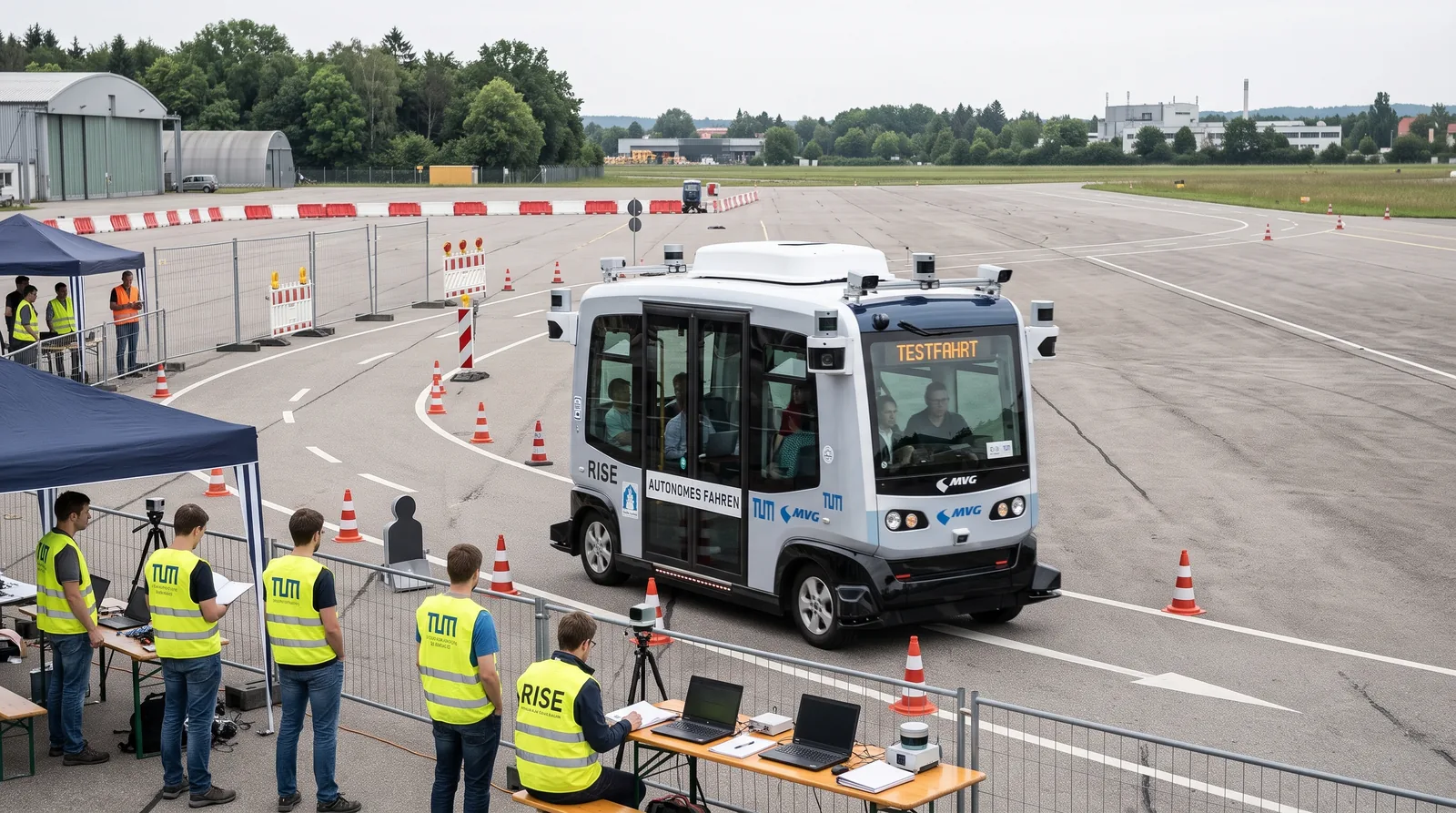
The project’s operational design follows a deliberately staged risk-reduction logic. Initial testing will take place on a closed, controlled site in Ottobrunn, where autonomous buses can be evaluated against technical and safety benchmarks without exposure to live traffic. This phase serves not only to validate vehicle performance, but also to develop the control center architectures, operational protocols, and digital infrastructure components that will need to function seamlessly before any public deployment.
Following controlled testing, vehicles will transition to live laboratory operations on two specific MVG lines—a configuration that deliberately limits geographic and operational scope while maximizing the realism of the testing environment. Operating on active transit routes means contending with real passenger loads, real traffic, real schedule pressures, and real regulatory oversight, none of which a closed facility can adequately simulate. The choice of exactly two routes is calibrated: it is narrow enough to manage complexity and ensure rigorous monitoring, yet broad enough to generate the operational data needed to inform scaling decisions. Vehicle development throughout this pipeline proceeds in parallel with integration work, ensuring that technical advances and operational requirements co-evolve rather than diverge.
Evaluating the Structural Scope and Operational Targets of the Initiative
The Federal Ministry of Transport has committed up to 20 million euros in funding, with the project running from October 1, 2026, through September 30, 2029. This three-year window encompasses both the Ottobrunn testing phase and the live MVG route operations. This timeline is tight by the standards of infrastructure development, and the project’s leaders have been explicit about what RISE is and is not: it is not a commercial deployment, but a systematic effort to establish the scientific, technical, organizational, and regulatory groundwork that a future deployment would require. Dr. Florian Bieberbach, Managing Director of MVG, identified integration as the central challenge: developing the vehicles is necessary but insufficient; vehicle technology, control centers, infrastructure, and operational processes must be made to work together seamlessly before autonomous buses can enter routine service. Dr. Frederik Zohm of MAN Truck & Bus framed the broader imperative in industrial terms: Germany’s strength in autonomous driving technology must be translated into scalable applications to preserve European value creation and expertise. These institutional perspectives, taken together, describe a project that treats the transition from prototype to routine operation as a sociotechnical problem requiring coordinated action across research, industry, and public administration simultaneously.
Unanswered Technical and Economic Questions in the Project Outline
The TUM press release and summit documentation do not disclose the specific autonomous vehicle models or control software architectures that will be deployed on the MVG test routes. They also omit precise technical specifications, such as sensor configurations, redundancy architectures, and fail-safe protocols, that will govern vehicle operation. The selection criteria for the two test routes are not stated; it remains unclear whether they were chosen for traffic complexity, ridership demographics, geographic coverage of underserved areas, or some combination thereof. Cost-benefit projections for the eventual scaling phase—including estimates of operational savings relative to driver-operated equivalents, or threshold conditions for cost-effective deployment—are absent from the current project framework. These gaps are consistent with a prototype-stage initiative whose primary output is knowledge rather than a deployable product, but they define the questions that will need answers before RISE results can inform policy decisions about broader autonomous transit rollout in Germany or elsewhere.
Verdict: The RISE project establishes a funded, multi-institutional roadmap—backed by 20 million euros from the German Federal Ministry of Transport—to advance autonomous public transit from controlled testing in Ottobrunn to live operations on two MVG routes between 2026 and 2029. Yet, technical vehicle specifications, test route selection criteria, and economic viability projections for the scaling phase remain absent from the current project framework.
Based on reporting from TU Munich. This is an independent explainer, written in our own words with AI assistance; TU Munich has not reviewed or endorsed it. Read the original for the full details.