Neuromorphic hardware design mimics biological autapses for local feedback regulation
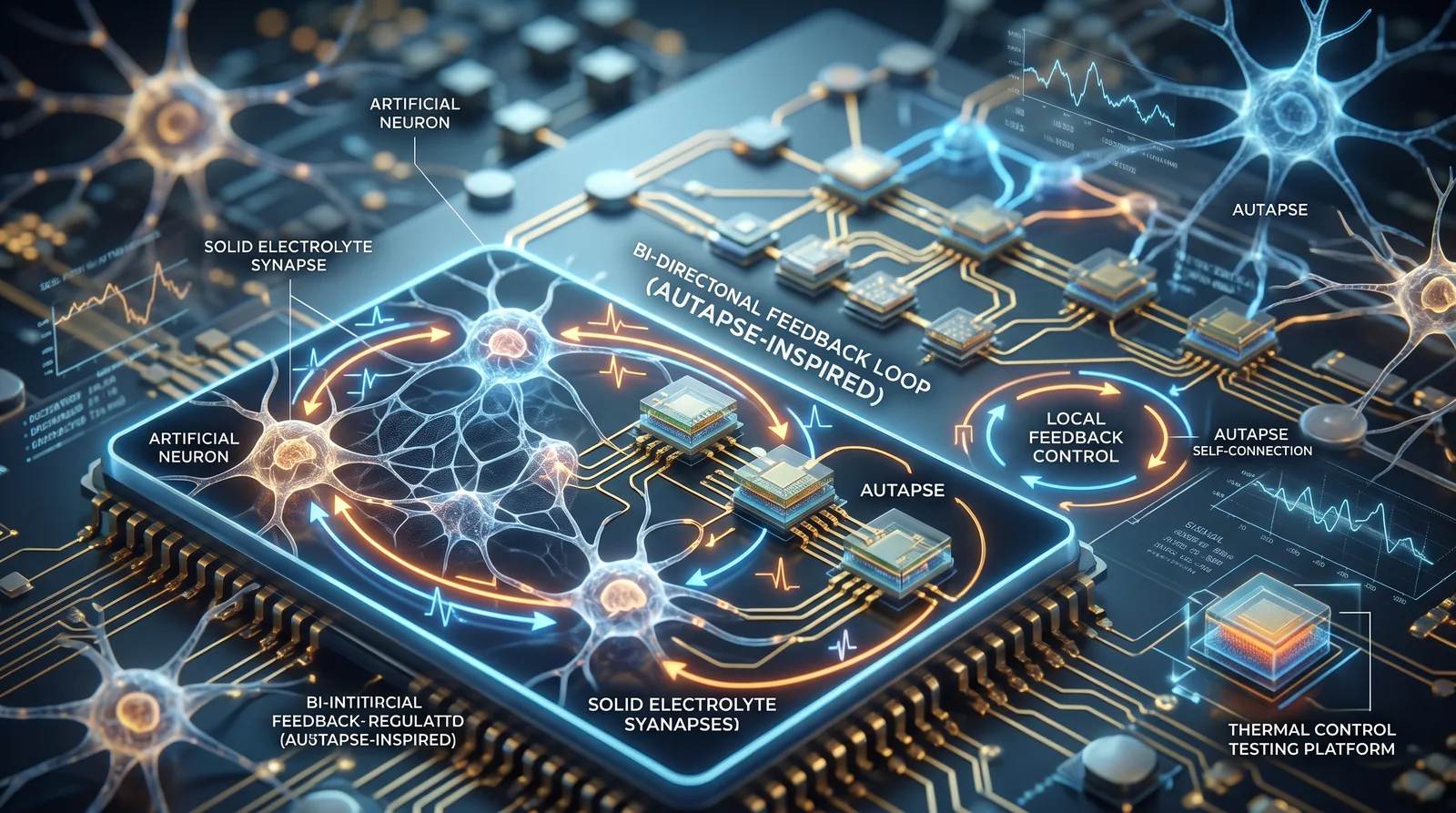
Researchers developed a neuromorphic hardware architecture inspired by biological autapses to perform feedback regulation locally using artificial neurons and solid electrolyte synaptic transistors. This approach matters because it aims to support independent, power-saving apparatuses by bypassing the obstacles of traditional centralized feedback control.
Reviewed by Matheus Grangeiro
- Peer reviewed
- Yes
Key numbers
4.0version
Creative Commons License version
RS-2024-00460364grant number
Research funding identifier from NRF
RS-2026-25504394grant number
Research funding identifier from NRF
Evidence level: Prototype or demonstration
Why it matters: Conventional feedback-control systems often rely on centralized processing and continuous external computation, which can increase energy consumption, latency and system complexity. A hardware architecture that performs local, bidirectional feedback with a small number of neuromorphic components could support more autonomous and energy-efficient devices.
How autapse-inspired hardware performs local feedback control An autapse is a self-synaptic connection in which a neuron feeds its output back to its own synaptic input, enabling intrinsic feedback modulation. The study, “Autapse-inspired neuromorphic hardware with synapse–neuron integration for bidirectional feedback control,” was published in Nature Communications on 12 November 2026.
Chan Kim, Seonkwon Kim and Jeong Hwan Song contributed equally to the work. Gun Hwan Kim and Jeong Ho Cho are corresponding authors; the research involved Yonsei University and the Korea Institute of Science and Technology.
The hardware combines a solid-electrolyte-based synaptic transistor, which can multiplex multiple input signals, with a bidirectional leaky integrate-and-fire artificial neuron. By feeding the neuronal output back to an additional synaptic gate, the system realizes both excitatory and inhibitory feedback loops within a compact architecture.
Overcoming limits of centralized feedback control Conventional feedback-control systems can require centralized processing and continuous external computation. The authors present localized neuromorphic feedback as a route to reduce energy consumption and system complexity.
In the demonstrated architecture, feedback regulation occurs locally in hardware rather than being delegated to an external computing unit. The synaptic transistor processes multiple inputs, while the artificial neuron integrates them and produces output pulses according to its leaky integrate-and-fire dynamics.
The autapse-inspired connection closes the loop: the neuron’s output is returned to an additional gate on the synapse. This enables excitatory and inhibitory feedback pathways within the same compact device set.
Evaluating the thermal-control demonstration The researchers built an artificial thermoregulation platform to test the architecture. Temperature-dependent inputs bidirectionally modulated the firing frequency of the artificial neuron, demonstrating biologically inspired feedback control.
This demonstration shows that the hardware can implement local feedback control for a representative thermal application. It does not establish that the same architecture will work across arbitrary control tasks, environmental conditions or industrial control systems.
The abstract describes the system as intended for autonomous and energy-efficient applications, but it does not report absolute power consumption, energy per operation, latency, control accuracy or a direct comparison with a conventional centralized controller.
What remains unresolved The available abstract does not report power consumption, energy efficiency, response time, control accuracy or performance relative to conventional feedback controllers.
The physical dimensions, fabrication yield, scalability and manufacturing cost of the solid-electrolyte synaptic transistor are not addressed in the available abstract.
The durability of the feedback loop under continuous thermal cycling, long-term operation or real-world environmental stress is not demonstrated in the available abstract.
The thermal-control platform is a laboratory demonstration; it does not establish deployment in autonomous vehicles, robotics, buildings or other real-world systems.
The biological analogy is limited: an autapse-inspired circuit reproduces a simplified feedback motif, not the complexity of biological neural networks.
What the autapse-inspired setup does not show It may seem that this neuromorphic setup replaces biological neural networks or replicates the brain. In fact: it implements a simplified autapse-inspired feedback architecture using an artificial neuron and a solid-electrolyte synaptic transistor, tested on a thermal-control platform.
It may seem that “bidirectional feedback” means the system can control temperature in two opposite directions. In fact: it means that temperature-dependent inputs modulate the neuron’s firing frequency bidirectionally, enabling excitatory and inhibitory feedback loops.
It may seem that the system is already energy-efficient in absolute terms. In fact: energy efficiency is a design goal stated in the abstract; no power-consumption measurement or comparison with a conventional controller is reported there.
It may seem that local feedback eliminates the need for external computing in all applications. In fact: the demonstration concerns a compact thermal-control task; broader autonomy and task generality remain untested.
Verdict: The study demonstrates a compact autapse-inspired neuromorphic hardware architecture that combines a multiplexing solid-electrolyte synaptic transistor with a bidirectional leaky integrate-and-fire artificial neuron. It realizes excitatory and inhibitory feedback loops and demonstrates bidirectional modulation of neuronal firing in an artificial thermoregulation platform; however, power consumption, control performance, scalability, durability and real-world deployment remain unreported in the available abstract.
Source: Nature Communications. The original is licensed CC BY. This text is an AI-assisted adaptation (summarized, simplified and translated) and may differ from the original.