Deep-sea mollusk reveals unique cellular structure for bacterial symbiosis
Researchers have identified a specialized cellular structure in the deep-water mollusk Chaetoderma shenloong that hosts thousands of symbiotic bacteria. This finding reveals a unique biological adaptation for survival in extreme deep-sea habitats lacking sunlight and oxygen.
Reviewed by Matheus Grangeiro
- Peer reviewed
- Yes
Key numbers
150mm
Maximum body length of Chaetoderma shenloong
10 to 15micrometres
Diameter of the dracosphera structure
20membrane layers
Number of membrane layers wrapping the dracosphera
1,600symbionts
Average number of symbionts accommodated by a single host cell
Evidence level: Morphological, imaging, genomic and transcriptomic observations
Why it matters: Deep-sea cold seeps lack sunlight and contain very little oxygen, yet they can support animals that depend on chemosynthetic microbial symbionts. Understanding how a host houses and supports dense bacterial communities in such environments can clarify the evolution of symbiosis and the functioning of deep-sea ecosystems.
How the dracosphera houses symbionts in the deep sea Chaetoderma shenloong, also called the Divine Dragon Glistenworm, lives in cold-seep sediments in the South China Sea, where it burrows tens of centimetres below the seafloor in layers containing almost no oxygen and abundant hydrogen sulfide. The species belongs to the aplacophoran class Caudofoveata and can grow to more than 150 mm in length.
A research team led by Prof. Qian Pei-Yuan of HKUST, working with Prof. Jin Sun of the Ocean University of China and Prof. Jian-Wen Qiu of Hong Kong Baptist University, published the findings in Nature Communications as “A multilamellar organelle for chemosymbiosis in an aplacophoran mollusc adapted to anoxic cold seep sediment.”
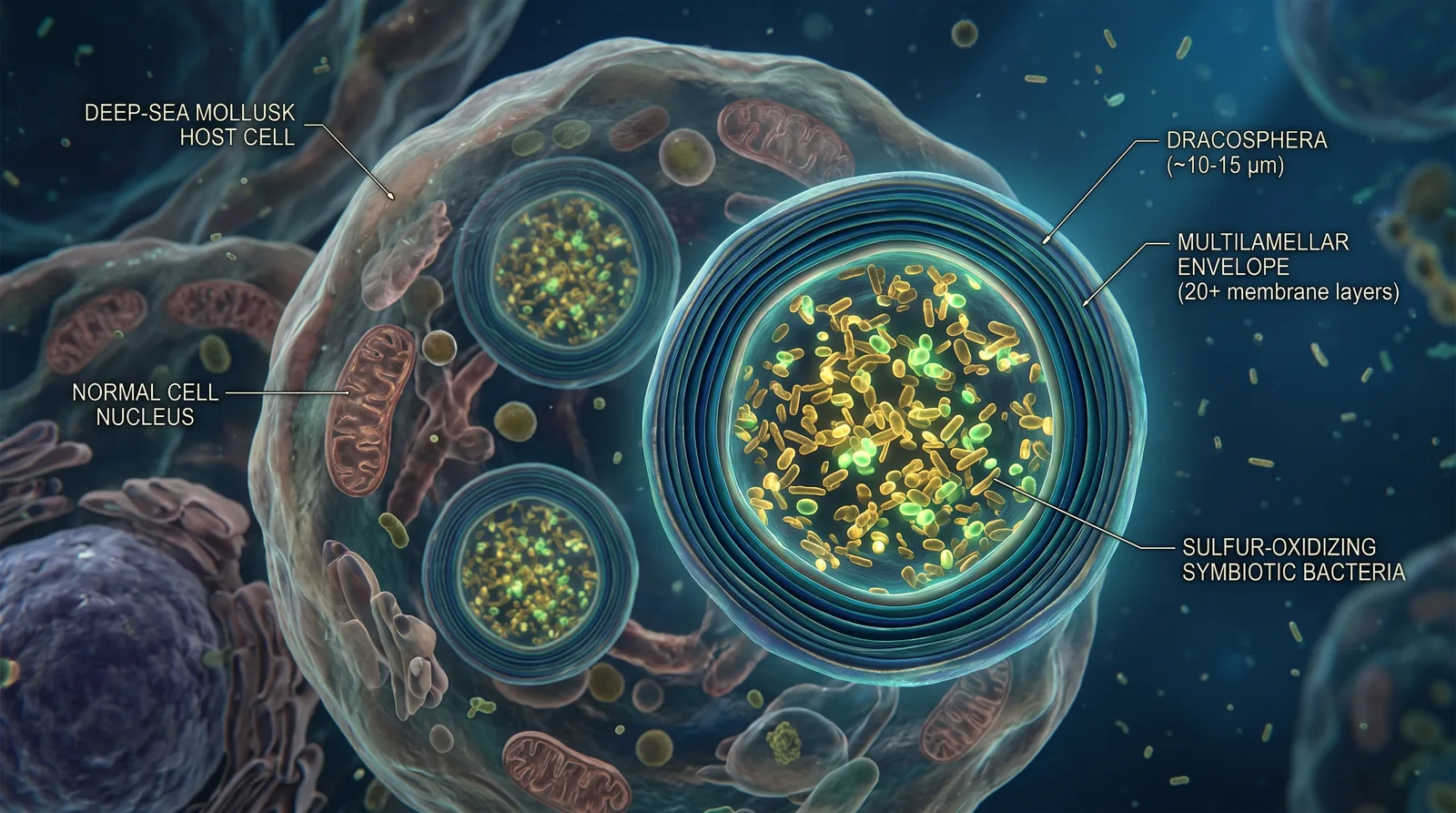
Using anatomical analysis, micro-computed tomography and three-dimensional image reconstruction, the researchers found that C. shenloong has a highly developed digestive-gland system that occupies most of its body cavity. These glands host large populations of sulfur-oxidizing symbiotic bacteria, which provide a major source of nutrients and energy.
What the dracosphera is—and is not Within the digestive glands, the team identified a spherical structure approximately 10–15 micrometres in diameter, enclosed by more than 20 membrane layers. The researchers named it the dracosphera, or “dragon ball.”
The dracosphera contains hundreds to thousands of sulfur-oxidizing symbionts. On average, a single host cell contains more than 1,600 symbionts.
The structure lacks common host-cell structures such as a nucleus and lysosomes. The researchers therefore describe it as neither an ordinary cell nor a typical digestive vacuole, but as a specialized structure dedicated to housing and maintaining bacterial symbionts.
What the anatomical observations suggest about oxygen regulation The researchers hypothesize that the multilamellar membrane envelope may regulate oxygen distribution within the body. It could act as a barrier that slows oxygen diffusion, helping preserve limited oxygen for host cells while maintaining conditions needed by the symbiotic bacteria.
This is a hypothesis, not a demonstrated mechanism. The available release does not report oxygen gradients, metabolic rates, diffusion coefficients, membrane permeability or direct measurements of gas exchange across the dracosphera envelope.
Genomic analysis indicates that the symbionts have adaptations for low-oxygen environments and can maintain metabolism with minimal oxygen. The host must remain deep in seafloor mud to access chemicals such as hydrogen sulfide that the bacteria can use.
Nutrient exchange and symbiont digestion The researchers also found abundant digestion-related cellular structures and enzyme-activity signals around the symbiotic region. These observations suggest that the host may digest a portion of its symbionts to obtain essential nutrients that it cannot produce itself.
This proposed exchange is mutually beneficial in principle: bacteria provide energy and nutrients through chemosynthesis, while the host provides shelter and access to chemical substrates. However, the release does not quantify the fraction of symbionts digested, the nutrient fluxes involved or the energetic contribution of each partner.
What the observations do not establish It may seem that the dracosphera functions like a nucleus or lysosome. In fact: it lacks common host-cell structures such as a nucleus and lysosomes and appears specialized for housing symbionts.
It may seem that the multilayer envelope has been shown to regulate oxygen diffusion. In fact: this remains a hypothesis requiring further experimental validation.
It may seem that every host cell contains thousands of symbionts. In fact: the reported average is more than 1,600 symbionts per host cell, while the dracosphera itself contains hundreds to thousands.
It may seem that C. shenloong was collected from both Kyushu and the South China Sea. In fact: the study focuses on South China Sea cold seeps, while traces of the species were also found at a mud volcano off Kyushu, Japan.
The release does not report metabolic rates, oxygen-diffusion coefficients, symbiont population bounds, global abundance or a direct demonstration of nutrient transfer.
The proposed wide distribution across global cold seeps is a hypothesis based on records of closely related species, not a demonstrated global population estimate.
Verdict: Imaging and genomic analyses of Chaetoderma shenloong identified a specialized, multilamellar organelle—the dracosphera—that houses sulfur-oxidizing symbionts in an oxygen-depleted deep-sea cold seep. The structure contains hundreds to thousands of bacteria, with more than 1,600 symbionts per host cell on average; however, its proposed role in oxygen regulation and nutrient exchange remains unconfirmed.
Based on reporting from HKUST. This is an independent explainer, written in our own words with AI assistance; HKUST has not reviewed or endorsed it. Read the original for the full details.