A New Power Converter Design for Renewable Energy
Solar panels and batteries produce low voltages, and raising them to something a grid-tied inverter can use is done by a converter that switches on and off thousands of times a second. Each of those transitions wastes energy, and this design claims to eliminate the waste on every switch and diode using one auxiliary circuit.
Reviewed by Matheus GrangeiroUpdated on
- Peer reviewed
- Yes
Evidence level: Prototype or demonstration
Why it matters: Switching losses are the reason a converter cannot simply be run faster, and running faster is what makes magnetic components smaller and cheaper. A design that reduces those losses changes the trade-off between size and efficiency rather than improving one at the expense of the other, which is why soft switching has been pursued for decades.
What soft switching means, and why it is hard to achieve everywhere Fatemeh Falahi, Ebrahim Babaei, Darioush Alizadeh and Mehran Sabahi designed a soft-switched interleaved high step-up non-isolated DC-DC converter for renewable-energy integration. The study was published in Scientific Reports on 8 October 2026.
A transistor dissipates energy during the instant it changes state because, for a moment, it carries both voltage and current. Soft switching arranges for one of those to be zero at the transition: zero-voltage switching (ZVS) turns a device on when there is no voltage across it, while zero-current switching (ZCS) turns it off when no current flows through it.
The usual difficulty is coverage and cost. Achieving soft switching for the main switches is well understood, but extending it to every switch and diode often requires additional switches, which can reintroduce losses and complexity.
The claim here is that all switches and diodes operate with both ZVS and ZCS during transitions, achieved with a single auxiliary resonant circuit and one auxiliary inductor, without any extra switches. That component count is the substance of the contribution, because it determines whether the idea is practical.
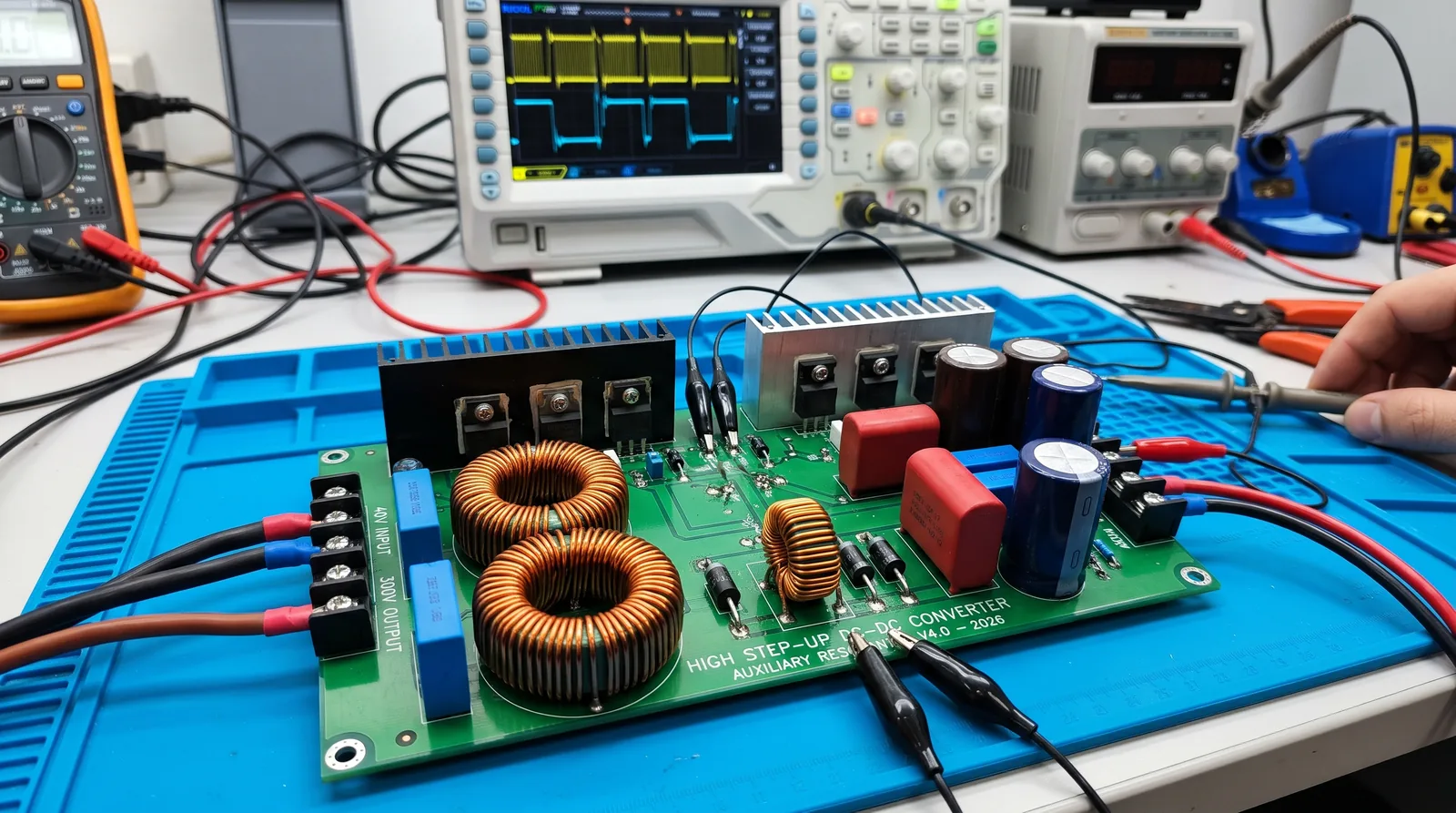
What the prototype actually showed The validation is a built converter, which matters because soft-switching schemes can work in theory but lose their advantage to parasitic effects in copper and silicon. The prototype converted 40 V input to 300 V output at an efficiency of 94.42%.
That ratio is the useful part of the specification. A step-up of 7.5 times is where simple converter topologies struggle, which is why high step-up designs exist as a separate family; reporting efficiency at that ratio is more informative than reporting a peak figure at a convenient operating point.
The design is described as adaptable to multi-phase interleaved configurations while retaining the advantages of the single-phase design. Interleaving splits current between parallel stages, which can reduce ripple and spread heat.
What a single prototype measurement leaves open One efficiency number describes one operating point. Converters are judged on a curve: efficiency at light load, full load and across input voltages, because a solar input varies throughout the day. The abstract does not report efficiency at 25 V input or at half power.
Nothing is reported in the abstract about the components under stress. Soft switching can move energy into resonant elements, so the voltage and current ratings of the auxiliary inductor and capacitor, and their losses, determine real cost and reliability.
The multi-phase claim is an adaptation rather than a measurement. The paper states that the topology is suitable for interleaved configurations, but the abstract does not report a built multi-phase prototype or its efficiency.
Why the component count is the number to watch In power electronics, the interesting question is often not whether a technique works, but what it costs. Zero-voltage and zero-current switching across all devices is a strong claim, and it would be less notable if it required multiple auxiliary switches.
One auxiliary resonant circuit, one auxiliary inductor and no extra switches is therefore the claim to examine in the full paper. If it holds under measurement, it could allow adoption without redesigning the control system, since no additional switch means no additional gate drive or timing complexity.
The honest status of this DC-DC converter is a well-aimed topology with a single prototype behind it. The 94.42% efficiency at 40 V to 300 V is a real measurement at one operating point; the extension to multiple phases is reasoned rather than measured, and the full efficiency curve is not reported in the abstract.
Does 94.42% make this the most efficient converter available? It may seem that the converter is 94.42% efficient in general. In fact: that is one measurement at 40 V input and 300 V output; converters are judged across load and input ranges.
It may seem that soft switching eliminates all losses. In fact: it significantly reduces or can effectively eliminate losses at switching transitions, while conduction losses and losses in auxiliary components remain.
It may seem that the multi-phase version was demonstrated. In fact: the paper describes the topology as adaptable to interleaved configurations, but the abstract does not report a built multi-phase prototype or its efficiency.
It may seem that the prototype is single-phase. In fact: the abstract does not explicitly state the phase count of the prototype; it only says the topology retains the advantages of the single-phase design.
It may seem that the converter is ready for deployment. In fact: it is a laboratory prototype validated at one operating point; scalability, component stress, thermal performance and long-term reliability are not reported in the abstract.
Verdict: The study presents a soft-switched interleaved high step-up non-isolated DC-DC converter that achieves ZVS and ZCS for all switches and diodes using one auxiliary resonant circuit and one auxiliary inductor, without extra switches. A prototype converted 40 V to 300 V at 94.42% efficiency; however, the efficiency curve, component stress, multi-phase validation and long-term reliability are not reported in the abstract.
Based on reporting from Scientific Reports. This is an independent explainer, written in our own words with AI assistance; Scientific Reports has not reviewed or endorsed it. Read the original for the full details.