Uncovering the pioneering path of parasitologist Maria Deane
Born in 1916, pioneering parasitologist Maria José von Paumgartten Deane overcame strict family objections and systemic barriers to study medicine in Belém. Her life's work alongside Leônidas de Mello Deane profoundly shaped our understanding of malaria, visceral leishmaniasis, and Chagas disease transmission.
Reviewed by Matheus Grangeiro
Key numbers
1930anos
decade when Maria entered higher education in Belém
1916ano
birth year of Maria José von Paumgartten Deane
1995ano
death year of Maria José von Paumgartten Deane
12dia
day of the interview in September 1989
1989ano
year the interview was conducted
2024ano
year the grandson signed the consent form
300horas
total hours of interviews in the Memoria de Manguinhos project
1914ano
birth year of Leônidas de Mello Deane
Press versus study
Simplification
What the press says
O artigo detalha vários aspectos da vida e carreira de Maria Deane, incluindo sua infância, faculdade, expedições científicas, exílio durante a ditadura militar e contribuições para a ciência.
What the study shows
O resumo da pesquisa indica que o texto apresenta e transcreve parte da entrevista sobre a trajetória da cientista, mencionando os anos 1930, o contexto masculino, estratégias de afirmação, o trabalho com Evandro Chagas e a parceria com Leônidas Deane.
Evidence level: Not specified in the source
Why it matters: Historical documentation of pioneering women in Brazilian science remains limited, and their contributions to tropical medicine are often underrepresented in institutional narratives. Oral-history archives can preserve firsthand accounts of scientific expeditions, gender discrimination, career interruptions, and institutional exclusion that may not appear in formal publications. The case of parasitologist Maria José von Paumgartten Deane illustrates how oral history can recover the personal and professional trajectory of a woman whose work contributed to research on malaria, visceral leishmaniasis, and Chagas disease.
From 1916 to institutional legacy Maria José von Paumgartten Deane was born in 1916 and died in 1995. Her career included work with the Rockefeller Foundation, the Special Public Health Service, the University of São Paulo, and the Instituto Oswaldo Cruz, where she later became vice-director in 1986.
In 1932, she entered the Faculdade de Medicina e Cirurgia do Pará in Belém. Her class included about 60 students, of whom only five were women—all named Maria.
Fiocruz honored her legacy in 2001 by naming its Manaus unit the Leônidas & Maria Deane Research Center, now known as Instituto Leônidas & Maria Deane – Fiocruz Amazônia. This institutional recognition reflects the lasting significance of her and her husband Leônidas Deane’s work in Brazilian tropical medicine.
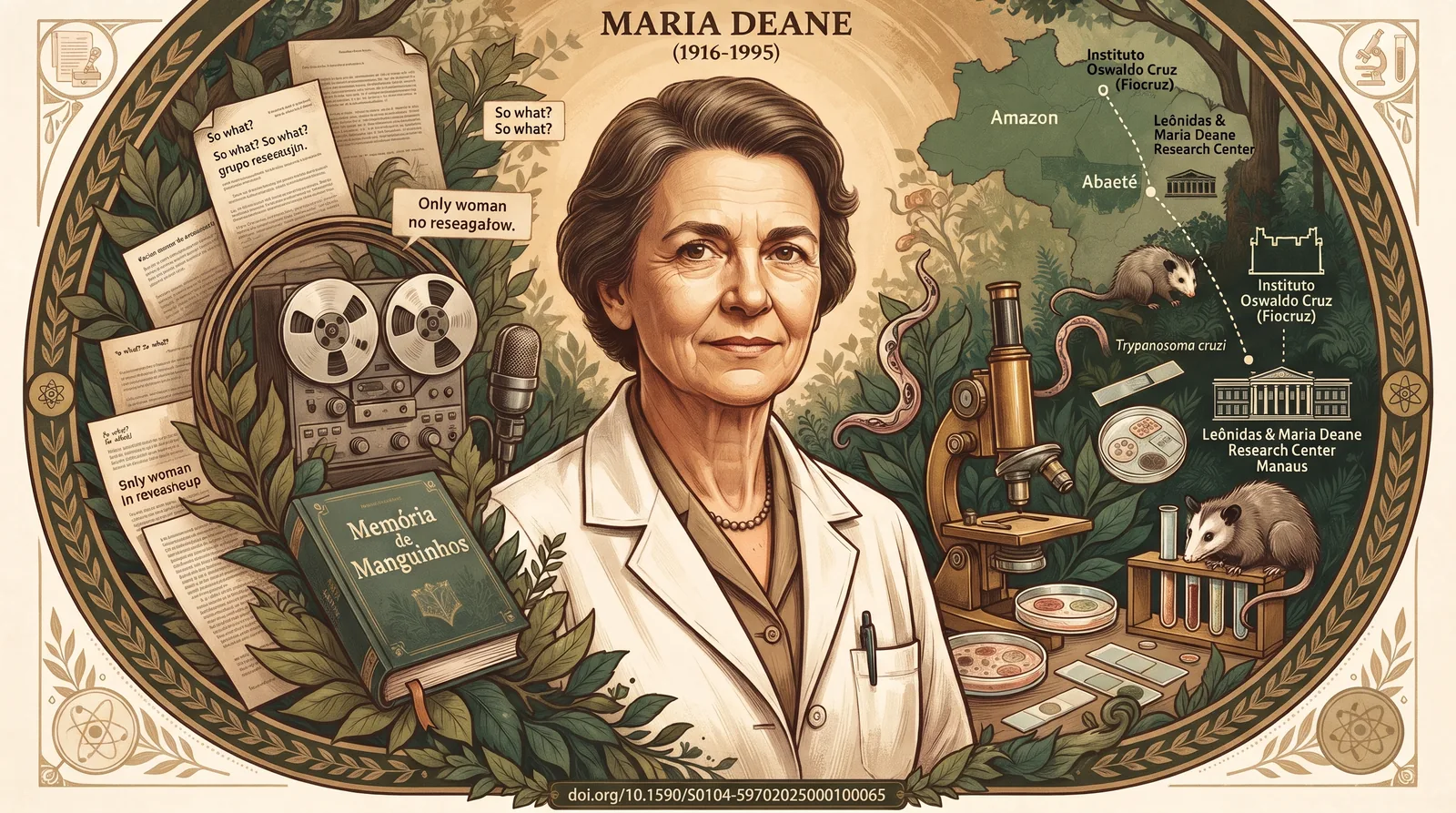
Breaking barriers in a male-dominated field When Maria chose to study medicine in Belém in the 1930s, she faced objections from her aunts. Her family consulted the family doctor, who warned her that she would have to examine naked male cadavers. Her reported response was, “So what?”
During field expeditions in the forests of Abaeté, in the Amazon region, Maria was the only woman among researchers from the Instituto de Patologia Experimental do Norte and the Instituto Oswaldo Cruz. The expeditions lasted weeks and searched for cases of visceral leishmaniasis.
She described experiencing the social difficulties of being a woman in an all-male research group, even though she said the working group accepted her well. Her account provides a firsthand perspective on gendered expectations and discrimination in Brazilian science during that period.
Unlocking the oral history of tropical medicine The biographical overview relies heavily on a September 12, 1989 interview conducted by Flávio Taveira and Rose Goldschmidt for the Memória de Manguinhos oral-history project at Casa de Oswaldo Cruz. The interview captured Maria Deane’s account of entering medicine, scientific expeditions, gender discrimination, motherhood, and her professional partnership with Leônidas Deane.
Documentalists Laurinda Maciel and Renata Borges published and transcribed part of the interview in História, Ciências, Saúde – Manguinhos. Maria Deane’s grandson, Camilo Deane Escobar, signed a consent form in 2024 because authorization for the original 1989 interview had remained pending.
The Memória de Manguinhos project, conducted between 1986 and 1989, produced more than 300 hours of interviews with 30 researchers whose trajectories were considered fundamental to the consolidation of the Instituto Oswaldo Cruz. This makes the archive a valuable source for reconstructing the history of Brazilian biomedical science beyond conventional publication records.
Scientific contributions and institutional impact Maria Deane contributed to research on malaria transmission and control, visceral leishmaniasis, and Chagas disease. Her work with Leônidas Deane included studies of the Anopheles gambiae mosquito during malaria-control efforts in northeastern Brazil.
In 1984, she described the dual cycle of Trypanosoma cruzi, the agent of Chagas disease, in opossums. This finding concerned areas free of domestic triatomines, identifying opossums as an important ancestral reservoir of the parasite.
Her career also included leadership roles. In 1986, she was elected vice-director of the Instituto Oswaldo Cruz, and two years later she contributed to restructuring the institute’s graduate program.
What the biographical overview does not show The published article and Fiocruz announcement focus on Maria Deane’s personal and professional trajectory through oral history. They do not provide a detailed methodological breakdown of all laboratory and field experiments she conducted.
The source does not quantify the full scientific impact of each discovery, the number of publications she authored, or the precise methods used in her research. It also does not provide a comprehensive assessment of how her findings influenced later vector-control programs.
The oral-history account is valuable, but it is a retrospective interview conducted decades after many of the events described. It should therefore be interpreted as a firsthand recollection shaped by memory, context, and interview conditions, rather than as a complete experimental record.
What the oral history does not show It may seem that the published article provides a full methodological breakdown of all scientific experiments conducted by Maria Deane. In fact: the source focuses on her personal and professional trajectory through oral history and does not provide detailed experimental methods.
It may seem that her 1984 finding on Trypanosoma cruzi directly proves modern vector-control strategies. In fact: the source describes the discovery and its scientific significance, but does not establish a direct causal link to current vector-control policy.
It may seem that the oral history fully captures every episode of discrimination she faced. In fact: it preserves selected recollections from a 1989 interview, not a complete record of every professional or personal experience.
It may seem that institutional recognition in 2001 proves the full extent of her scientific legacy. In fact: the naming of Fiocruz’s Manaus unit honors her and Leônidas Deane, but it does not by itself quantify the breadth or impact of her research contributions.
Verdict: Archival oral histories and published transcripts preserve firsthand accounts of Maria Deane’s pioneering expeditions, her entry into medicine in a male-dominated environment, and the gender barriers she encountered in 1930s Brazil. Her career included major contributions to malaria, visceral leishmaniasis, and Chagas disease research, including the 1984 description of Trypanosoma cruzi’s dual cycle in opossums. However, this specific biographical overview does not capture the detailed experimental methods behind her laboratory and field studies.
Based on reporting from Agência Fiocruz. This is an independent explainer, written in our own words with AI assistance; Agência Fiocruz has not reviewed or endorsed it. Read the original for the full details.