How SMC5/6 shapes three-dimensional genome architecture and stability
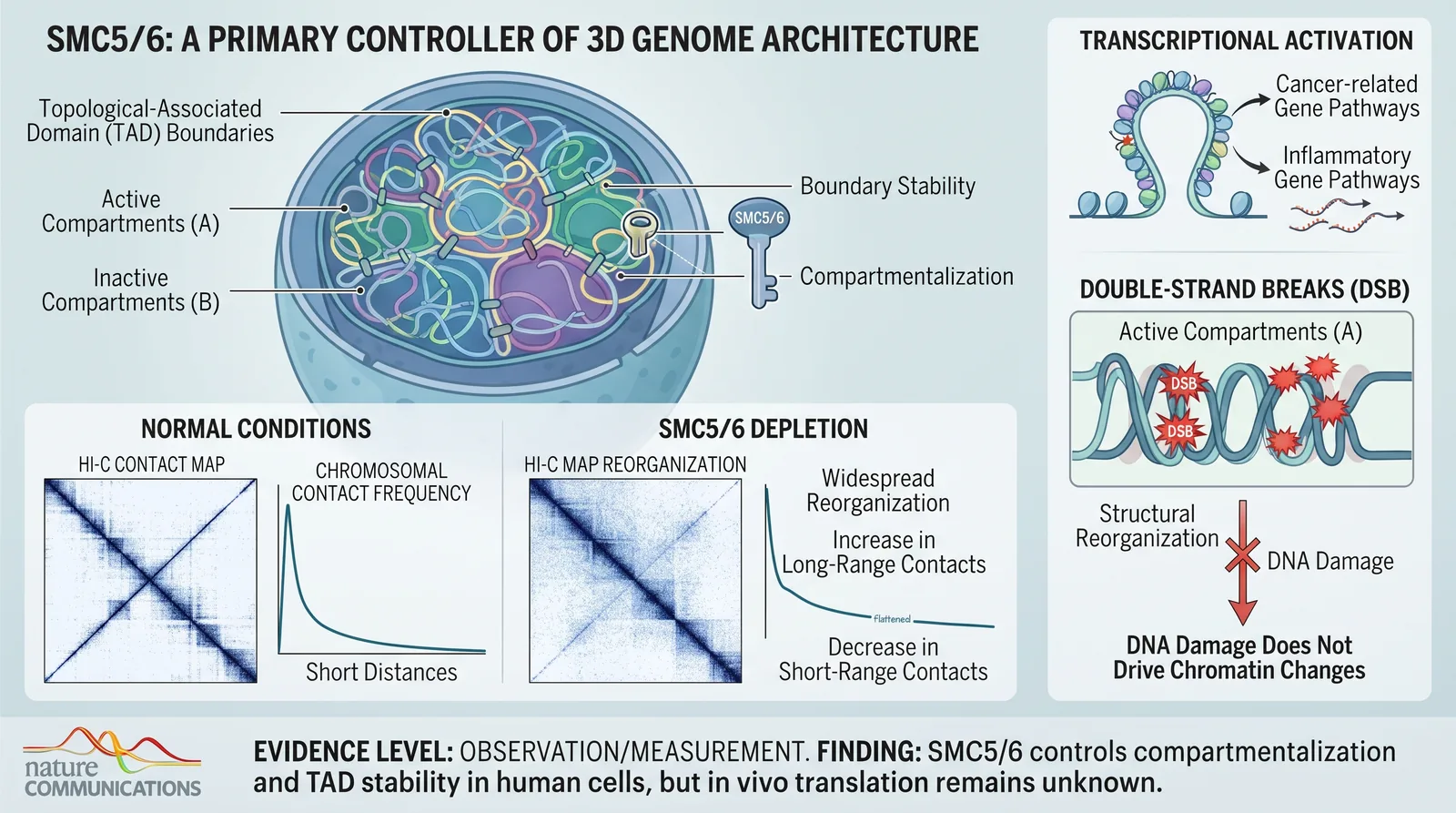
Researchers conditionally depleted SMC5 in human cells and discovered that its removal triggers widespread reorganization of chromosomal contacts and DNA damage. This finding connects spatial genome organization directly with transcriptional management and stability.
Reviewed by Matheus Grangeiro
- Peer reviewed
- Yes
Key numbers
2%
portion of the genome affected by changes in 3D genome compartmentalization upon SMC5 loss
682190grant number
European Research Council grant REPSUMODDT
18976grant number
Italian Association for Cancer Research Investigator Grant
23710grant number
Italian Association for Cancer Research Investigator Grant
32181grant number
Italian Association for Cancer Research Investigator Grant
28147grant number
AIRC fellowship
800924grant number
AIRC iCARE Fellowship
31282-2024grant number
AIRC pre-doc fellowship
Evidence level: Observation or measurement
Why it matters: Cells must maintain the three-dimensional organization of their genomes while protecting DNA from damage and preventing inappropriate activation of cancer-related or inflammatory genes. The SMC5/6 complex is part of the Structural Maintenance of Chromosomes protein family, which helps organize chromosomes, regulate chromatin states, and influence transcription. This study provides direct evidence that SMC5/6 helps preserve large-scale chromatin compartments and topologically associating domain boundaries in human cells, linking genome architecture to transcriptional control and genome stability.
How SMC5/6 shapes genome architecture Proteins in the Structural Maintenance of Chromosomes family perform essential cellular tasks, including organizing the genome in three dimensions, influencing chromatin states, and regulating transcription. Before this study, the precise role of SMC5/6 in higher-order chromatin architecture was not well defined.
The researchers conditionally depleted SMC5 in human B lymphoblastoid cells and used Hi-C to map chromatin contacts. Hi-C measures how often different regions of the genome physically interact, allowing researchers to infer changes in three-dimensional genome organization.
After SMC5 depletion, the researchers observed a global rewiring of chromatin interactions. Long-range contacts increased while short-range contacts decreased, indicating a substantial rearrangement of chromosome organization within the nucleus.
The study found that SMC5 loss altered three-dimensional genome compartmentalization across approximately 2% of the genome. Although this is a limited fraction, the result identifies SMC5/6 as a key regulator of compartmentalization and topologically associating domain boundary integrity.
What the study shows about damage and transcription Changes in nuclear architecture can trigger downstream biological responses. When SMC5 was depleted, the researchers observed transcriptional activation of inflammatory and cancer-associated gene programs.
SMC5 depletion also promoted the accumulation of double-strand DNA breaks. These breaks occurred preferentially in active chromatin compartments and in regions with higher gene-expression levels.
Importantly, genomic regions undergoing architectural reorganization showed comparatively fewer DNA breaks. This indicates that the chromatin changes were not simply caused by DNA damage; rather, SMC5/6 appears to influence genome organization and genome stability through related but distinguishable mechanisms.
Connecting spatial organization to stability The findings link spatial genome organization directly to transcriptional regulation and genome stability. By mapping chromosomal interactions after SMC5 depletion, the researchers move SMC5/6 from a poorly defined factor to a recognized regulator of chromatin compartmentalization and topologically associating domain boundaries.
The observation that structural changes affected only about 2% of the genome shows that SMC5/6 loss does not destabilize every chromatin compartment equally. Instead, its effects are detectable but spatially selective.
The study also shows that DNA damage and architectural reorganization are not automatically coupled. Double-strand breaks accumulated in active compartments rather than in rearranged regions, supporting the interpretation that SMC5/6 has distinct roles in maintaining both genome structure and DNA integrity.
What remains unknown beyond cell cultures The precise molecular mechanisms by which SMC5/6 maintains topologically associating domain boundary integrity are not fully defined. Additional research is needed to identify the biochemical steps through which the complex stabilizes these structural boundaries.
It also remains unknown how the findings translate in vivo across different tissue types or whole organisms. Experiments in isolated human B lymphoblastoid cells cannot automatically predict how complex living tissues will respond to SMC5 depletion.
The study used a conditional depletion approach in a specific human cell type. Therefore, its conclusions should not be generalized to all cell types, developmental stages, or disease contexts without further validation.
What the structural shifts do not show It may seem that structural reorganization of the genome directly causes the accumulation of DNA breaks. In fact: regions undergoing architectural reorganization showed comparatively fewer breaks, suggesting that DNA damage does not drive the observed chromatin changes.
It may seem that SMC5/6 controls the entire genome’s three-dimensional organization. In fact: the study found changes in compartmentalization affecting approximately 2% of the genome, not a uniform rearrangement across all chromatin.
It may seem that the transcriptional activation proves that SMC5/6 loss causes cancer. In fact: the study shows activation of cancer-associated and inflammatory gene programs in cultured human cells; it does not establish that SMC5/6 depletion causes cancer in organisms or patients.
It may seem that the findings apply equally to all human tissues. In fact: the experiments were conducted in human B lymphoblastoid cells, and translation to other tissues or whole organisms remains untested.
Verdict: The study demonstrates through conditional SMC5 depletion and Hi-C analysis that SMC5/6 helps maintain three-dimensional genome compartmentalization and topologically associating domain boundary integrity in human B lymphoblastoid cells. SMC5 loss causes global chromatin rewiring, alters compartmentalization across about 2% of the genome, activates inflammatory and cancer-associated gene programs, and promotes DNA breaks preferentially in active compartments. However, the precise molecular mechanisms and the relevance of these findings across tissues and whole organisms remain unknown.
Based on reporting from Nature Communications. This is an independent explainer, written in our own words with AI assistance; Nature Communications has not reviewed or endorsed it. Read the original for the full details.