Tracing the spread of coronavirus variant PJ.2.1 in Brazil
The PJ.2.1 lineage of Sars-CoV-2 was detected in Brazil after emerging in Canada, becoming dominant in samples analyzed within the capital of Rio de Janeiro. Genomic monitoring is essential for tracking the pathogen, although precise transmission rates and hospitalization data remain unmeasured.
Reviewed by Matheus Grangeiro
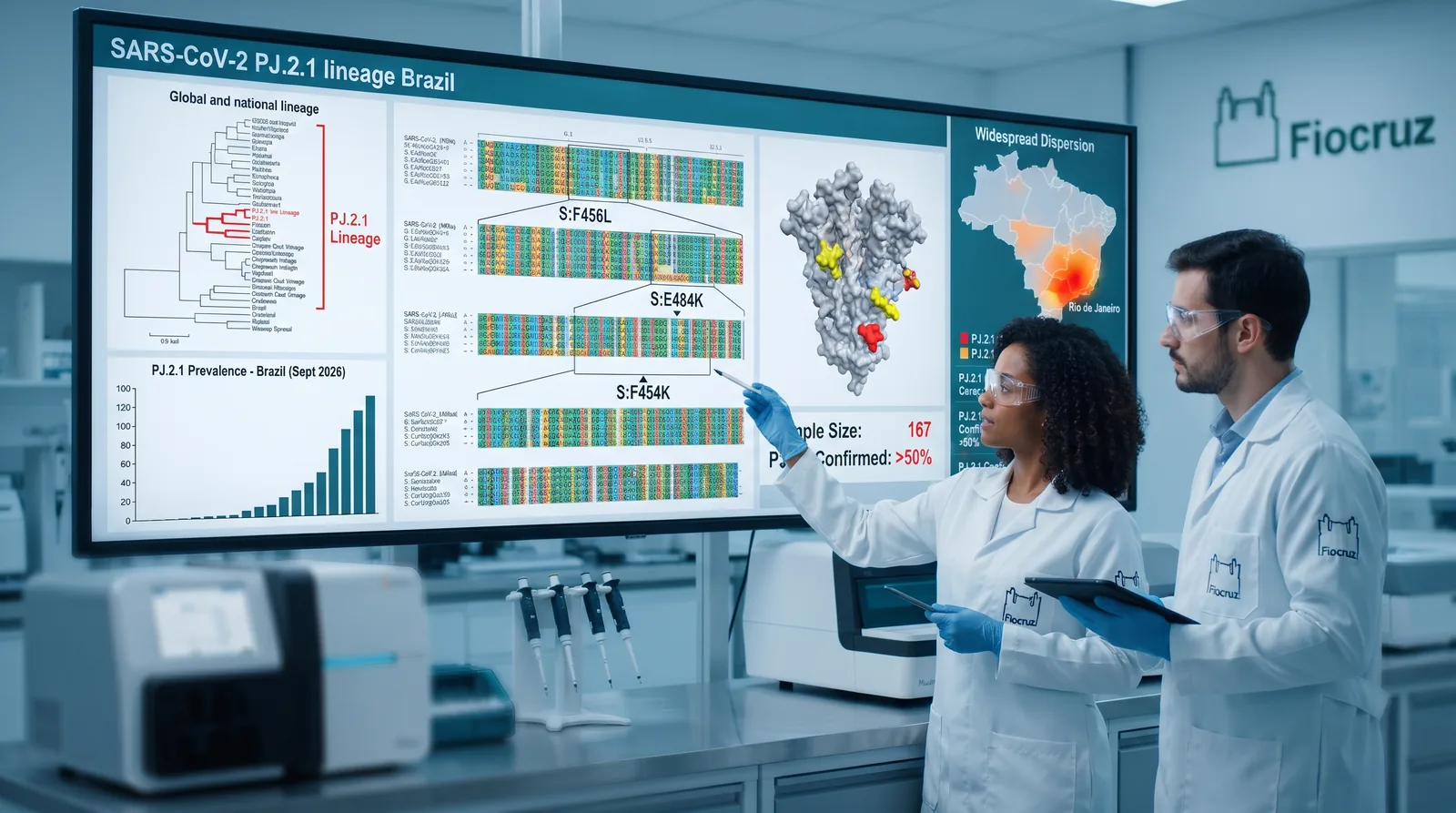
- Sample size
- 167
Key numbers
2026ano
Ano da identificação inicial da linhagem PJ.2.1 no Canadá
167amostras
Total de amostras analisadas na vigilância genômica no Rio de Janeiro
58por cento
Proporção de genomas sequenciados identificados como PJ.2.1 no Rio de Janeiro
25cientistas
Número de membros no Grupo Consultivo Técnico sobre Evolução de Vírus da OMS
umano
Tempo mínimo desde a última dose de vacina que pode deixar a pessoa desprotegida
Evidence level: Observation or measurement
Why it matters: The spread of a new SARS-CoV-2 lineage with mutations that may increase receptor binding and transmissibility requires continuous genomic surveillance. Public health authorities need timely information to track geographic dispersion, assess potential risks, and adjust vaccination and prevention strategies. For people whose last vaccine dose was more than 12 months ago, antibody levels may have declined over time, making up-to-date vaccination especially relevant for protection against severe disease.
How genomic sequencing tracks PJ.2.1 Genetic sequencing decodes the viral genome and identifies mutations that distinguish one lineage from another. In the case of PJ.2.1, the reported mutations are associated with greater affinity for human cell receptors and potentially greater transmissibility.
This does not mean that sequencing alone proves how quickly the variant will spread in every setting. It allows laboratories to identify the lineage, monitor its presence in samples, and follow its geographic movement over time.
The World Health Organization classified PJ.2.1 as a variant under monitoring. That classification means the lineage requires continued surveillance; it does not by itself establish that the variant is more dangerous or causes more severe disease than other circulating lineages.
Arrival and spread in Brazil The first reports of PJ.2.1 were recorded in Canada in May 2026. The lineage began circulating more widely in North America during the second half of the year and was introduced into Brazil at the end of August.
Analyses by the Respiratory, Exanthematic, Enterovirus and Viral Emergencies Laboratory at the Oswaldo Cruz Institute identified PJ.2.1 as predominant in the city of Rio de Janeiro. The surveillance work was conducted in partnership with the Rio de Janeiro Municipal Health Secretariat.
Among 167 samples analyzed, PJ.2.1 was identified in 58% of sequenced genomes. This means that slightly more than half of the sequenced samples in that specific surveillance set contained the lineage; it does not mean that 58% of all people in Rio de Janeiro were infected with PJ.2.1.
Surveillance finding Result Samples analyzed in Rio de Janeiro 167. Share of sequenced genomes containing PJ.2.1 58%. First global reports Canada, May 2026. Introduction into Brazil End of August 2026. Other Brazilian locations with confirmed cases São Paulo, Espírito Santo, Federal District, Rio Grande do Sul, and Santa Catarina. WHO classification Variant under monitoring. What “more transmissible” means The Fiocruz researcher states that PJ.2.1 has genome mutations that allow greater affinity for human cell receptors, making the virus more transmissible. This is a biological and surveillance-based assessment, not a precisely measured reproduction number or growth-rate advantage.
The available reporting does not provide a quantitative estimate of how much more transmissible PJ.2.1 is than other variants. It also does not report hospitalization rates, intensive-care admissions, or deaths specifically attributable to this lineage.
Therefore, the appropriate conclusion is that PJ.2.1 warrants monitoring because of its potential for increased transmission, not that its clinical severity or public-health impact has been fully established.
Symptoms and clinical impact The reported symptoms associated with PJ.2.1 are similar to those of influenza or a common cold: fever, cough, sore throat, and runny nose. These symptoms are not unique to this lineage and cannot be used to identify it without laboratory testing.
The source does not provide data showing that PJ.2.1 causes more severe illness than other circulating SARS-CoV-2 lineages. It also does not provide evidence that the lineage has caused a specific increase in hospitalizations or deaths.
Because the variant may have greater potential to spread, people in higher-risk groups may face a greater chance of exposure. This makes continued vaccination and prevention measures particularly important for those groups, even though the evidence does not yet quantify the variant’s specific clinical burden.
Vaccines and prevention The available vaccines offered through Brazil’s Unified Health System are reported to provide protection against PJ.2.1. Their principal objective is to reduce severe COVID-19 cases, especially among people at higher risk.
The source states that people whose last vaccine dose was administered more than a year ago may have declining antibody levels and can receive another vaccine dose. It recommends that people in risk groups keep their vaccination up to date according to state and municipal schedules.
Preventive recommendations also include frequent hand hygiene and mask use by people with symptoms. These measures aim to reduce transmission to others, particularly in settings where vulnerable people may be present.
What the dominant samples do not show It may seem that the rapid spread of PJ.2.1 means current vaccines have lost all efficacy. In fact: Fiocruz states that available vaccines protect against the lineage and that their main goal is to reduce severe disease.
It may seem that PJ.2.1 is proven to be more dangerous because the WHO classified it as a variant under monitoring. In fact: the classification indicates a need for surveillance, not established greater severity or clinical danger.
It may seem that 58% of people in Rio de Janeiro were infected with PJ.2.1. In fact: the 58% figure refers to the share of 167 sequenced surveillance samples in which the lineage was identified, not the share of the city’s population.
It may seem that the variant’s exact transmission advantage and hospitalization impact are known. In fact: the available reporting does not quantify its transmissibility relative to other variants, nor does it provide lineage-specific hospitalization or death data.
Verdict: Genomic surveillance in Rio de Janeiro identified PJ.2.1 in 58% of 167 sequenced samples and documented confirmed cases in several other Brazilian states. The lineage is classified by the WHO as a variant under monitoring because its mutations may increase receptor affinity and transmissibility. However, the available data do not quantify its precise transmission advantage, clinical severity, hospitalization burden, or deaths specifically attributable to PJ.2.1.
Based on reporting from Agência Fiocruz. This is an independent explainer, written in our own words with AI assistance; Agência Fiocruz has not reviewed or endorsed it. Read the original for the full details.