Ten emerging energy innovations targeting global electricity demands
A new publication details ten emerging energy innovations designed to curb pollution and expand electricity access before the end of the decade. These developments arrive as global electricity consumption is projected to grow significantly.
Reviewed by Matheus Grangeiro
Key numbers
2030year
target year for real-world use of the reported technologies
2025 to 2030years
forecast period for global electricity demand increase
40%
maximum emissions reduction from calcined-clay limestone cement
20%
maximum additional energy generated by perovskite-silicon tandem solar cells
300meters
water depth threshold for floating offshore wind moorings
1,700academic fields
number of academic fields served by Frontiers journals
Evidence level: Expert assessment and prospective technology report; not an experimental study
Why it matters: Global electricity demand is forecast to rise by almost one-fifth between 2025 and 2030, while volatile fuel prices and concentrated mineral supply chains can make energy systems vulnerable. Technologies that use widely available materials, reduce emissions and diversify supply could improve energy security—but their feasibility depends on deployment, cost and system integration.
How alternative materials and tandem designs alter energy generation The World Economic Forum and Frontiers identified ten emerging technologies with a credible path to real-world use by 2030. The report, Top 10 Emerging Technologies for Planetary Health: Energy Edition, assesses technologies that could reduce emissions, ease reliance on concentrated supply chains and improve access to reliable power.
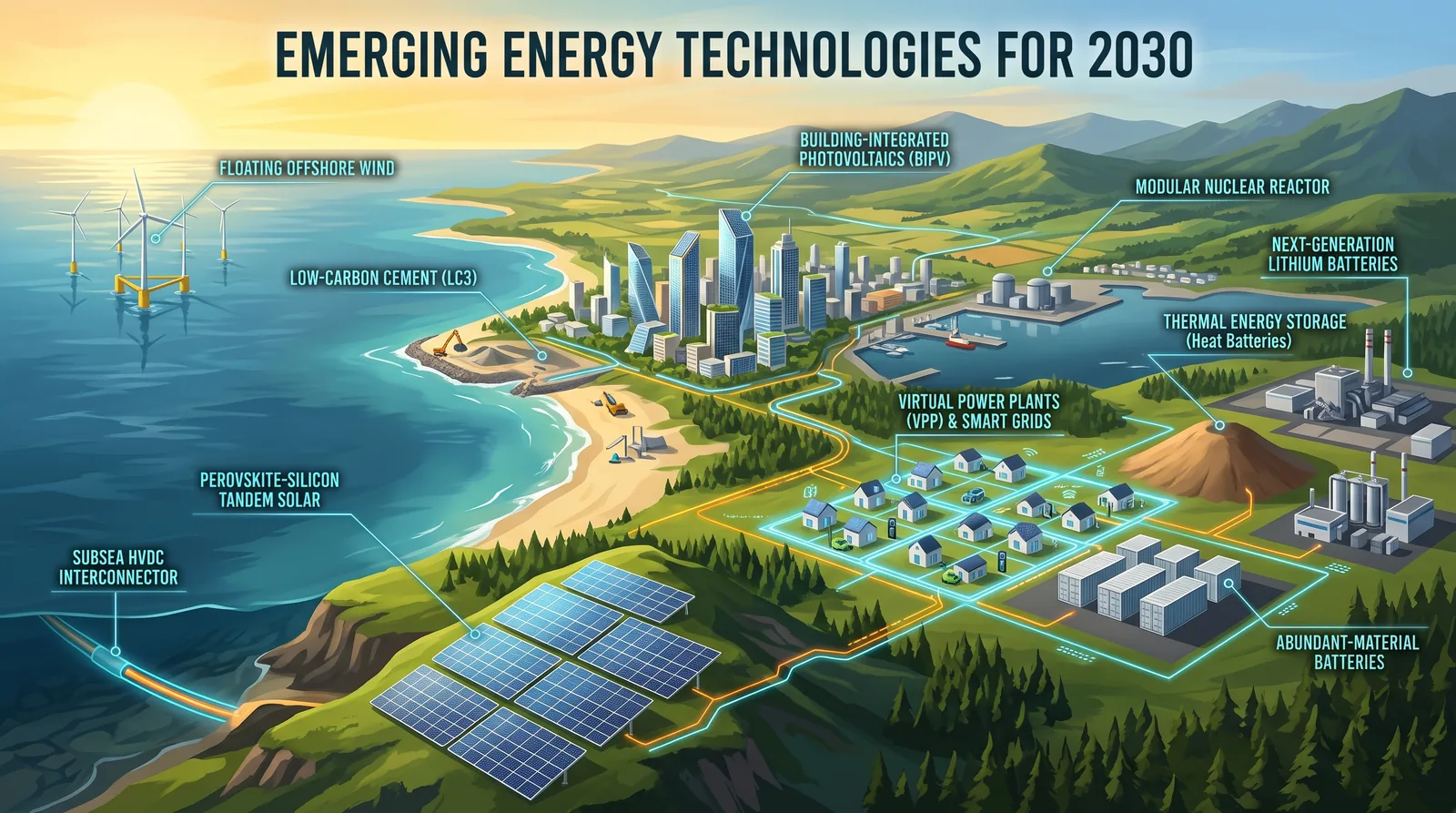
Perovskite-silicon tandem solar cells stack a perovskite layer on a silicon cell. This design can generate up to 20% more energy from the same site than a conventional silicon-only installation.
Calcined-clay limestone cement (LC3) replaces nearly half of conventional clinker with calcined clay and limestone. This less energy-intensive process can cut cement-production emissions by up to 40%.
Abundant-material batteries use sodium, zinc or iron instead of lithium. They trade lithium’s light weight for advantages including cold tolerance, fire safety and multi-day energy storage.
Pathways for software coordination and grid expansion by 2030 Virtual power plants use software to coordinate home batteries, electric-vehicle chargers and smart thermostats. They can supply electricity during peaks or reduce demand, while digital twins—live virtual models of the grid—can help predict its next movements.
Advanced subsea high-voltage direct-current (HVDC) interconnectors link national grids, allowing surplus clean power to move to where it is needed. These systems can reduce curtailment and improve cross-border flexibility.
Modular nuclear reactors are small, factory-built and transportable. They are intended to deliver cleaner power at a competitive cost, although the announcement does not report deployment timelines, costs or regulatory pathways for specific projects.
Capturing industrial heat and harnessing deep marine winds Thermal energy storage, or heat batteries, store renewable electricity as heat in brick, sand or molten salt. This stored heat can supply industrial furnaces, which account for about one-fifth of global energy use.
Building-integrated photovoltaics turn roofs, façades and windows made with silicon-laminated materials into solar generators without requiring additional land.
Floating offshore wind turbines are moored in waters deeper than 300 metres, unlocking wind resources in areas where fixed-bottom turbines are less practical. Next-generation lithium batteries, including lithium-sulfur and solid-state designs, aim to increase energy density while lowering fire risk.
Evaluating the ten innovations against global electricity demands The report evaluates each technology for its potential effects on planetary boundaries, equity and security. It notes that seven of nine planetary boundaries have been breached, all at their highest recorded levels, according to the Planetary Health Check 2026.
The ten technologies are: LC3 cement; virtual power plants and grids; abundant-material batteries; thermal energy storage; perovskite-silicon tandem solar cells; advanced subsea HVDC interconnectors; modular nuclear reactors; building-integrated photovoltaics; floating offshore wind; and next-generation lithium batteries.
The report’s claims are prospective. It identifies credible pathways to real-world use by 2030, but it does not demonstrate that any technology has already achieved large-scale deployment or that its projected benefits will materialize.
What the report does not show It may seem that the ten technologies are guaranteed to reach practical deployment by 2030. In fact: the report says each has a credible path to real-world use by 2030; it does not establish deployment certainty.
It may seem that abundant-material batteries use sand, brick and iron. In fact: they use sodium, zinc and iron; sand and brick are storage media for heat batteries.
It may seem that perovskite-silicon tandem cells improve “efficiency per unit area” by 20%. In fact: the reported gain is up to 20% more energy generated from the same site.
It may seem that the report compares the technologies with fossil-fuel peaking plants. In fact: the available release does not make that comparison.
The release does not report capital costs, operating costs, deployment timelines, supply-chain requirements, grid-integration barriers or country-specific deployment plans for any of the ten technologies.
The report’s assessment of planetary-boundary impacts is qualitative and strategic; it does not provide a quantitative life-cycle assessment for each technology.
Verdict: The World Economic Forum and Frontiers identify ten energy technologies with credible pathways to real-world use by 2030, including tandem solar cells, LC3 cement, abundant-material batteries, heat batteries, virtual power plants, subsea HVDC interconnectors, modular nuclear reactors, building-integrated photovoltaics, floating offshore wind and next-generation lithium batteries. The report is prospective; it does not establish deployment certainty, quantify costs or demonstrate real-world performance at scale.
Based on reporting from Frontiers Science News. This is an independent explainer, written in our own words with AI assistance; Frontiers Science News has not reviewed or endorsed it. Read the original for the full details.