Mapping pristine Pacific coral atolls from the atmosphere to the abyss
Comprehensive surveys across two isolated Pacific atolls revealed thriving, near-pristine ecosystems spanning from aerial environments to the deep-sea abyss. These findings directly led to the official protection of a massive surrounding ocean zone as a national marine sanctuary.
Reviewed by Matheus Grangeiro
- Peer reviewed
- Yes
Key numbers
116kilometers
Distance from Bikar to the nearest inhabited atoll
385kilometers
Distance from Bokak to the nearest inhabited atoll
2023year
Year when extensive monitoring of local land, sea, and sky ecosystems was conducted
48,000square kilometers
Area declared as the country's first national marine sanctuary around the atolls
15colonies
Seabird colonies confirmed or likely to be breeding across both atolls
266groups
Reef fish groups found during the surveys
138groups
Fish groups living at greater depths
79groups
Deep-sea fish groups recorded
Evidence level: Single-time field survey; observational baseline
Why it matters: Marine and terrestrial environments with minimal human influence are exceptionally scarce globally. Remote atolls that retain intact ecological processes can serve as reference systems for understanding what has been lost elsewhere and for guiding conservation and restoration.
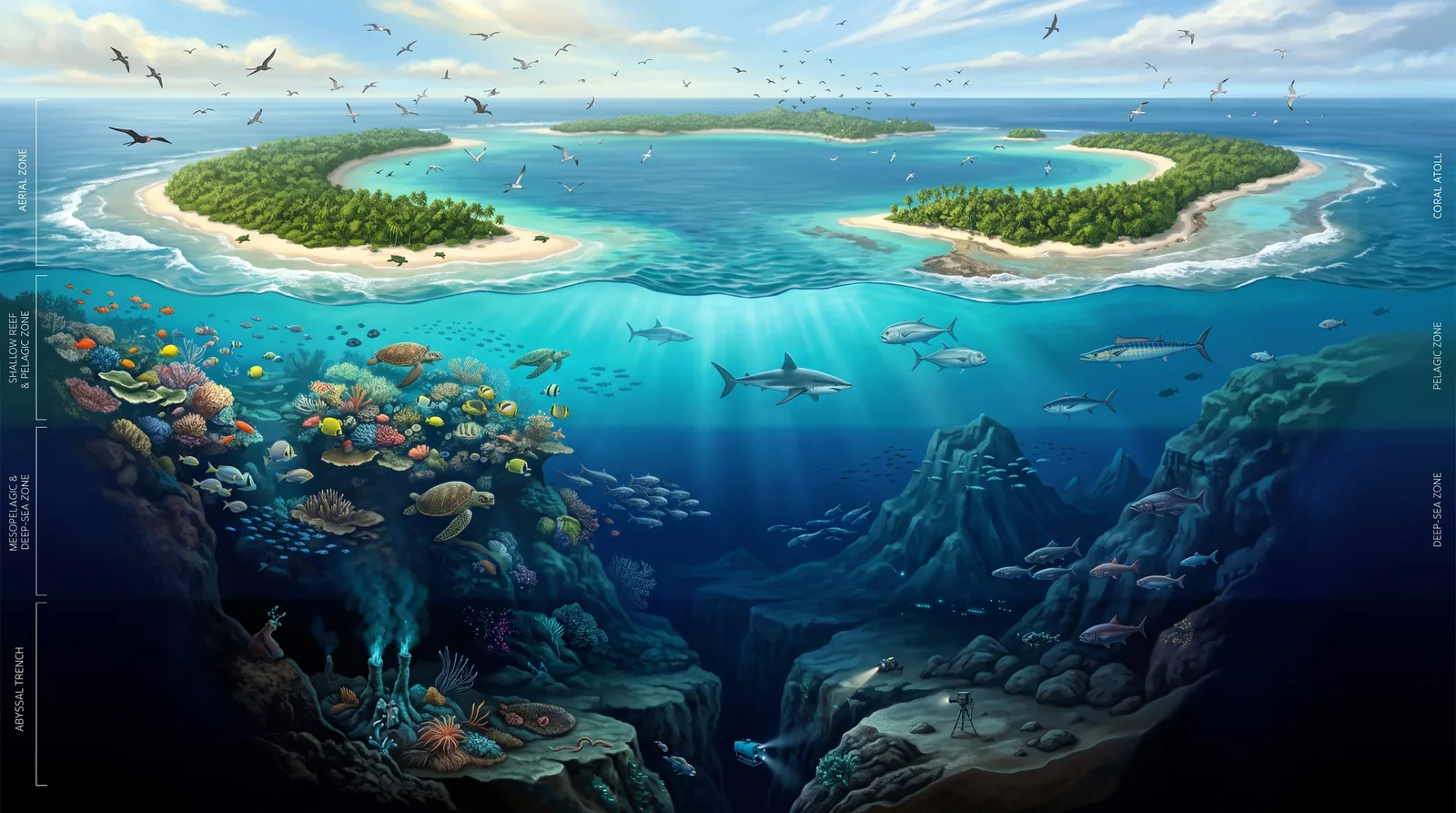
Mapping habitats from the sea surface to the deep sea In 2023, the Marshall Islands Marine Resource Authority and the National Geographic Pristine Seas programme conducted a collaborative expedition to assess Bikar and Bokak, the northernmost atolls in the Marshall Islands. Bikar lies approximately 116 km and Bokak approximately 385 km from the nearest inhabited atoll.
Researchers assessed ecosystems from the sky and land to the deep sea. They surveyed seabird and shorebird populations, characterized native vegetation, documented turtle nesting, and studied coral reefs and fish assemblages using scuba diving, underwater video, deep-sea camera deployments and a submarine.
The expedition documented thriving wildlife, mature native forests and active breeding grounds across terrestrial, coastal and marine habitats. The authors describe Bikar and Bokak as among the most intact ecosystems remaining in the tropical Pacific—and potentially among the most intact worldwide.
What the survey recorded Across both atolls, researchers confirmed or identified as likely breeding 15 seabird colonies. They recorded 266 groups of reef fishes, 138 groups of fishes at greater depths and 79 groups of deep-sea fishes.
They also recorded 15 groups of open-water predators, including sharks, jacks and wahoo. Fourteen of the observed groups had not previously been recorded in the Marshall Islands, and two may represent species new to science.
These results establish the first comprehensive ecological baseline for the newly created Bikar and Bokak national marine sanctuaries, spanning land, shallow reefs, mesophotic habitats and deep-sea communities.
What the single-time survey cannot explain Because the survey captured conditions at one point in time, it could not determine the environmental mechanisms behind ecological differences between Bikar and Bokak. The authors suggest that lagoon size, water exchange, sediment transport, habitat configuration, nutrient dynamics and ecological history may all contribute.
The study also did not examine nutrient transfer or ecological connectivity among habitats. The authors argue that future monitoring should assess entire multi-habitat ecosystems rather than focusing only on shallow coral reefs.
Translating the baseline into protection The assessment was designed to inform the creation of a highly protected area under the Marshall Islands’ Reimaanlok vision, a national, community-led conservation framework for protecting marine and terrestrial resources while sustaining island livelihoods.
Two years after the field assessment, an area of approximately 48,000 square kilometres surrounding Bikar and Bokak was designated the Marshall Islands’ first national marine sanctuary. The sanctuary designation followed the assessment, but the available source does not establish a direct causal link between the survey and the legal designation.
First author Dr Alan Friedlander, a marine ecologist at the University of Hawai‘i and chief scientist for Pristine Seas during the expedition, described the atolls as “living laboratories” and ecological reference systems for conservation and restoration.
What remains unknown The available record does not provide timelines for enforcement, management plans or implementation of the new sanctuary.
The expedition and sanctuary-implementation costs are not reported.
The survey cannot establish trends, population trajectories or the effects of future climate change; repeat monitoring will be required.
The mechanisms linking habitat differences to species composition, biomass and nesting patterns remain unresolved.
The findings describe two remote atolls and should not be generalized as representative of all Pacific reef systems.
What the ecological differences do not imply It may seem that Bikar and Bokak share identical ecological characteristics because they are geographically close. In fact: Bokak had higher total reef-fish biomass and coral-dominated reef communities, while Bikar had a greater diversity of algal taxa and almost all of the recorded green sea-turtle nesting, with 132 nest pits.
The differences do not establish that one atoll is “healthier” than the other. They reflect different ecological conditions and histories that the single-time survey could not fully disentangle.
The presence of abundant wildlife does not prove that the atolls are immune to future human pressures or climate-driven change.
Verdict: A 2023 multi-habitat survey of Bikar and Bokak established the first comprehensive ecological baseline for the atolls, documenting 15 seabird colonies, 483 fish groups across reef, mesophotic and deep-sea habitats, 15 open-water predator groups, 14 groups new to the Marshall Islands and two potential new species. Two years later, approximately 48,000 square kilometres around the atolls became the Marshall Islands’ first national marine sanctuary; however, the survey cannot explain the mechanisms behind ecological differences or demonstrate long-term conservation outcomes.
Based on reporting from Frontiers Science News. This is an independent explainer, written in our own words with AI assistance; Frontiers Science News has not reviewed or endorsed it. Read the original for the full details.