Flexible deep-sea sensors reshape oceanographic monitoring
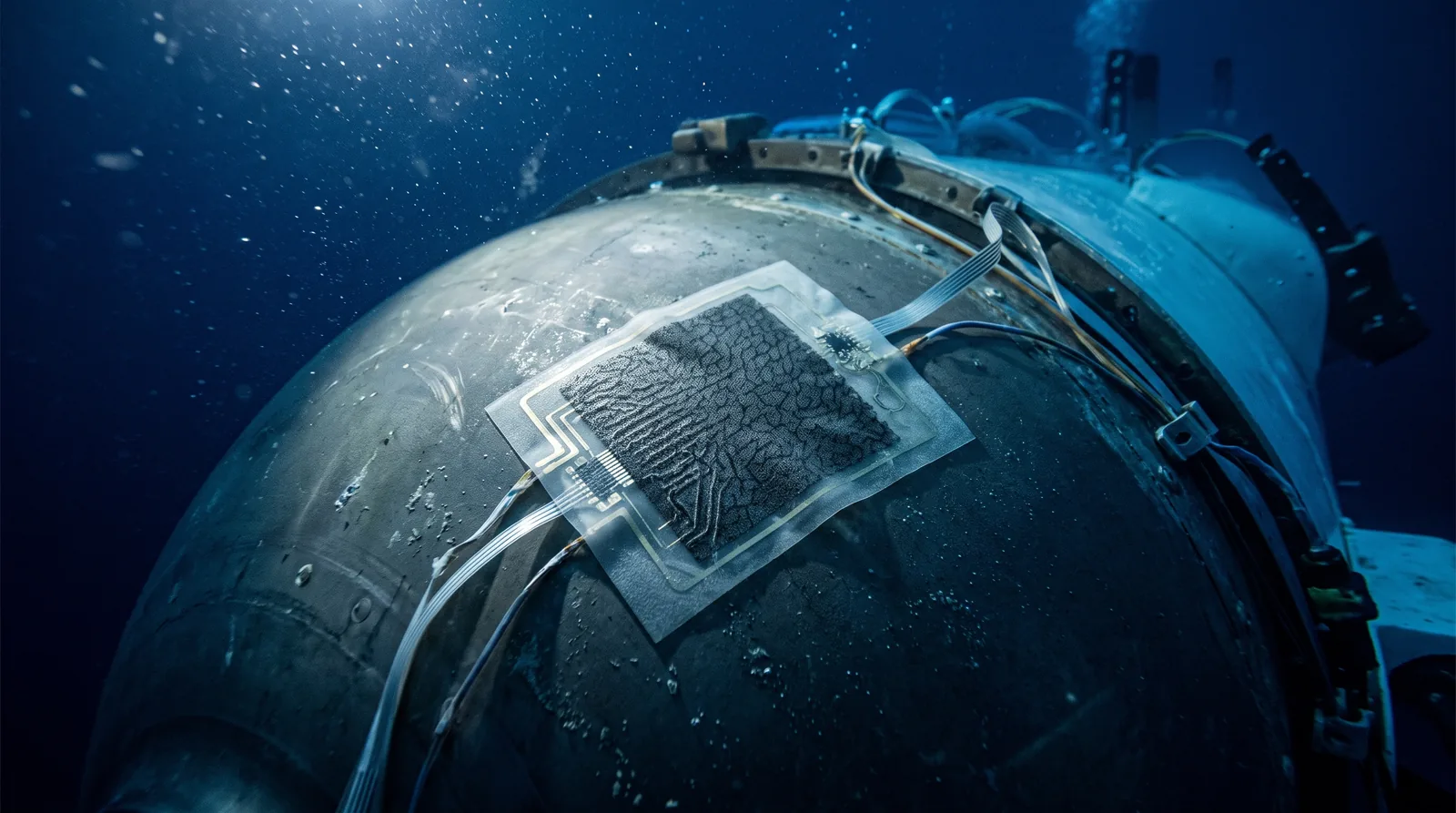
Researchers developed a flexible temperature and depth monitoring system built from porous laser-induced graphene and polydimethylsiloxane that successfully operated down to 4,812 meters. This matters because vast ocean areas lack adequate sampling due to the mass and rigidity of traditional tools.
Reviewed by Matheus Grangeiro
- Peer reviewed
- Yes
Key numbers
24.63µA
average quiescent current of the electronics unit
0–10MPa
hydrostatic pressure measurement range
±0.91% full scale
depth error limit
±0.29°C
temperature accuracy limit
4812.2m
maximum depth reached during deep-sea trials
~50MPa
hydrostatic pressure withstood during deep-sea trials
Evidence level: Prototype or demonstration
Why it matters: Vast oceanic areas lack adequate sampling because traditional measurement tools are rigid and massive, limiting oceanographers and climate researchers studying planetary thermal dynamics and carbon fluxes. If confirmed, data collection becomes possible on mobile or unconventional platforms that rigid sensors cannot reach.
How flexible materials and neural networks track deep-sea conditions
Sensing capabilities rely on a composite material made of porous laser-induced graphene and polydimethylsiloxane, allowing the system to attach to curved or moving boundaries. The electronic assembly features a lightweight, stress-tolerant design consuming an average resting current of 24.63 microamperes. Data correction for temperature and pressure is handled through a polynomial calculation combined with a neural network architecture featuring two hidden layers.
Flexible monitoring versus traditional rigid ocean platforms
Traditional measurement tools deliver high single-location accuracy, but their mass and rigidity restrict their application on modern mobile ocean platforms. The new integrated and flexible monitoring system enables data collection on mobile or unconventional platforms that rigid traditional sensors cannot reach.
Performance metrics and practical deep-sea validation
The sensor functions effectively across hydrostatic pressure variations up to 10 megapascals and maintains physical robustness when subjected to approximately 50 megapascals of water pressure. Post-correction measurements achieve a depth calculation precision within 0.91 percent of the full scale and a temperature reading accuracy within 0.29 degrees Celsius. Practical testing occurred in deep ocean environments down to a depth of 4,812.2 meters, proving the device capable of operating reliably in severe marine conditions.
Open questions on manufacturing scale and long-term deployment
The source leaves open the manufacturing cost and scalability of the flexible sensor. Long-term biofouling resistance and sensor drift over multi-month deployments remain unknown. There is no exact timeline for commercial or broad scientific deployment.
Verdict: This study presents a promising prototype of a flexible deep-sea sensor, but its long-term durability and manufacturing scalability remain to be tested.
Based on reporting from Nature Communications. This is an independent explainer, written in our own words with AI assistance; Nature Communications has not reviewed or endorsed it. Read the original for the full details.