How extreme weather flushes land plastics into the sea
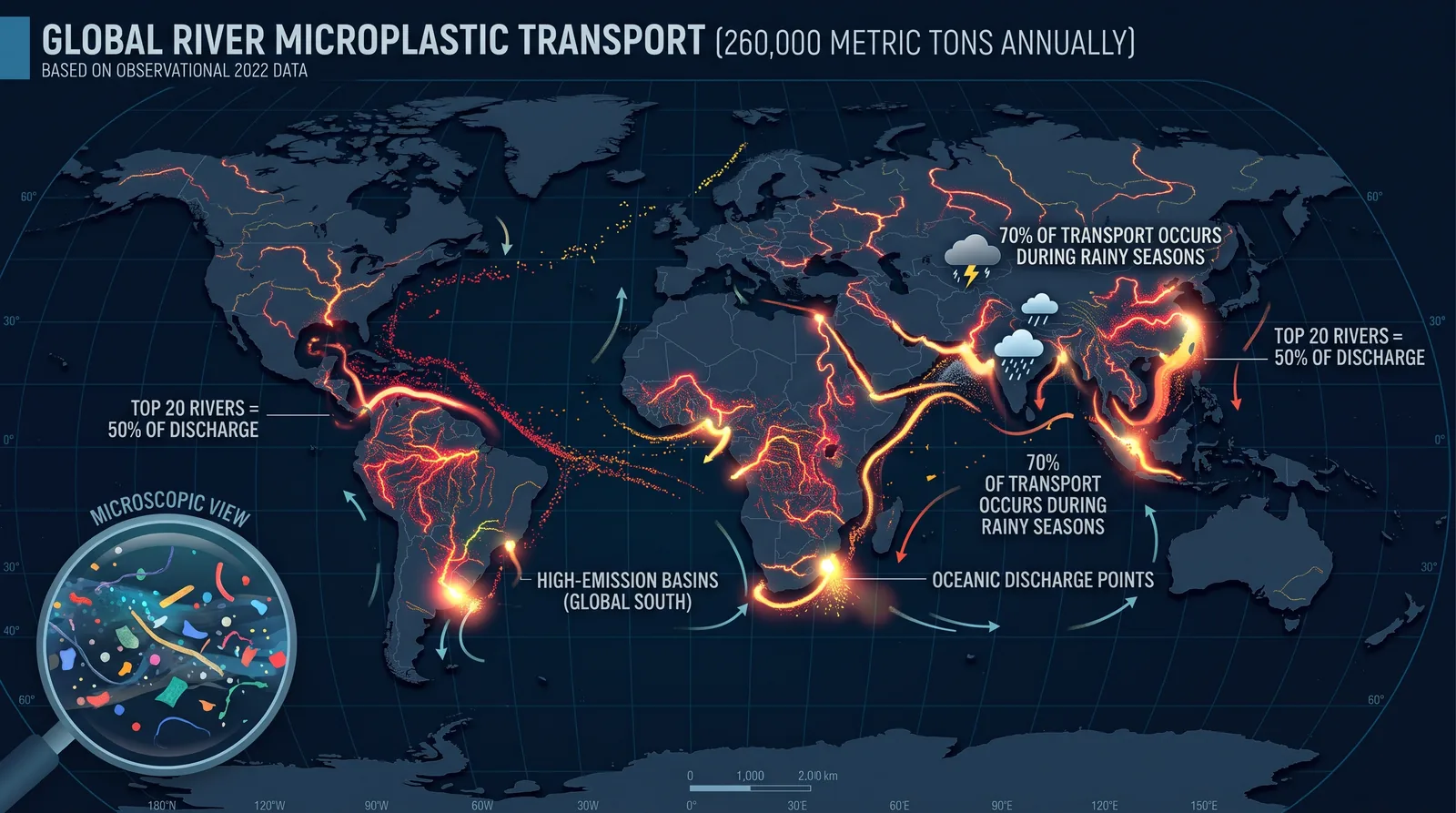
A new global analysis shows that rivers transported approximately 260000 metric tons of microplastics into marine environments in 2022, with just 20 rivers accounting for half of this total. Understanding this concentrated delivery changes how we must approach plastic pollution mitigation, shifting focus from steady management to intense seasonal events.
Reviewed by Matheus Grangeiro
- Peer reviewed
- Yes
Key numbers
260000metric tons
global riverine transport of microplastics into the ocean in 2022
2022year
year of estimated global microplastic transport
20rivers
number of rivers responsible for half of global riverine microplastic export
70percent
share of annual microplastic transport occurring during the rainy season
Press versus study
Simplification
What the press says
Rivers around the world carried about 260,000 metric tons of microplastics into the ocean in 2022
What the study shows
rivers delivered far more microplastics to the ocean than most previous estimates suggest
Simplification
What the press says
just 20 rivers accounted for about half of the global riverine microplastic export to the ocean.
What the study shows
Southeast and East Asia contributing >50% of the total flux.
Evidence level: Observational study with global transport modelling
Why it matters: Microplastics are widespread in the ocean and may affect marine ecosystems and human health through food webs. Rivers are an important pathway for land-based microplastics entering the sea, but global estimates of how much they transport—and when that transport occurs—have remained limited.
How extreme weather flushes land plastics into the sea A study led by Wang Xuejun and Liu Maodian of Peking University’s College of Urban and Environmental Sciences found that rivers worldwide carried about 260,000 metric tons of microplastics into the ocean in 2022. The study was published in Science on 24 September 2026.
The researchers used river microplastic observations to model global patterns and daily changes in microplastic transport from rivers to the ocean. They found that pollution is not released at a steady rate throughout the year.
Across most river basins, higher rainfall and runoff were associated with higher microplastic concentrations. Intense rainfall can wash plastic particles accumulated on urban surfaces, in soils and along riverbanks into waterways, creating short periods of concentrated transport, or “pulses.”
The effect is especially pronounced during rainy seasons. On average, about 70% of annual transport occurred during the rainy season.
Why monthly averages miss the true scale of plastic pollution Models that rely only on annual or monthly average hydrological conditions may underestimate the contribution of short-term extreme events. The study argues that these averages can smooth away the short, concentrated delivery peaks produced by heavy rainfall and floods.
The impact of rainfall also differs across regions. In areas where plastic use is growing rapidly and waste and wastewater treatment infrastructure remains relatively limited, rainfall may be more likely to raise river microplastic concentrations.
In some regions with more developed infrastructure, rainfall may instead mainly have a dilution effect. This does not mean that infrastructure eliminates runoff; it means that the net effect of rainfall on river concentrations can differ by region.
The study also found that greater vegetation cover was generally associated with lower river microplastic concentrations, while urbanized surfaces may facilitate the movement of plastic into rivers through surface runoff.
Global totals and the concentration of sources Rivers globally transported approximately 260,000 metric tons of microplastics into marine environments in 2022. Just 20 rivers accounted for about half of global riverine microplastic export to the ocean.
The study does not name the 20 rivers in the available release, nor does it specify the analytical techniques or instruments used to quantify microplastics in individual river observations.
The release also does not address the financial cost or logistical feasibility of implementing targeted interception infrastructure during rainy seasons or extreme rainfall events.
What the study does not show It may seem that microplastics enter the ocean at a steady, predictable rate every month. In fact: about 70% of annual transport occurs during the rainy season, on average, driven by heavy rainfall and floods.
It may seem that advanced infrastructure guarantees zero plastic runoff during storms. In fact: the study finds that, in some regions with more developed infrastructure, rainfall may mainly dilute river concentrations; it does not claim elimination of runoff.
It may seem that the 260,000-tonne estimate is a direct measurement of every river. In fact: it is a modelled global estimate based on river microplastic observations.
It may seem that the 20 highest-emitting rivers are identified in the release. In fact: the release reports their collective contribution but does not name them.
It may seem that vegetation eliminates microplastic pollution. In fact: greater vegetation cover is associated with lower river concentrations, but the release does not establish causation or a specific mitigation threshold.
The release does not report the analytical methods, river identities, cost of interception infrastructure, logistical feasibility or country-specific deployment plans.
Verdict: A global modelling study estimates that rivers carried about 260,000 metric tons of microplastics into the ocean in 2022, with about 70% of annual transport occurring during rainy seasons and about half concentrated in just 20 rivers. The findings support targeting high-emission basins in the Global South and strengthening interception during wet periods, but the release does not identify the rivers, specify analytical methods or quantify the cost and feasibility of intervention.
Based on reporting from Peking University. This is an independent explainer, written in our own words with AI assistance; Peking University has not reviewed or endorsed it. Read the original for the full details.