Single solid material displays liquid, glass, and crystal properties simultaneously
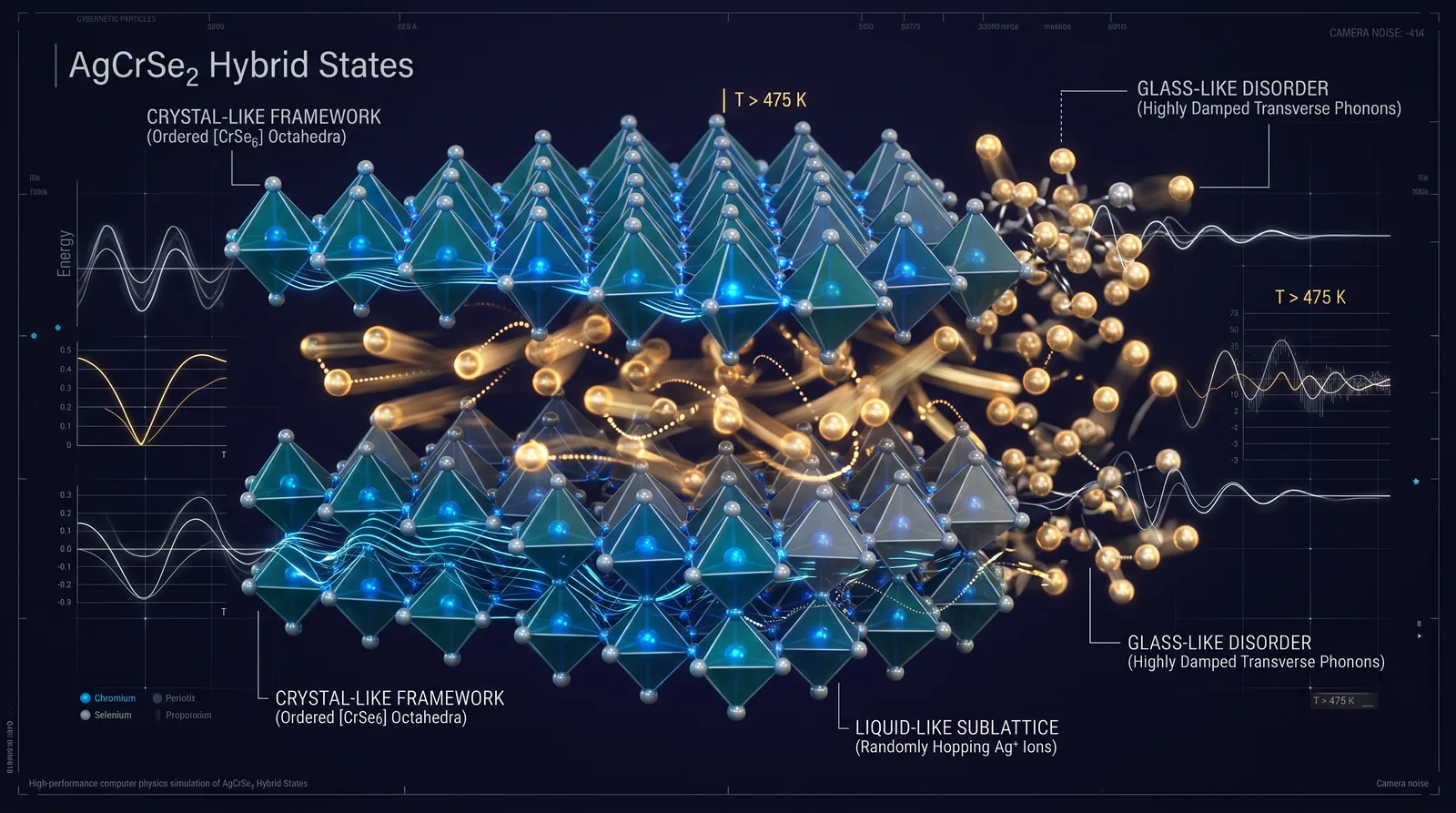
Researchers observed that the material AgCrSe2 simultaneously displays liquid-like, glass-like, and crystal-like phonon characteristics. This discovery challenges traditional boundaries separating phases of matter and opens new pathways for managing heat transport.
Reviewed by Matheus Grangeiro
- Peer reviewed
- Yes
Key numbers
November 5date
Publication date in J. Am. Chem. Soc.
475K
Superionic transition temperature of AgCrSe2
Press versus study
Omission
What the press says
The press text describes the specific details of the crystal structure of AgCrSe2, noting that rigid edge-sharing [CrSe6] octahedra form a stable periodic framework while Ag+ ions occupy interlayer sites and hop randomly above 475 K.
What the study shows
The paper data is an abstract and does not mention the specific details of the [CrSe6] octahedra framework or the 475 K superionic transition temperature.
Evidence level: Observational and computational materials study
Why it matters: Phonons—collective atomic vibrations—strongly influence thermal conductivity and other material properties. Conventional theory often treats crystals, glasses and liquids as having distinct lattice-dynamics regimes, but a material that combines crystal-like, glass-like and liquid-like phonon behaviour could offer new ways to control heat flow.
How one crystalline solid hosts three phonon behaviours Researchers at the Institute of Metal Research of the Chinese Academy of Sciences directly observed liquid-like, glass-like and crystal-like phonon behaviours coexisting in AgCrSe₂, a crystalline layered superionic conductor. The study was published in the Journal of the American Chemical Society on 5 November 2026.
In the conventional picture, a perfect crystal has well-defined phonon quasiparticles because its atoms maintain long-range periodic order. In glasses and liquids, structural disorder strongly damps phonons, and transverse modes may be suppressed.
AgCrSe₂ has a quasi-two-dimensional structure and undergoes a superionic transition near 475 K. Rigid edge-sharing [CrSe₆] octahedra form a stable periodic framework, while Ag⁺ ions occupy two equivalent interlayer sites.
Below the transition, Ag⁺ ions preferentially occupy one site. Above it, the [CrSe₆] framework remains long-range ordered, but Ag⁺ ions hop randomly between the two sites, creating a rigid lattice framework with a fluid-like, disordered sublattice.
Mapping anisotropic phonon transport The researchers combined high-resolution inelastic neutron scattering, first-principles calculations and molecular-dynamics simulations to obtain the complete phonon dispersion of AgCrSe₂ single crystals. They found that transverse-phonon behaviour varies strongly with propagation direction and atomic-vibration direction.
For transverse phonons propagating in-plane with in-plane atomic vibrations, the phonon dispersion shows a nesting feature that enhances phonon scattering. Together with the dynamic disorder of Ag⁺ ions, this enhanced scattering suppresses the quasiparticle character of these phonons, producing liquid-like behaviour.
For transverse phonons propagating out-of-plane with in-plane atomic vibrations, scattering from the dynamic disorder of Ag⁺ ions is selective. These modes gradually lose quasiparticle character as the wavevector increases, exhibiting glass-like behaviour.
By contrast, transverse phonons propagating in-plane with out-of-plane atomic vibrations remain well-defined propagating modes even in the superionic state. They retain conventional crystal-like behaviour.
What the measurements show about heat transport Thermal-conductivity measurements on single crystals revealed ultralow thermal conductivity and pronounced anisotropy in heat transport. These macroscopic results are consistent with the direction-dependent phonon dynamics observed at the microscopic level.
The available CAS release does not report numerical thermal-conductivity values, uncertainty estimates, temperature-dependent curves or a quantitative separation of the contributions from different phonon modes. It therefore establishes a qualitative link between phonon behaviour and heat transport, not a fully parameterized transport model.
What remains unresolved The release does not report the timeline, cost or specific practical applications for controlling anisotropic phonon transport in AgCrSe₂ or related materials.
The reported “ultralow” conductivity is qualitative; without numerical values and uncertainties, its magnitude cannot be compared quantitatively with other thermoelectric or thermal-barrier materials.
The study does not establish that the phonon behaviours cause the measured anisotropic conductivity; it reports consistency between microscopic dynamics and macroscopic heat transport.
The DOI could not be retrieved for this review, so claims about what the paper’s abstract does or does not contain cannot be verified from the available material.
The findings concern AgCrSe₂ under laboratory conditions; they do not establish performance, stability or manufacturability in devices or industrial settings.
What the silver sublattice transition does not mean It may seem that AgCrSe₂ melts into an ordinary liquid above its transition temperature. In fact: only the Ag⁺ sublattice becomes fluid-like and dynamically disordered, while the [CrSe₆] framework remains a rigid, long-range-ordered crystal.
It may seem that “liquid-like,” “glass-like” and “crystal-like” describe three coexisting thermodynamic phases. In fact: they describe coexisting phonon behaviours within one crystalline solid.
It may seem that all phonons lose quasiparticle character in the superionic state. In fact: only particular transverse-phonon modes lose or weaken quasiparticle character; others remain well-defined propagating modes.
Verdict: Researchers observed coexisting liquid-like, glass-like and crystal-like phonon behaviours in AgCrSe₂ single crystals using inelastic neutron scattering, first-principles calculations and molecular-dynamics simulations. The material retains a rigid crystalline framework while its Ag⁺ sublattice becomes dynamically disordered above a superionic transition near 475 K; the work supports anisotropic, ultralow heat transport, but numerical conductivity values, mechanisms of causation and practical deployment remain unreported.
Based on reporting from Chinese Academy of Sciences. This is an independent explainer, written in our own words with AI assistance; Chinese Academy of Sciences has not reviewed or endorsed it. Read the original for the full details.
Study: doi.org/10.1021/jacs.6c17837