Extending spin polarization persistence at room temperature with perovskite quantum wells
Researchers engineered a chiral multiple quantum well architecture that extends spin polarization duration by roughly three hundred times at ambient temperature. This development matters because controlling spin states without cooling could bypass current semiconductor efficiency barriers.
Reviewed by Matheus GrangeiroUpdated on
- Peer reviewed
- Yes
Key numbers
300times longer
spin polarization duration relative to conventional setups
1dimension
two-dimensional perovskite phase n value
2, 3, 4dimension
quasi-two-dimensional perovskite phase n values
5nanoseconds
spin polarization persistence duration at room temperature
1.4 × 10⁻²
luminescence dissymmetry factor (glum)
80%
polarization degree for spin-dependent charge transport
Evidence level: Not specified in the source
Why it matters: Spin-based electronics promise to couple faster processing with lower power consumption, yet in perovskites spin information is erased within picoseconds by strong spin–orbit coupling, phonon scattering and defects. Long-lived spin polarization has consequently been achievable mainly at ultralow temperatures. A material that retains spin order at room temperature, without cooling, would remove one of the principal barriers to practical spintronic and chiroptical devices.
How perovskite chiral multiple quantum wells preserve spin states
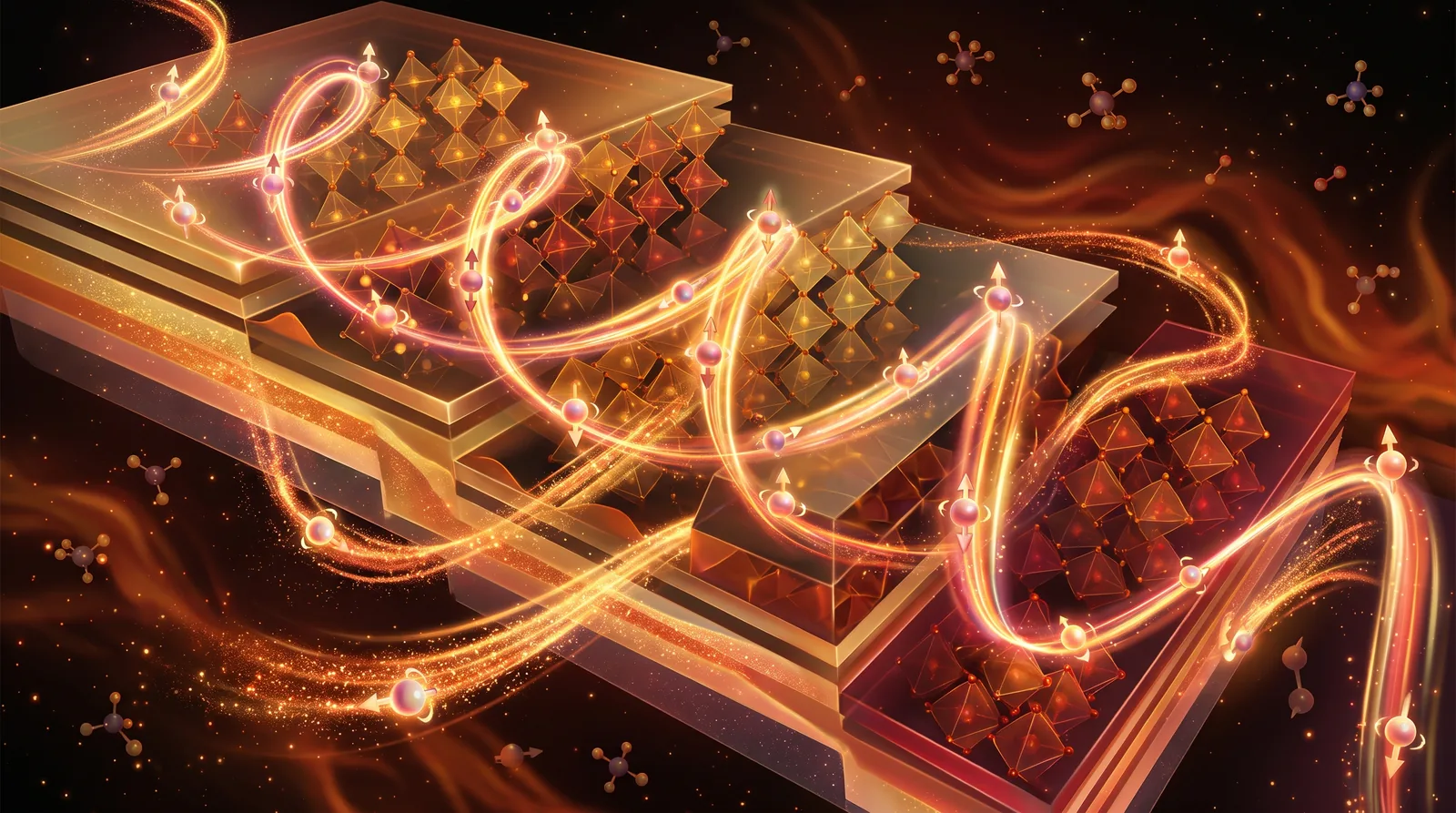
A team led by Haipeng Lu, a chemist at the Hong Kong University of Science and Technology (HKUST), assembled a perovskite-based chiral multiple quantum well architecture by a two-step, seed-assisted crystallization method. The resulting wells are well oriented and vary in width, and intrinsic chirality runs continuously across perovskite phases of different dimensionality: two-dimensional (n = 1), quasi-two-dimensional (n = 2, 3, 4 and so on) and three-dimensional (n = ∞).
The design rests on a spin cascade. Coupled wells establish an energy gradient together with a chiral environment, and this combination produces intermediate spin-polarized states through which spin is passed from well to well. Interfacial spin losses are thereby reduced, while spin relaxation in the bulk phases is suppressed. Graded energy landscapes and intrinsic chirality, in other words, allow spin to travel through the material rather than dissipate within it. The authors report that this arrangement preserves spin information under ambient conditions.
The rationale is clearer against the failure mode it addresses. In layered perovskites, heavy lead and halide atoms generate strong spin–orbit coupling, which is useful for manipulating spins but also opens efficient relaxation pathways, among them Rashba-type splitting at interfaces. An abrupt boundary between phases therefore acts as a spin sink. By grading the energy landscape, the architecture replaces such boundaries with a staircase of intermediate states, so that spin is handed along instead of scattered at each junction.
Performance metrics of the extended spin polarization
At room temperature, spin polarization persisted for roughly 5 nanoseconds, about 300 times longer than previously achieved. The reference system for that comparison is not identified in the available coverage. For scale, a 2025 study of chiral perovskite colloidal quantum wells reported a longest spin relaxation component of about 210 picoseconds; the two figures come from different materials and should not be equated with the 300-fold claim.
Two further metrics accompany the lifetime. Circularly polarized luminescence reaches a dissymmetry factor (g_lum) of up to 1.4 × 10⁻², and spin-dependent charge transport shows a polarization degree above 80 percent. Because the second value concerns carriers moving through the film rather than light emitted from it, the pair indicates that spin order survives in both optical and electrical channels.
Demonstrations and functional scope of the prototype
The researchers built two proof-of-concept demonstrations: X-ray-triggered dissymmetric photopolymerization and high-performance circularly polarized light detection. The first links X-ray excitation to a chirality-selective chemical outcome; the second applies the material’s spin-selective optics to sensing. Potential uses cited include asymmetric photocatalysis and advanced optical sensors, within the broader context of quantum technologies and spin-based devices. All of these remain prospective, since the demonstrations were conducted as isolated experiments rather than integrated devices.
Analyzing the breakthrough in ambient spintronics
Taken together, the data indicate that engineering the energy landscape, rather than merely suppressing relaxation at its source, can stabilize spin in a soft semiconductor at ambient temperature. Earlier perovskite spin systems lost polarization within picoseconds; a cascade that moves spin through intermediate states is reported to slow that loss considerably.
Interpretation requires restraint, however. The headline improvement has no stated baseline, and nanosecond persistence, though long for a perovskite, bounds the operations that could be performed before polarization decays. Performance beyond room temperature, or in devices other than the two demonstrations, is likewise not described. Whether the cascade principle transfers to other chiral perovskite compositions, or depends on the particular phase distribution obtained through seeded crystallization, is a question the present data cannot answer, and it will determine whether the approach is a design rule or a single successful recipe.
What remains unknown about commercial integration
The manufacturing cost and scalability of the seed-assisted crystallization approach are not specified. The timeline for integration into commercial optoelectronic devices has not been established, and the long-term stability and degradation rates of the perovskite chiral multiple quantum well system under operating conditions remain to be determined. Nor does the coverage describe how the 5-nanosecond lifetime was measured, so comparison with other platforms awaits the full methods. The release does not state the study’s limitations explicitly, so these gaps reflect what the coverage omits as much as what the authors have measured.
Verdict: A perovskite chiral multiple quantum well architecture, prepared by seed-assisted crystallization, is reported to extend room-temperature spin polarization to approximately 5 nanoseconds, roughly 300-fold, with spin-dependent charge transport exceeding 80 percent polarization. However, manufacturing cost, scalability and long-term operational stability remain to be demonstrated.
Based on reporting from HKUST. This is an independent explainer, written in our own words with AI assistance; HKUST has not reviewed or endorsed it. Read the original for the full details.