Slug-inspired hydrogel seals internal organ leaks through endoscopes
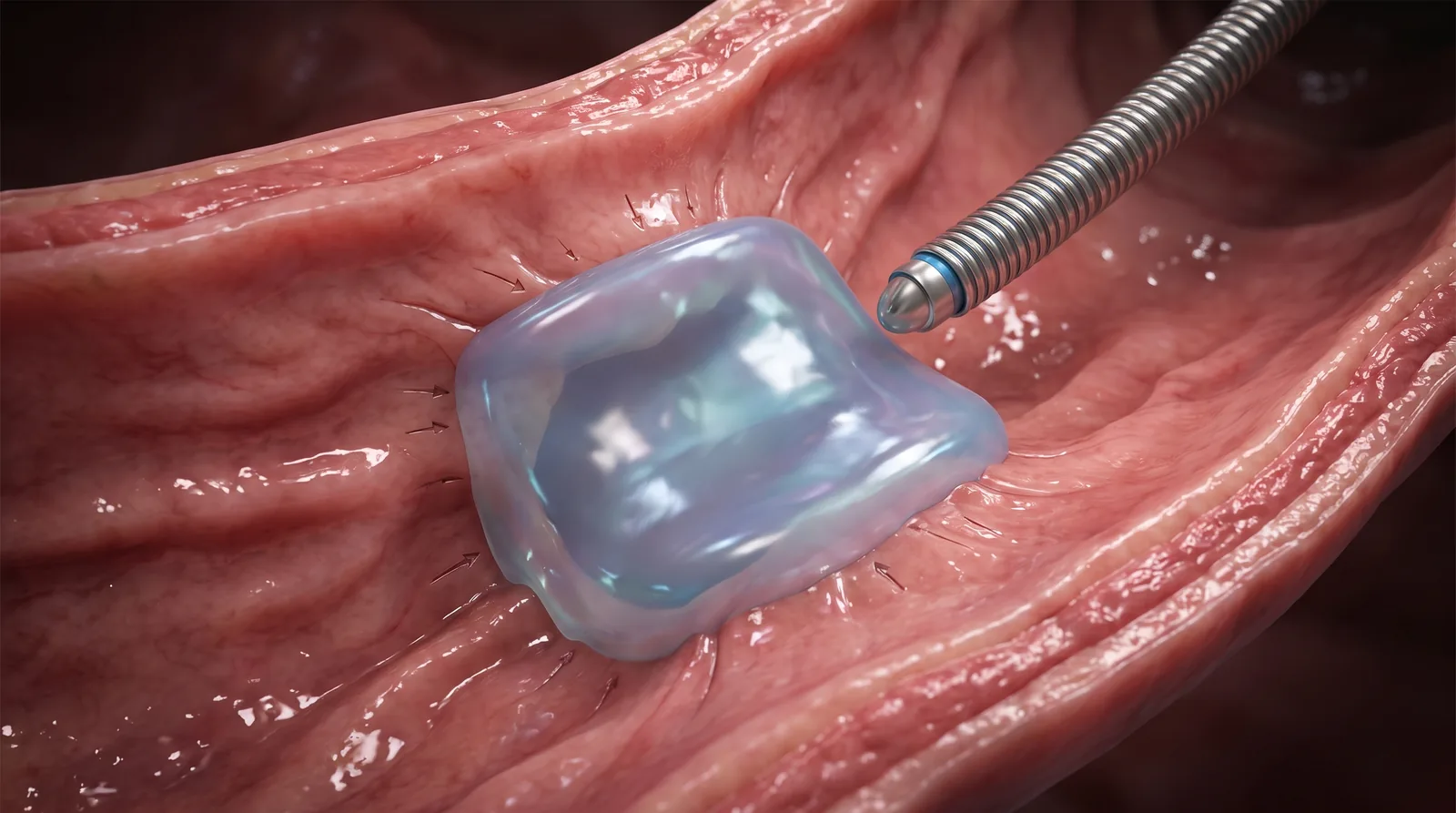
Researchers developed a slug-inspired hydrogel that flows as a liquid through endoscopes at room temperature and gels within seconds at body temperature. Tested in rodents and pigs, the material successfully sealed gastrointestinal perforations without leaving permanent residues.
Reviewed by Matheus Grangeiro
- Peer reviewed
- Yes
Key numbers
25°C
room temperature condition for liquid sealant
27gauge
needle size for injection
37°C
approximate body temperature
30seconds
time required for gel transformation
10.46kPa
shear strength of adhesive side
0.11kPa
shear strength of non-adhesive side
100fold
difference in shear strength between sides
10mm
perforation size in ex vivo model
Evidence level: In animals
Why it matters: Gastrointestinal fistulas and perforations represent some of the most consequential complications in abdominal surgery; untreated leakage of intragastric contents can precipitate peritonitis, septic shock, and mortality rates elevated by more than 30%. The endoscopic tools currently available to manage these defects — titanium clips, stents, and fibrin glues — each fail in characteristic ways: clips cannot span irregular wound margins and promote recurrence, stents migrate, and fibrin glue loses adhesive strength in the acidic gastric environment where it is most needed. A sealant that could be delivered through a standard endoscope, adhere selectively to tissue without fouling the luminal face, and actively close the defect rather than merely covering it would address these failure modes simultaneously.
How a Slug-Inspired Liquid Seals Wet Internal Wounds
The biological precedent for PGaIII comes from the defensive mucus of the Arion subfuscus slug, whose secretions transition from a flowing liquid to a tenacious gel when metal ions interact with its protein network — a phase change governed by environmental conditions rather than manual manipulation. Investigators at the Institute of Process Engineering of the Chinese Academy of Sciences translated this principle into a synthetic sealant by combining linear poly(N-isopropylacrylamide) (PNIPAM) with trivalent gallium ions (Ga³⁺). Below the lower critical solution temperature, at approximately 25 °C, PGaIII remains a transparent, free-flowing liquid capable of passing through a 27-gauge needle and a standard endoscopic channel without resistance. At body temperature — around 37 °C — the PNIPAM backbone undergoes a hydrophobic collapse, and the material gels within approximately 30 seconds of contact with tissue.
What distinguishes PGaIII from prior injectable hydrogels is the asymmetry it achieves without requiring that asymmetry be preserved during delivery. The tissue-contacting face, which bears electrostatic and topological interaction sites, develops a shear adhesion strength of 10.46 kPa; the lumen-facing surface, by design non-adhesive, registers just 0.11 kPa — a 100-fold disparity arising from the material’s internal architecture rather than from post-injection orientation. The team designated this single-step delivery mechanism “slug-inspired electrostatically assisted topological (SET) Janus adhesion,” reflecting both its biological inspiration and the fact that injection, adhesion, and contraction are completed in one continuous operation.
Performance Against Simulated Gastric Acid and Traditional Methods
The gastric environment imposes a testing condition that eliminates most polymer-based sealants: sustained exposure to pH 1.0. For commercial fibrin glue, immersion in simulated gastric acid measurably reduces adhesive strength and burst pressure. PGaIII behaves in precisely the opposite fashion; acid exposure drives additional hydrophobic water expulsion from the gel network, densifying the adhesive interface and increasing both metrics. Concurrently, the hydrogel contracts by 51.6% of its initial surface area, generating a centripetal traction force that actively draws wound edges inward — a mechanism that counteracts the perforation-enlarging swelling observed with conventional hydrogels and provides a physical barrier against fistula widening.
Antibacterial activity stems from gallium’s ability to substitute for iron in bacterial metabolic pathways. Because iron acquisition is essential for the virulence and survival of most gastrointestinal pathogens, Ga³⁺ ions disrupt this process irreversibly, yielding a 98.6% inhibition rate against Escherichia coli and Staphylococcus aureus — organisms commonly implicated in post-perforation peritonitis. In a rat gastric fistula model, postoperative mortality in the PGaIII group was 3.3%, compared with 6.7% in the suture group and 56.7% in the fibrin glue group, with near-complete gastric wall recovery at day 21 and minimal adhesion formation. In Bama pigs, a 20 mm gastric defect treated endoscopically with PGaIII showed complete mucosal closure within 14 days, smooth regenerated epithelium, and no detectable foreign-body residue — outcomes that titanium clips failed to match.
Evaluating Preclinical Efficacy and Translational Hurdles
Taken together, the in vitro and in vivo data present a coherent mechanistic picture: PGaIII’s thermal gelation, SET Janus adhesion, acid-reinforced bonding, active contractile closure, and gallium-mediated antimicrobial activity address each of the principal failure modes of existing endoscopic closure devices. The 100-fold shear adhesion disparity between surfaces, the near-complete bacterial inhibition, and the successful leak-free sealing of both a 10 mm ex vivo porcine perforation and a 20 mm in vivo Bama pig defect constitute a consistent, multi-scale preclinical efficacy profile.
Nonetheless, the gap between porcine models and clinical deployment is substantial. The long-term fate of Ga³⁺ ions following gel degradation — including systemic distribution, organ accumulation, and excretion kinetics — has not yet been characterized in large-animal pharmacokinetic studies. Manufacturing reproducibility at clinical scale, catheter delivery system geometry for different endoscope configurations, and the potential influence of pH fluctuations during active gastrointestinal bleeding on degradation rate all remain open engineering problems. Human gastrointestinal tissue mechanics and immune responses differ meaningfully from those of rats and Bama pigs, and no safety or efficacy data in humans exist.
Unresolved Questions in Long-Term Clearance and Production
The next phase of development, led by Prof. BAI Shuo’s group at the Institute of Process Engineering and Dr. LI Jingtao’s team at the China–Japan Friendship Hospital, will center on gallium clearance kinetics and metabolic fate in large-animal models — a prerequisite for regulatory toxicology filings. Alongside this, investigators must characterize how gastrointestinal pH fluctuations, which vary substantially between fasting and fed states and during acute bleeding, alter the hydrogel’s degradation profile and residual adhesion properties. Optimization of catheter delivery geometries for compatibility with the range of endoscope channel diameters used clinically, and the development of manufacturing processes that ensure batch-to-batch consistency in thermal response and Janus adhesion ratio, represent the principal engineering milestones separating the current prototype from first-in-human trials.
Verdict: In rat and porcine models, PGaIII demonstrates substantially lower mortality, superior wound closure, and negligible tissue adhesion compared with sutures, fibrin glue, and titanium clips; gallium clearance, long-term toxicity, and manufacturing scalability require resolution before human trials can proceed.
Based on reporting from Chinese Academy of Sciences. This is an independent explainer, written in our own words with AI assistance; Chinese Academy of Sciences has not reviewed or endorsed it. Read the original for the full details.