Tracing the Evolutionary History and Habitats of Woolly Rhinoceroses
Researchers reconstructed the evolutionary history and habitat changes of woolly rhinoceroses over a span of 500,000 years. The findings are based on a published study examining ancient genetic material and habitat models.
Reviewed by Matheus Grangeiro
In short: Researchers reconstructed the evolutionary history and habitat changes of woolly rhinoceroses over a span of 500,000 years. The findings are based on a published study examining ancient genetic material and habitat models.
Long ago, woolly rhinoceroses roamed the cold landscapes of the Earth, yet much of their history remained a mystery until now.
What happened, in plain words
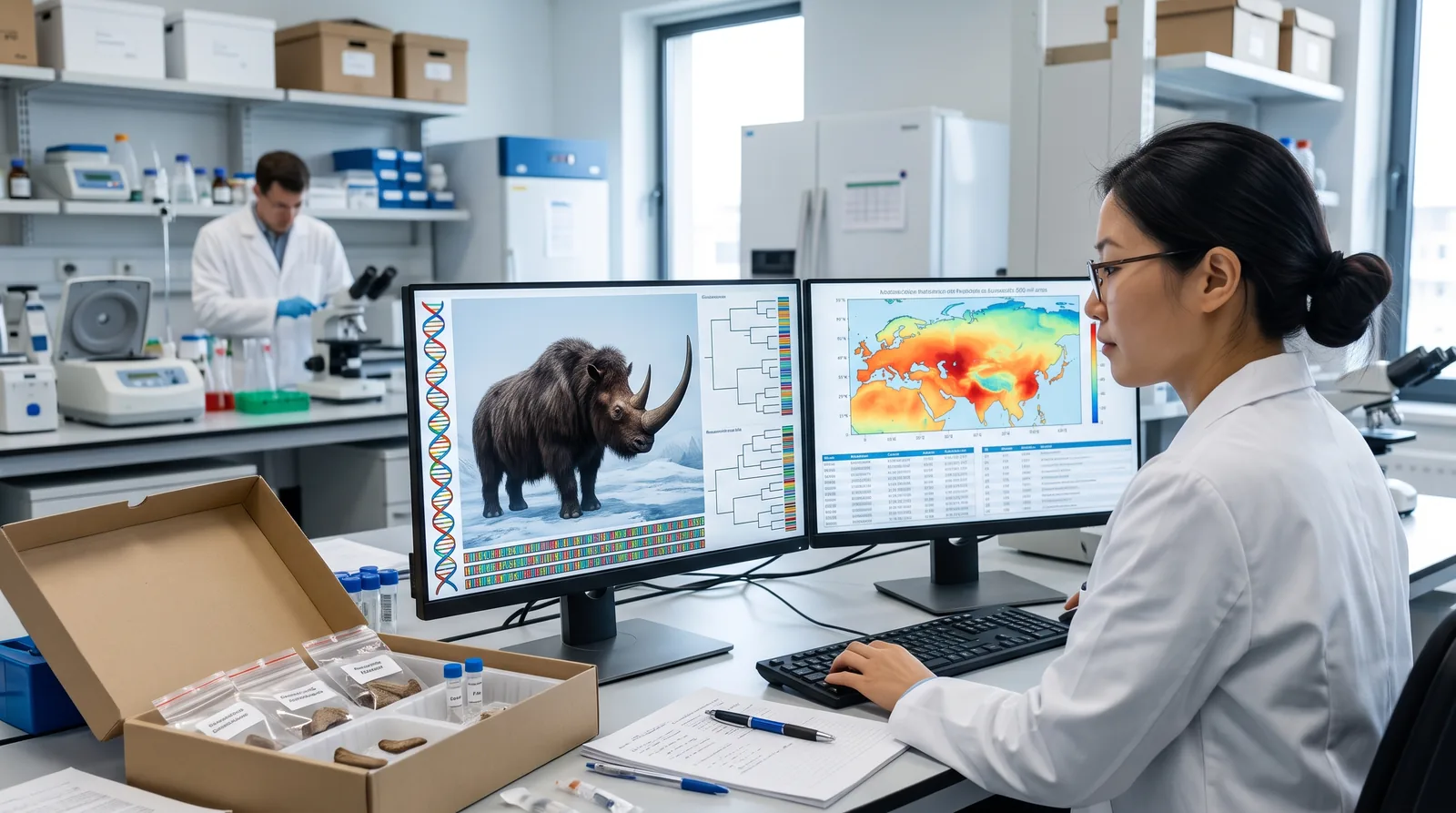
A research team led by Yu He from Peking University, along with partners from the Chinese Academy of Sciences and other groups, studied the evolutionary past and habitat shifts of woolly rhinoceroses across the last 500,000 years. Published in Science, the work involved analyzing 29 mitochondrial genomes and 14 nuclear genomes taken from remains found at 10 sites or regions. The scientists also ran models to map how suitable their habitats were over half a million years until the animals went extinct.
Key points
- Temperate regions as diversity centers: The research reveals that genetic diversity for the species was mainly created and kept alive in temperate, mid-latitude parts of Eurasia, rather than just in high-latitude areas.
- Timeline of common ancestors: Calculations estimate that the most recent common ancestor of the woolly rhinoceros lived around 460,000 years ago during a major glacial period known as Marine Isotopic Stage 12.
- Regional genetic differences: Genetic tests uncovered distinct lineages in East Asia, the Altai, and Europe, while northeastern Siberian groups appear to have mixed from Altai and East Asian populations.
Terms explained
- mitochondrial genomes — Genetic material passed down through the maternal line that helps scientists trace ancestral lineages. Example: Mitochondrial genomes act like a family tree handed down only from mothers to their offspring.
- nuclear genomes — The complete set of genetic instructions stored in the nucleus of a cell, inherited from both parents. Example: Nuclear genomes provide a combined genetic blueprint from both mother and father.
- admixture — The mixing of genetic material from different populations or groups that were previously isolated. Example: Admixture happens when two separate groups interbreed and combine their traits.
Critical analysis
What is encouraging. The work combines biological evidence from ancient DNA with environmental habitat models, offering a broad look at how climate cycles shaped the distribution and genetics of an extinct megafauna species.
What deserves caution:
- Limited physical samples. The conclusions rely on a relatively small group of genomic samples collected across a massive geographic area. Because only certain remains were tested, the data may miss local genetic variations that existed elsewhere.
- Modeled environmental data. Much of the habitat history comes from computer models simulating past climates over hundreds of thousands of years. These simulations are estimations and cannot fully capture every local weather change the animals actually experienced.
- Incomplete geographic coverage. While the project expands research into mid-latitude regions, ancient DNA preservation varies widely by location. This leaves gaps where remains may have decayed completely, preventing scientists from getting a complete global picture.
Bottom line: By analyzing ancient genomes and habitat models, researchers show that temperate Eurasia played a key role in the long-term genetic history of the woolly rhinoceros.
What we still don't know
The source does not fully detail every local environmental shift across all regions, nor does it cover every single population that ever existed. Furthermore, the exact reasons behind the final extinction of the species are not deeply explored in the text.
Based on reporting from Peking University. This is an independent explainer, written in our own words with AI assistance; Peking University has not reviewed or endorsed it. Read the original for the full details.